

Quick Answer:
Abandoned places in the UK are not randomly distributed. Most are former psychiatric asylums and former military sites, emptied by two policy decisions made a decade apart: the closure of the county asylums, and the post-Cold War shrinking of the armed forces. The pattern is a policy map, not an accident.
Scroll through enough British urban exploration photography and you start to notice something odd. The pictures all look the same.
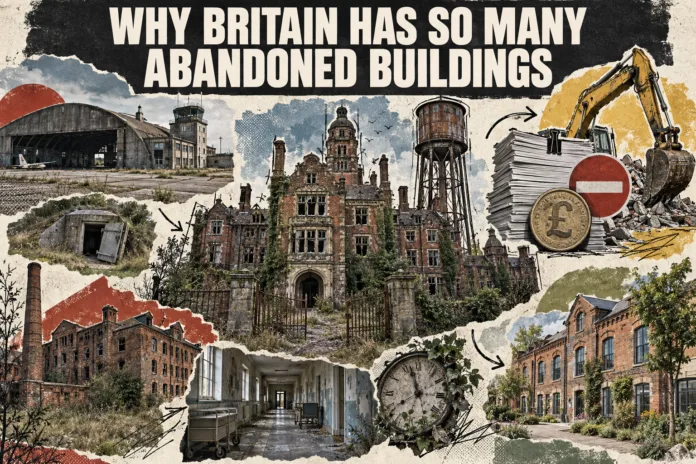
Not similar. The same. A corridor a hundred metres long with a vaulted ceiling and arched windows down one side. Peeling institutional green paint, applied to a height of about four feet, with cream above it. A water tower through a broken pane. A clock tower with the hands stopped. Cast-iron radiators. A ballroom, of all things, with a sprung floor and a stage at one end.
Photographers in Lancashire, Sussex, Surrey and Yorkshire are all shooting what appears to be the same building, because in a meaningful sense they are. Those buildings went up to a common specification, under the same legislation, for the same purpose. And they were all emptied within about twenty years of each other by the same policy.
Once you see that, the map of derelict Britain stops looking like decay and starts looking like administration. These places are not where things went wrong. They are where things were decided.
Why are there so many abandoned places in the UK?
Three reasons stack up behind the number of abandoned places in the UK, and they compound.
The first is that Britain built an enormous amount of large-scale public institutional architecture in the nineteenth and twentieth centuries: asylums, infirmaries, workhouses, barracks, airfields, mills. Buildings designed for one purpose and effectively useless for any other.
The second is that two government decisions emptied a great deal of it in a short window. The county asylum system was wound down from the 1960s onward and largely finished by the early 2000s. The armed forces were cut sharply after 1990, releasing a great deal of land and buildings at once.
The third is the one nobody writes about, and it is the one that actually determines whether a building stands empty for thirty years or is gone within two: demolition costs money, and quite often it costs more than the cleared site is worth. A building is not abandoned because nobody wants it. It is abandoned because, for the person who owns it, doing nothing is cheaper than doing anything.
Everything else is detail on those three.
The asylums, and what happened after Enoch Powell
The County Asylums Act and Lunacy Act of 1845 obliged every county in England and Wales to provide an asylum. Around 119 county asylums were eventually built. They were sited outside towns, on large estates, with their own farms, water supplies, gasworks, chapels, mortuaries and burial grounds. They were designed to be self-sufficient, because they were designed to be permanent.
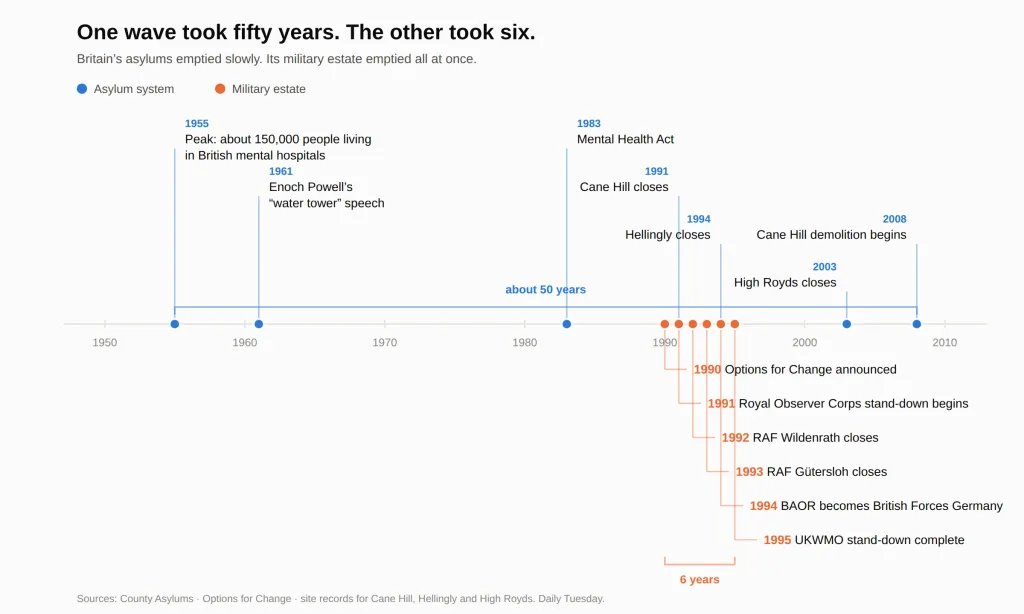
By the mid-1950s roughly 150,000 people were living in British mental hospitals.
The turn came from several directions at once. Goffman, Foucault and Szasz dismantled the intellectual case for the institution. New drugs made other approaches possible. And in 1961 the Health Minister, Enoch Powell, gave the speech that gets called the water tower speech, in which he described the asylums as isolated, majestic, imposing, and doomed, and committed to their abolition.
It took forty years. By the late 1980s bed numbers had halved. The 1983 Mental Health Act and the community care policies that followed accelerated it. Between 1998 and 2014 the UK cut psychiatric beds from 100 per 100,000 people to 45 per 100,000, a faster reduction than any other OECD country managed.
What that left behind was a hundred-odd enormous Victorian estates with no economic purpose and, frequently, listed status.
Cane Hill in Surrey opened in 1882 and held 2,500 patients at its wartime peak. The main hospital closed in March 1991. It then stood for seventeen years. Between 2000 and 2002 it was repeatedly set on fire; one blaze in September 2001 drew 43 fire engines from 11 brigades. Demolition began in 2008. In November 2010, after most of the site was already gone, a final fire destroyed the clock tower and the administration block facade — the parts that had been earmarked to survive.
Hellingly in East Sussex opened in 1903 and closed in 1994. Housing proposals came and went, the local authority turned them down, and the site sat for sixteen years. Arson took the main hall, the kitchen and the stores in 2008. Clearance began in 2009 and ran to 2013. It is a housing estate now. The chapel survived.
That pattern — closure, a decade or more of nothing, arson, then demolition — is not exceptional. It is the standard life cycle.
The military estate, and the peace dividend
On 25 July 1990, with the Berlin Wall down and the Soviet Union nine months from dissolution, the government announced Options for Change.
It cut total service manpower by around 18 per cent, to roughly 255,000. The British Army of the Rhine was replaced by British Forces Germany in 1994 with its strength halved. Eighteen Royal Armoured Corps regiments were amalgamated into ten. The surface fleet went from about fifty frigates and destroyers to forty. RAF Wildenrath closed in April 1992, RAF Gütersloh in March 1993.
And in a detail that produced a specific and very photogenic category of ruin, the Royal Observer Corps and the United Kingdom Warning and Monitoring Organisation were stood down between September 1991 and December 1995. That organisation’s job had been to detect and report nuclear detonations, and to do it they had built a network of small underground monitoring posts across the country. Concrete boxes, fifteen feet down, reached by a ladder. When the organisation was disbanded, the posts were simply left.
There are hundreds of them in British fields. Most people who own the land above one have no idea what it was for.
Airfields are the other legacy, and a very particular problem: hundreds of acres of reinforced concrete, hangars built to a scale nothing civilian requires, contamination from decades of fuel and solvents, and frequently a location chosen precisely because it was nowhere near anything.
The hospitals and the mills
Two smaller categories round it out.
General hospitals were consolidated through the same decades into fewer, larger, newer sites, leaving Victorian infirmaries behind on valuable urban land — which is why these tend to be converted rather than left, and why they are less prominent in urbex photography.
And the industrial estate: mills, collieries, foundries and warehouses emptied by deindustrialisation from the 1970s onward. These follow regional economics rather than national policy, and their fate depends almost entirely on where they are. A mill in Manchester becomes flats. The same mill in a town with no housing pressure stays a mill-shaped hole in the ground for forty years.
Why don’t these buildings just get demolished?
Most abandoned places in the UK are still standing for one reason, and it is money.
Demolition is not free. For a large institutional building it is very expensive, and the costs are front-loaded and unpredictable: asbestos survey and licensed removal, structural work, waste disposal at landfill rates, ground contamination remediation, ecological surveys for bats and nesting birds. Set against that is whatever the cleared land is worth, minus whatever planning permission the council will actually grant.
When the second number is smaller than the first, nothing happens. Not out of neglect — as a rational decision, made annually, by an owner who would lose money by acting.
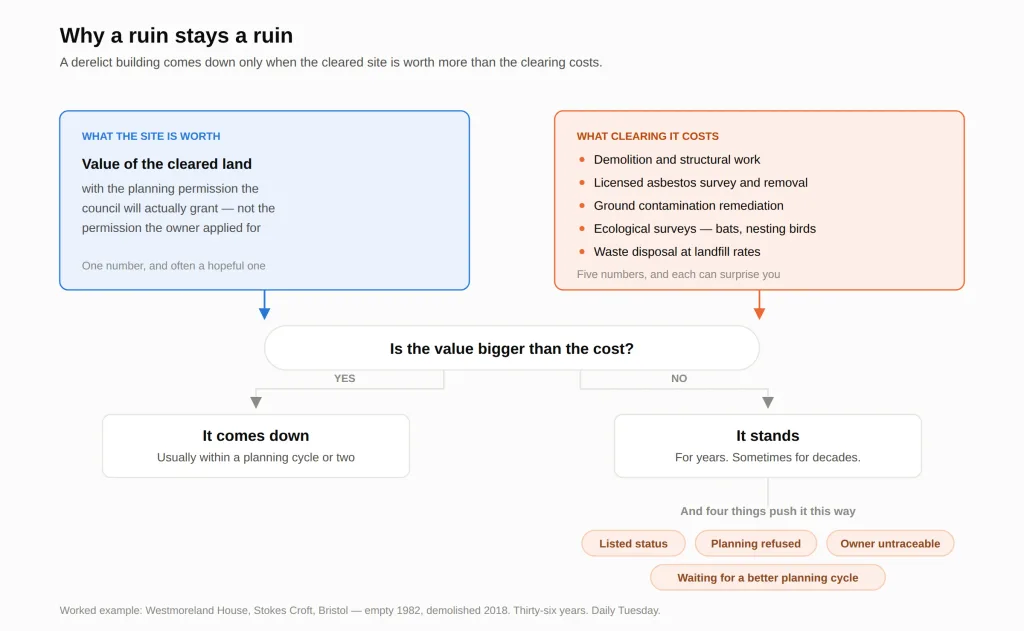
Then layer on the complications. Listed status blocks clearance and forces expensive sympathetic restoration instead. Councils refuse schemes the owner wants and approve schemes the owner cannot finance. Ownership changes hands between developers who each hope the next planning cycle will be kinder. And in some cases the freeholder simply cannot be identified.
Westmoreland House on Stokes Croft in Bristol is the perfect specimen. Opened in January 1966. Its occupant collapsed in 1982 over an unpaid £250,000 tax bill. Bought by a developer in 1989, which then spent years failing to agree a scheme with the city council. A regional development agency plan was killed by budget cuts in 2009. Residents campaigned against luxury flats. Demolition was finally scheduled for July 2018, and delayed again when asbestos was discovered. The machines went in on 21 November 2018.
Thirty-six years, in the middle of a city, on a main road.
Nobody forgot about Westmoreland House. It stood because every individual decision about it was rational and none of them added up to anything.
Is it illegal to explore abandoned places in the UK?
In England and Wales, simple trespass is a civil matter rather than a criminal one. That is the sentence urban explorers quote, and it is true as far as it goes. The police generally cannot act on it; the remedy belongs to the landowner, through the civil courts.
It stops being true quickly.
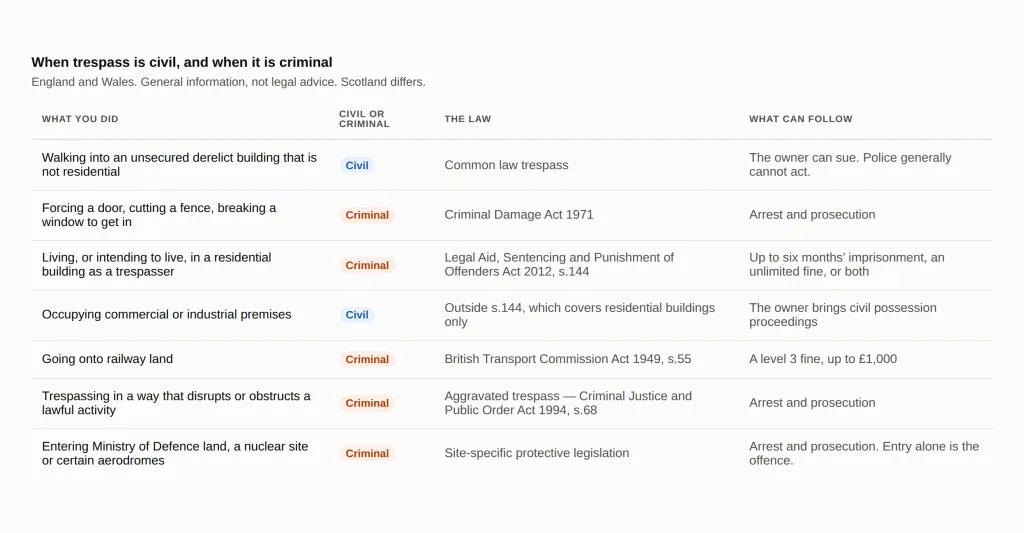
Causing any damage on the way in — a forced door, a cut fence, a broken window — is criminal damage. Trespass on railway land is a criminal offence carrying a fine. Aggravated trespass, under the Criminal Justice and Public Order Act 1994, applies where a trespasser disrupts or obstructs lawful activity. And certain sites, including military and nuclear installations, are specifically protected, where entry alone is an offence regardless of intent or damage.
Then there is the part the law doesn’t cover. Derelict institutional buildings contain asbestos in quantity, floors that have been taking water for twenty years, unguarded lift shafts, and no lighting. The arson at Cane Hill and Hellingly did not leave the surviving structures safer. People are seriously injured doing this, and a rescue from a collapsed asylum floor is a difficult job for the people who have to do it.
Can you legally live in an abandoned house in the UK?
No, and this specifically changed in 2012.
Section 144 of the Legal Aid, Sentencing and Punishment of Offenders Act 2012 came into force on 1 September that year and made it a criminal offence to squat in a residential building in England and Wales. The prosecution has to establish two things: that the person knowingly entered as a trespasser, and that they are living there or intend to. Being present is not enough on its own. Conviction can bring up to six months’ imprisonment, a fine, or both, and police can arrest without a warrant.
Two limits are worth knowing. The offence covers buildings designed or adapted for living in — it does not apply to commercial or industrial premises, where trespass remains a civil matter. And it excludes former tenants or licensees who stay on after their agreement ends, which is a separate area of housing law entirely.
Can I claim abandoned property in the UK?
This is adverse possession, and the honest answer is that it is far harder than its reputation suggests.
For unregistered land, the old position still broadly applies: twelve years of uninterrupted adverse possession under the Limitation Act 1980.
For registered land — which is most land now — the Land Registration Act 2002 changed things fundamentally from October 2003. The occupier must show ten years of adverse possession and then apply to the Land Registry. The registered owner is notified and has 65 working days to serve a counter-notice. If they object, the application fails unless the occupier can bring themselves within one of three narrow exceptions, of which the realistic one is a reasonable boundary mistake.
In practice that means adverse possession against registered land now mostly succeeds in disputes about where a garden fence sits, not in claims over abandoned buildings. Any owner who is paying attention can stop it with a letter.
One curiosity: the 2012 criminalisation of residential squatting does not itself bar an adverse possession claim. The courts have held that a conviction doesn’t prevent someone establishing possession. It is a narrow point, and not a strategy.
How do you find abandoned properties in the UK?
If the question means buying one, there are legitimate routes and they are more productive than walking around looking.
HM Land Registry will tell you who owns a given title for a small fee, which is the first step for anything. Most councils employ an empty homes officer whose job is bringing long-term vacant property back into use, and who will often talk to a serious buyer. Property auctions are where repossessed, probate and problem buildings are actually sold. Councils publish registers of properties subject to enforcement action. And local planning portals show which derelict sites have live applications, which tells you who is already circling.
The scale is larger than most people assume. In October 2022 there were 676,304 empty homes recorded in England, of which 248,149 had been vacant for more than six months.
The ones that were saved
Not every one of the abandoned places in the UK ends as a ruin, and it is worth saying that the derelicts are the survivors of a selection process rather than the whole population. A great many of these buildings were converted, and the good conversions are invisible precisely because they worked.
High Royds, near Leeds, opened in 1888 as the West Riding Pauper Lunatic Asylum and closed in 2003. It is now housing. The administration building is Grade II listed and still has its Italian mosaic corridor floor, patterned with Yorkshire roses. The ballroom is a residents’ lounge.
That outcome required the site to be close enough to a city for the flats to sell, intact enough that conversion beat demolition on cost, and listed enough to make anyone try. Cane Hill had two of those three. Hellingly had one.
The margin between a ruin and a conversion is usually not architectural merit. It’s a postcode.
What happens to them now?
The map of abandoned places in the UK is shrinking, and housing pressure is what’s doing it. Sites that made no financial sense to convert in 1995 make sense now, and relaxed permitted development rights have made change of use easier. Most of the famous asylums are gone or going.
Which gives the photography a function nobody intended. Cane Hill’s interiors exist now only in pictures taken by people who were trespassing when they took them. No official survey recorded those corridors before the fires. When a building has been demolished, an unauthorised photograph is not a lesser record than an authorised one. It’s the only one.
The buildings were a map of what the state decided to stop doing. The photographs are what’s left of the map.
Key takeaways
- Abandoned places in the UK cluster around two policy decisions: the closure of the county asylum system, and the post-1990 reduction of the armed forces.
- Around 119 county asylums were built in England and Wales after 1845; roughly 150,000 people lived in British mental hospitals at the mid-1950s peak.
- Options for Change, announced in July 1990, cut service manpower by around 18 per cent and released large quantities of land, airfields and bunkers.
- Buildings stay derelict because demolition costs, asbestos, listed status and planning disputes often make inaction cheaper than action. Westmoreland House in Bristol stood empty for 36 years.
- In England and Wales simple trespass is civil, but criminal damage, railway trespass, aggravated trespass and protected-site rules are not.
- Squatting in a residential building has been a criminal offence since September 2012.
Frequently asked questions
How many county asylums were there in England and Wales?
Around 119 were built following the County Asylums Act and Lunacy Act of 1845. Only a handful still operate as mental health facilities.
What was the water tower speech?
A 1961 speech by the Health Minister, Enoch Powell, which set out the case for closing Britain’s asylums and is generally treated as the start of the policy that emptied them.
Why do so many abandoned asylums burn down?
Empty timber-framed Victorian buildings with no security, no water supply and open access are extremely vulnerable to arson. Cane Hill and Hellingly both suffered major fires while awaiting a decision on their future.
Are the old nuclear monitoring bunkers still there?
Many are. The Royal Observer Corps and the UK Warning and Monitoring Organisation were stood down between 1991 and 1995, and a large number of their small underground posts were simply left in place.
How many empty homes are there in England?
676,304 were recorded in October 2022, of which 248,149 had been empty for more than six months.