
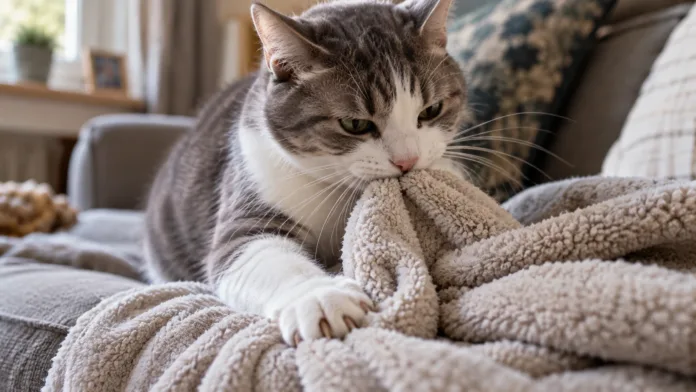

Your cat settles on your lap, starts pushing its front paws in and out like it is working a lump of dough, purrs, and then grabs a mouthful of blanket. Cat owners call it making biscuits, and most guides online give you the same quick answer. This one goes further: what experts actually know, why some cats bite or suck the blanket while they do it, and the few times it is worth calling the vet.
Biscuit basics in 20 seconds
- Cats make biscuits because kittens knead their mum’s belly to get the milk flowing, and lots of cats never stop.
- Adult cats mostly knead when they feel comfortable and safe, often around someone they trust.
- Biting or sucking the blanket is usually the mouth half of that same nursing routine.
- Sucking is normally harmless. Swallowing fabric is not, so that one needs a vet.
Why do cats make biscuits?
Cats make biscuits because the habit starts at the milk bar. Kittens tread on their mother’s belly with alternate front paws to get her milk flowing, according to International Cat Care. Many cats keep doing it for life, and as adults they knead when they feel relaxed, comfortable and safe.
Why the habit sticks around is a harder question, and it is the bit most articles skip.
No one really knows why this behaviour is carried into adulthood by some cats.
Cats Protection
They are not alone. A vet at Kansas State University told Scientific American that several of the popular explanations are only theories. So here is every reason you will read about, rated by how sure the experts really are.
Certain
It gets the milk flowing
Every vet and welfare source we checked agrees this is why kittens do it.
Likely
It feels comforting
Blue Cross says cats knead when they are happy, and International Cat Care links adult kneading to the comfort of nursing. Woodgreen adds that it can help a stressed cat feel calmer.
Possible
It leaves their scent
Cats have scent glands in their paws. Woodgreen says the scent marks a spot as familiar and safe, and a University of Adelaide researcher says kneading may deposit it. Nobody has proved it.
Possible
It is a good stretch
An animal behaviour scientist at Oklahoma State University told Scientific American that kneading stretches a cat’s muscles.
Disputed
It makes a bed
The old theory says wild ancestors trampled long grass into a nest. Cats Protection points out that African wildcats usually prefer raised sleeping spots.
Unclear
It means she is in season
The Scottish SPCA says females tend to knead when they come into heat, but the PDSA’s list of season signs does not mention it.
What does it mean when a cat makes biscuits?
When a cat makes biscuits, it usually means it feels relaxed and safe. The details tell you more, so here are the most common versions at a glance. Each one is explained further down.
| What you see | What it usually means | What to do |
|---|---|---|
| Kneading your lap while purring | Your cat feels safe with you and links you with the comfort of nursing. | RelaxEnjoy it. Use a thick blanket if the claws hurt. |
| Kneading its bed before sleeping | Part of a normal bedtime routine. | RelaxNothing to do. |
| Drooling while kneading | A leftover from kittenhood: it is expecting a milk feed. | RelaxNothing to do. It is normal. |
| Holding or sucking the blanket | Comfort suckling, often linked to being weaned a little early. | RelaxLeave it, as long as nothing gets swallowed. |
| Chewing holes or swallowing fabric | A habit called pica. Swallowed fabric can cause a blockage. | Call the vetTalk to your vet and keep woollens out of reach. |
| Kneading far more than usual | It can point to stress or anxiety. | Keep an eyeThink about what has changed at home, and talk to your vet if it carries on. |
| A male cat humping the blanket | Not unusual, even after neutering. | Keep an eyeSee your vet if there is swelling, a lot of licking or trouble peeing. |
| No kneading at all | Normal. Some cats never do it. | RelaxNothing to do. |
Why do cats knead blankets and purr?
Soft, warm blankets are the easiest thing in the house to knead, and the act itself is tied to the comfort of nursing. International Cat Care says cats are most likely to knead around someone they feel safe with, which may be why your blanket, or your lap, gets most of the attention. Many cats also knead their bed while settling down: vets at VCA Animal Hospitals describe kneading as a regular part of a cat’s bedtime routine.
The purring and drooling are normal too. Blue Cross says some cats purr and some even dribble, and International Cat Care explains the drool as the cat anticipating a milk feed, just as it did as a kitten.
Why does my cat bite the blanket while kneading?
Usually because nursing was never just about the paws. A kitten treads with its feet while it suckles with its mouth, so some adult cats replay both halves at once: paws pushing, mouth gripping the blanket. Most guides stop there, but the biting comes in a few different forms, and they do not all mean the same thing.
Holding or gently mouthing the blanket
The comfort version. Nothing to worry about.
Sucking until there is a wet patch
Usually harmless too. More on that below.
Chewing holes and swallowing bits
A different habit called pica. See the vet checklist below.
Sharp bites aimed at you
Woodgreen’s advice is to give your cat some space rather than tell it off.
Why does my cat suck on blankets?
Sucking on a blanket, often while kneading and purring, is an adult cat suckling the way it did as a kitten. Woodgreen says it is normal and usually linked to being weaned a little early. Some cats take it further and start chewing or eating fabric. International Cat Care says pica, the habit of eating things that are not food, is more common in Siamese, Burmese, Tonkinese and other Oriental breeds, although any cat can do it, and kittens as young as three months may chew their bedding.
of cats chewed things that are not food (plastic more often than fabric) at around six months old, according to their owners in the Bristol Cats Study. By around 18 months it was 30.9%.
A Tufts University-led study of 204 Siamese and Birman cats, as reported by Tufts and the Fear Free programme, found that every cat with a wool-sucking habit had an abnormally large appetite, and that a medical condition raised the risk in Siamese cats.
The line that matters is swallowing. A 2016 study in the Journal of Feline Medicine and Surgery found a clear link between cats sucking fabric and eating it, and International Cat Care warns that swallowed items can cause a life-threatening blockage that may need surgery. Wool and yarn are among the most common culprits.
If your cat only sucks, there is no need to stop it. If it chews, keep woollens out of reach and talk to your vet. International Cat Care says pica can be triggered by stress, boredom or frustration, and that a cat should never be punished for it.
Was my cat taken from its mum too early?
Possibly, but it is rarely the whole story. This is the worry owners raise most often, and the research genuinely points both ways.
The case for
A University of Helsinki study of nearly 6,000 cats found that those weaned before eight weeks were more likely to show aggression and repetitive behaviours. Cats weaned at 14 weeks had fewer behaviour problems.
The Tufts study also linked early weaning and small litters to wool sucking, but only in Birmans.
The case against
The 2016 study found that eating non-food items did not seem to be explained by early weaning or a poor environment.
Our verdict: early weaning may play a part, but it is rarely the whole story. Cats Protection advises that kittens stay with their mother until they are at least eight weeks old. If you adopted an adult or a rescue cat, you cannot change its early life, and blanket sucking on its own is usually nothing to worry about.
Why does my male cat hump the blanket when he kneads?
It catches a lot of owners off guard, but vets say it is not unusual, even in neutered males. We could not find any UK charity guidance on this one, so this section relies on US vets. A vet and behaviourist writing for Catster says some neutered males carry on mounting or thrusting, and that it may be a comfort habit or a learned one. Behaviour specialists at VCA Animal Hospitals say neutering may reduce mounting, but some males keep showing sexual interest afterwards.
On its own it is usually nothing to worry about. Check with your vet if you notice swelling, a lot of licking or any trouble peeing.
Why does my cat make biscuits on me?
Take it as a compliment. International Cat Care says a cat kneading you is linking you with the comfort and safety it once got from its mother.
The 2am version has an explanation too. VCA’s vets describe kneading as part of many cats’ bedtime routine, so it often happens just as you, and they, are trying to settle down.
One caution: kneading and purring do not always mean happy. Vets note that cats who are unwell or in pain sometimes knead and purr to soothe themselves, and Woodgreen says a sudden big rise in kneading can be a sign of stress or anxiety.
Why doesn’t my cat make biscuits?
Because some cats just don’t, and that is fine. Woodgreen says there is no cause for concern if your cat does not knead, and Cats Protection notes that only some cats carry the habit into adulthood. The experts do not fully agree, though: the Scottish SPCA says every cat makes biscuits. We could not find any reliable figure for how many cats knead, so nobody can tell you how unusual a non-kneader really is.
Why is it called making biscuits?
Because a kneading cat looks like someone working bread dough, as Blue Cross puts it. The habit has picked up plenty of other names along the way:
- making biscuits
- pawing
- playing the piano
- making muffins
- baking bread
- milk treading
- paddy pawing
- making puddings
Names collected by Cats Protection, the US charity Best Friends and Mumsnet owners. “Milk treading” is credited to the zoologist Desmond Morris.
In the UK, the biscuit nickname has properly taken over. In a 2018 Mumsnet thread, one owner had to ask what “making biscuits” even meant, and another who had kept cats for 38 years had never heard it. By November 2022 it had its own TikTok meme, Overworked Cats Making Biscuits, in which owners beg viewers to stop ordering biscuits from their exhausted cats.
When should kneading or blanket sucking worry you?
Almost never on its own. These are the signs that mean it is time to call your vet.
Call the vet if your cat…
- is swallowing bits of fabric, or you find holes and missing pieces in its blanket. The PDSA says to contact your vet straight away rather than wait and see.
- is vomiting, has diarrhoea or constipation, seems lethargic or goes off its food after chewing something. International Cat Care lists these as signs of a blockage.
- has a thread or string hanging from its mouth. Do not pull it, says the PDSA.
- suddenly kneads or sucks far more than usual, which Woodgreen says can point to stress or anxiety.
- has sore paws, legs or mouth from kneading or sucking, which experts writing in The Conversation say can signal stress or pain.
- is a male showing swelling, lots of licking or trouble peeing.
How do I stop my cat’s kneading hurting?
You do not need to stop the kneading itself, and Blue Cross points out that you cannot really stop it anyway. The trick is to protect yourself.
Use a thick blanket or cushion
Put it on your lap before your cat settles. A veterinary nurse at International Cat Care suggests leaving it out for your cat when you are not there, too.
Settle or distract
The Scottish SPCA suggests gently encouraging your cat to lie down, or offering a toy.
Check the claws
Cats Protection says most cats look after their own claws, but older or arthritic cats may need trims. Never use human nail clippers or claw covers, and ignore US advice about declawing: it is already illegal in the UK, as the RSPCA has confirmed.
Never punish it
International Cat Care warns that telling a cat off for kneading could damage your bond.
Cats making biscuits: quick answers
Are cats happy when they make biscuits?
Usually, yes. Blue Cross says cats knead when they are happy, but a sudden big increase in kneading can also be a sign of stress.
Do cats grow out of making biscuits?
Some do. Cats Protection says only some cats carry kneading into adulthood, and nobody knows exactly why.
Why does my cat drool when making biscuits?
Drooling while kneading is normal. International Cat Care says cats dribble because they are anticipating a milk feed, just as they did as kittens.
Why does my cat purr while kneading?
Purring and kneading usually go together when a cat is relaxed. Unwell cats can also knead and purr to soothe themselves, so watch for other signs.
Is it bad if my cat sucks on blankets?
Usually not. Sucking is normal, but if your cat chews and swallows fabric, call your vet, because it can cause a blockage.
Should I let my cat knead me?
Yes, as long as it does not hurt. Put a thick blanket on your lap, and never punish your cat for kneading.
Why does my cat knead me at night?
Kneading is often part of a cat’s bedtime routine, so it tends to happen when they are settling down to sleep.