

Trump claims a Gaza deal is in place, but Israel and Hamas remain split over disarmament
Donald Trump has claimed that an agreement has been reached for the “complete disarmament” of Hamas and the withdrawal of Israeli forces from Gaza, but early responses from both sides suggest the deal may be far from settled.
The US president described the agreement as a “critical step” towards Gaza being governed by a new Palestinian administration working with his Board of Peace. He said the arrangement would also give Israel the security it wants by ensuring Gaza is no longer used as a base for attacks.
But the Hamas disarmament deal immediately ran into questions over timing, trust and enforcement.
Trump’s 20-point ceasefire plan, announced last year, calls for Hamas to surrender its weapons and destroy its network of tunnels. It also proposes an Israeli withdrawal from Gaza, a new technocratic Palestinian government, an international security force and the reconstruction of the territory after more than two years of war.
Senior Hamas figures have reportedly accepted parts of the plan. However, the group is resisting any move to hand over weapons before Israel withdraws from Gaza.
Ghazi Hamad, a member of Hamas’s negotiating team, said the group would not act on disarmament before Israeli forces leave the Gaza Strip. He also said Hamas would not implement the agreement unless Israel met its own obligations.
Israel has taken the opposite position. An Israeli official said the proposed terms did not satisfy the country’s demands and insisted that Hamas must fully disarm before any process moves forward. That includes the removal of weapons from Gaza and what Israel describes as the complete demilitarisation of the Strip.
A US official also appeared to acknowledge the gap between the two sides, saying Israel remained highly sceptical that Hamas would disarm. The official added that Trump would be “very, very disappointed” if Israel failed to follow the agreement.
The dispute goes to the heart of the plan. Hamas’s armed wing remains central to the group’s identity and power in Gaza. Its arsenal includes rockets, anti-tank missiles and explosives, and giving that up would mark a major shift.
Earlier this month, Hamas said it had dissolved its government in Gaza and was preparing to transfer authority to a technical committee backed by the United Nations. That step was presented as part of the ceasefire process, but it does not resolve the harder question of weapons.
Officials from the US and the Board of Peace have not given a precise timeline for disarming Hamas or other armed groups in Gaza, including Palestinian Islamic Jihad. They suggested the process could take between 200 and 350 days.
That lack of detail is likely to matter. A disarmament process would need clear guarantees over who collects the weapons, who verifies that tunnels and stockpiles have been destroyed, and what happens if either side accuses the other of breaking the agreement. Without those mechanisms, the deal could remain more of a political announcement than a workable settlement.
The proposed International Stabilisation Force is another unresolved part of the plan. Trump’s roadmap depends on outside forces helping to secure Gaza after any Israeli withdrawal, but it is still unclear which countries would contribute troops, what powers they would have, and whether Israel, Hamas and other Palestinian factions would accept their presence.
The dispute also shows why the second phase of the ceasefire has been so difficult to unlock. Israel wants firm security guarantees before pulling back, while Hamas wants proof that the war and occupation will end before giving up its weapons. Those positions leave mediators trying to turn a broad agreement into a sequence of steps both sides can trust.
Hamas leaders are expected to hold further talks with mediators from Egypt, Qatar and Turkey on the second phase of Trump’s Gaza plan. Hamad said the process could take about two weeks, or longer, because every detail of implementation still needs to be agreed.
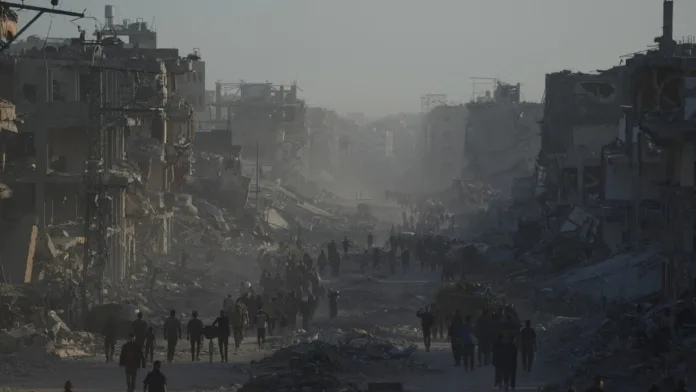
On the ground, Gaza remains far from the roadmap described by Trump. Israeli strikes killed at least six Palestinians on Thursday, including two children, according to local medics.
Israel has also continued to expand its military presence in Gaza. Prime Minister Benjamin Netanyahu has said Israel intends to expand the area under its control to 70% of the territory.
It remains unclear how many troops would be available for the proposed International Stabilisation Force, or when Israeli forces would actually leave Gaza.
For now, Trump is presenting the plan as a breakthrough. But the reality looks much more fragile: Hamas wants withdrawal before disarmament, Israel wants disarmament first, and Gaza is still under fire.