
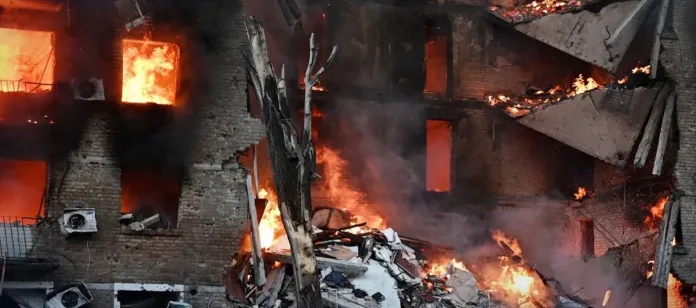

European leaders condemned Russia after a deadly strike on Kyiv involving an Oreshnik missile
Russia’s latest assault on Ukraine has triggered fierce condemnation across Europe after officials said Moscow used an Oreshnik intermediate-range ballistic missile during a deadly attack on Kyiv and surrounding areas. At least four people were killed, and around 100 were injured in the strikes, according to Ukrainian authorities.
Ukrainian President Volodymyr Zelenskyy described the assault as one of the hardest blows suffered by the capital in recent attacks.
Writing on Telegram, he condemned Russian forces in blistering terms and accused Moscow of intensifying its campaign of terror against civilians. According to Zelenskyy, the strikes hit Kyiv particularly hard.
The use of the Oreshnik missile drew especially sharp international reaction.
European Union foreign policy chief Kaja Kallas accused Russia of engaging in reckless nuclear brinkmanship, pointing to reports that Moscow had deployed a missile system designed to carry nuclear warheads.
She said Russia had reached a dead end on the battlefield and was instead turning to deliberate attacks on city centres intended to maximise civilian suffering. Kallas described the reported use of the Oreshnik system as both a political intimidation tactic and a dangerous escalation.
The latest attack marks the third reported use of Russia’s powerful hypersonic Oreshnik ballistic missile against Ukraine.
International criticism expanded rapidly after details of the strike emerged.
German Foreign Minister Johann Wadephul joined French President Emmanuel Macron in condemning the assault. Wadephul called the reported missile deployment another escalation in the conflict. British Foreign Secretary Yvette Cooper also criticised Moscow, saying the intensifying attacks on Ukrainian civilians exposed Russian weakness. She described scenes emerging from Kyiv as awful.
The destruction extended beyond homes and civilian infrastructure.
World Health Organisation director general Tedros Adhanom Ghebreyesus said debris from the Russian strikes damaged offices in Kyiv used by the WHO and several United Nations agencies. Windows on the third floor of the building were damaged, although no injuries were reported among staff.
The crisis also reopened concerns about Belarus and its role in the war.
According to a source close to Emmanuel Macron, the French president warned Belarusian leader Alexander Lukashenko against becoming drawn into Russia’s invasion of Ukraine.
The conversation reportedly took place during the first known telephone call between the two leaders since the opening phase of Russia’s full-scale invasion in February 2022. The source said Macron emphasised the dangers for Belarus of allowing itself deeper involvement in Moscow’s military campaign and urged Lukashenko to improve ties with Europe.
Belarus remains a key Russian ally and hosts Moscow’s nuclear-capable Oreshnik missile system.
Earlier this month, Russia and Belarus conducted nuclear drills against a backdrop of escalating Ukrainian drone attacks inside Russian territory. Belarus shares a border with NATO’s eastern flank, adding further geopolitical sensitivity to any expansion of military activity involving Minsk.
Meanwhile, Ukraine signalled that it continues to strike targets inside Russia.
Ukraine’s SBU security service said its drones attacked an oil pumping dispatch station in Russia’s Vladimir region on Sunday. Officials described the facility as an important fuel distribution hub serving oil depots near Moscow and supplying major airports including Sheremetyevo, Domodedovo and Vnukovo.
The SBU reported that the strike triggered a fire spreading across roughly 800 square metres.
Later, Vladimir region governor Alexander Avdeyev said the blaze near the town of Kameshkovo had been extinguished.
The latest exchange of strikes, warnings and diplomatic pressure underlines how the war continues to widen in both scale and intensity, with fears mounting over the use of increasingly powerful missile systems and the growing risk of broader regional involvement.