
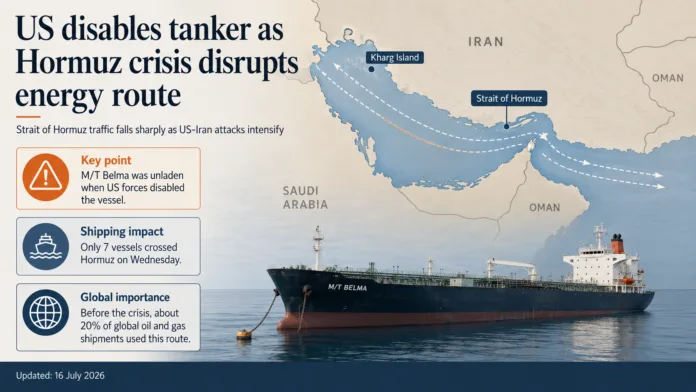

Washington says the empty M/T Belma ignored repeated warnings while heading towards an Iranian oil terminal
Key takeaway
Strait of Hormuz crisis is deepening day by day. US forces have disabled an unladen oil tanker travelling towards Iran as part of Washington’s renewed naval blockade. The incident did not involve a tanker carrying an oil cargo, but it has intensified concerns about maritime security because traffic through the Strait of Hormuz has fallen to a fraction of its previous level.
US aircraft disables tanker heading towards Iran
The United States has disabled an empty commercial oil tanker that was sailing towards Iran’s main crude-export hub, adding a new maritime dimension to the renewed military confrontation between Washington and Tehran.
US Central Command said the Curaçao-flagged M/T Belma was travelling through international waters towards Kharg Island when it failed to respond to repeated warnings. A US aircraft then fired Hellfire missiles at the vessel’s exhaust stack, leaving the ship unable to continue its journey.
The tanker was unladen, meaning it was not carrying an oil cargo at the time. This distinction is important because some initial headlines described the incident simply as an attack on an oil tanker, which could incorrectly suggest that a loaded energy shipment was struck. CENTCOM did not report casualties in its statement.
CENTCOM said the vessel was travelling through international waters and had ignored multiple warnings.
Strikes spread as Iran retaliates across the region
The tanker incident came as US forces expanded their attacks against Iranian military targets. The Associated Press reported strikes near Tehran and in Semnan province, an area associated with Iran’s missile and space programmes, while earlier US operations targeted coastal defences, missile positions and maritime capabilities.
Iran responded with missile and drone attacks directed towards Bahrain, Jordan and Kuwait, all of which host or support US military operations. Authorities in those countries had not immediately confirmed casualties or significant damage from the latest attacks when this article was updated.
Iran’s Revolutionary Guard has also threatened to interfere with energy exports from other Middle Eastern countries if Iranian shipments remain blocked. That statement represents an escalation in rhetoric rather than confirmation that all regional exports have been halted, although the threat is being taken seriously because several major Gulf producers depend on maritime routes connected to Hormuz.
US President Donald Trump has maintained that Iran may still seek an agreement, but the continuing strikes, the renewed blockade and Tehran’s retaliation have weakened the interim arrangements that had temporarily reduced the fighting.
How badly has Strait of Hormuz traffic been disrupted?
The Strait of Hormuz is not completely empty, despite Iranian statements that the waterway has been closed. However, commercial activity has slowed dramatically as shipowners, crews and insurers assess the risk of further attacks.
Shipping data cited by Reuters showed that only seven vessels crossed the strait on Wednesday, compared with 13 on Tuesday. Four of those vessels entered the Gulf without cargo, while three outbound ships were carrying liquefied petroleum gas, coal and fuel oil.
No very large crude carriers or liquefied natural gas tankers were recorded passing through the strait on Wednesday. A tanker carrying one million barrels of Saudi crude had crossed the previous day with its tracking transponder switched off.
Before the current war, approximately one-fifth of global oil and gas shipments travelled through the Strait of Hormuz. The most accurate description of the present situation is therefore that the route is severely restricted and operating at exceptionally low capacity, rather than that no ships are able to cross it.
What could the crisis mean for UK energy prices?
The immediate concern for the UK is not that the disabled tanker was carrying oil—it was empty—but that the wider conflict could keep a major global energy corridor operating far below normal levels.
Brent crude, the international benchmark widely used by energy markets, was trading at about $84.95 a barrel on Thursday morning after initially rising and then moving slightly lower. Prices remain sensitive to military developments, shipping movements and any indication that additional Gulf exports could be disrupted.
Higher crude prices do not produce an automatic or immediate increase at British petrol stations. Refining costs, existing fuel stocks, competition, taxation and movements in the pound also affect pump prices. Nevertheless, a prolonged reduction in Gulf shipping could raise wholesale fuel and transport costs, creating renewed inflation pressure for UK households and businesses.
The duration of the disruption is likely to matter more than a single day’s movement in oil markets. Prices could ease if vessels return and negotiations resume, but they could rise again if attacks spread to ports, production facilities or other export routes.
What happens next?
Attention will now focus on whether the US continues disabling vessels that attempt to reach Iranian ports, whether Iran carries out its threat to disrupt other regional energy exports and whether commercial shipping companies remain willing to use the strait.
Diplomatic statements from both sides suggest negotiations have not been ruled out, although military actions currently point towards further escalation rather than an immediate settlement.
For energy markets, the clearest sign of improvement would be a sustained rise in tanker traffic through Hormuz. Until that happens, the combination of reduced shipping, reciprocal attacks and uncertainty over regional exports is likely to keep oil prices volatile.