
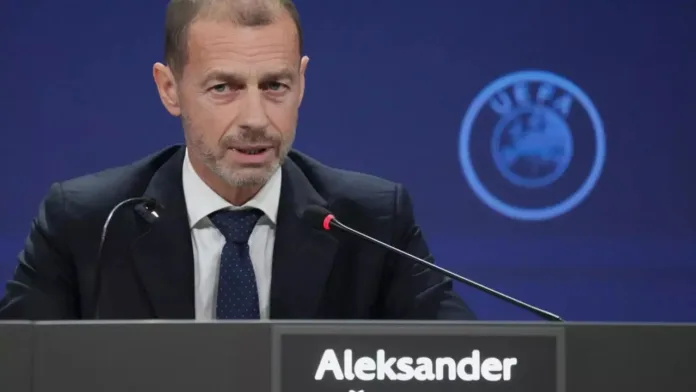

UEFA threatens a World Cup boycott if FIFA pushes ahead with its private investment plan
UEFA has thrown world football into crisis by threatening to pull its national teams out of FIFA competitions if Gianni Infantino presses ahead with his controversial private investment plan.
The warning came in a blunt statement from European football’s governing body after an emergency meeting with its 55 member associations. UEFA said its national associations would not take part in FIFA competitions for as long as the proposals remain alive.
The World Cup boycott threat is the strongest response yet to Infantino’s plan to sell a 20% stake in a FIFA subsidiary that would help run and commercialise major competitions, including the World Cup.
The proposed company would still be controlled by FIFA, but it would receive backing from private investors. Reports have linked the investment plan to Thrive Eternal, a vehicle founded by Joshua Kushner, the brother of Jared Kushner, Donald Trump’s son-in-law. Current reports do not show Donald Trump himself as directly involved in the deal.
FIFA has offered member associations major financial incentives to support the proposal. Countries have been given until 19 September to decide whether to accept the deal, with an initial $20m payment and the prospect of $40m in total.
For smaller football nations, that money could be transformative. For UEFA, however, the issue is not only about funding. It is about control, governance and whether private investors should be allowed anywhere near the commercial structure of the World Cup.
UEFA’s position is clear: FIFA competitions should not be opened to private ownership. Its statement said European nations would only return if the proposal was abandoned completely and binding assurances were given that FIFA would never again open its governance or competitions to private ownership.
The immediate consequences are uncertain. The next FIFA events involving European teams include youth and women’s competitions, and officials are still trying to work out what UEFA’s stance means in practice.
That uncertainty has left players, teams and associations in a difficult position. Wales, for example, are involved in Women’s World Cup play-offs in the autumn and could be chasing a historic first qualification. UEFA figures insist they do not want players or nations punished, but say FIFA created the crisis.
Infantino is now facing one of the biggest challenges of his presidency. He had been expected to stand for another term in March with little serious opposition. That may no longer be guaranteed.
CONCACAF has also rejected the proposals, adding to the pressure on FIFA. Several senior football figures have criticised the lack of consultation, with anger focused not only on the plan itself but also on the way it was developed.
FIFA has defended the proposal and says consultation was disrupted by inaccurate media reports. It insists nobody is selling football and says the plan is intended to unlock more money for development across the global game.
But critics argue that the World Cup is not an investment product. They fear that once private capital gains a stake in FIFA competitions, commercial pressure could start shaping decisions that should belong to the game itself.
The stakes are enormous. UEFA may represent only 55 of FIFA’s 211 member associations, but European teams dominate the sport’s biggest competitions and drive much of its commercial value. A FIFA World Cup without Europe would be damaged both on the pitch and in the market.
For now, both sides are staring each other down. FIFA says the plan could transform football development. UEFA says it crosses a line. Unless one side backs down, the threat of a World Cup boycott has moved from unthinkable to suddenly possible.