
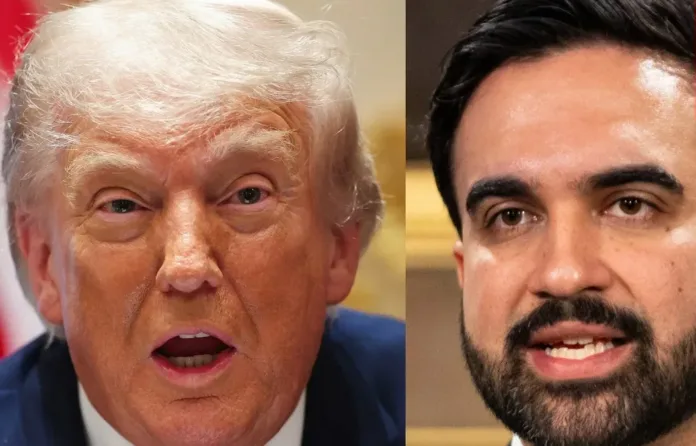

Trump says Benjamin Netanyahu will not be arrested in the US despite an ICC warrant
Donald Trump has said Benjamin Netanyahu will not be arrested if he visits the United States, escalating a political row over the Israeli prime minister’s international criminal court warrant.
The US president made the statement after New York City mayor Zohran Mamdani said his administration was examining whether it would have the legal authority to detain Netanyahu if he travelled to the city for the UN general assembly in September.
The Netanyahu arrest warrant was issued by the International Criminal Court in November 2024 over alleged war crimes and crimes against humanity in Gaza. Netanyahu has not been convicted, and Israel rejects the allegations.
Trump responded forcefully on Truth Social, saying Netanyahu would not be arrested “in any way, shape, or form” while in the US. He also defended the Israeli leader by pointing to Israel’s conflict with Iran and argued that attention should be on those responsible for Tehran’s role in regional violence.
The comments put Trump directly at odds with Mamdani, who has said Netanyahu belongs in The Hague, where the ICC is based. Mamdani has also described Israel’s war in Gaza as genocide, a characterisation rejected by Israel.
Mamdani told the New York Times that he was in active discussions with the city’s law department about what powers he may have. He said his administration would act only within the limits of the law and would not create new laws to pursue an arrest.
The dispute highlights the uncertain position of the Netanyahu arrest warrant in the US. The United States is not a member of the ICC and does not recognise the court’s jurisdiction over American or Israeli officials. That means any attempted arrest on US soil would face major legal and diplomatic barriers.
Still, Mamdani’s comments have turned the issue into a high-profile test of how far local officials can go in responding to international warrants. His position also reflects wider political pressure inside parts of the Democratic Party over US support for Israel and the war in Gaza.
The ICC warrant also names Yoav Gallant, Israel’s former defence minister. The court accused Israeli leaders of crimes including starvation as a method of warfare and other inhumane acts. Those accusations remain allegations, and the court has not reached a trial verdict.
A warrant was also issued for Hamas military leader Mohammed Deif. The ICC accused him of crimes including murder, hostage-taking and sexual violence. Israel has said Deif was killed, but the court has previously said it was not in a position to confirm his death.
The Netanyahu arrest warrant has already complicated the Israeli leader’s international travel, particularly to countries that are members of the ICC. Member states are generally expected to cooperate with the court, although enforcement can depend on national law and political decisions.
Trump’s statement signals that Washington will not allow such action against Netanyahu during a US visit. It also turns a legal question into a broader fight over Israel, Gaza, Iran and the limits of international justice.
For Netanyahu, the assurance from Trump may reduce immediate concerns about travel to the US. For Mamdani, the issue has become a way to challenge both Washington and Israel over accountability for the war in Gaza.
The row is unlikely to end quickly. The Netanyahu arrest warrant remains active, the US continues to reject ICC authority, and any visit during the UN General Assembly could become a flashpoint between local politics, federal power and international law.