
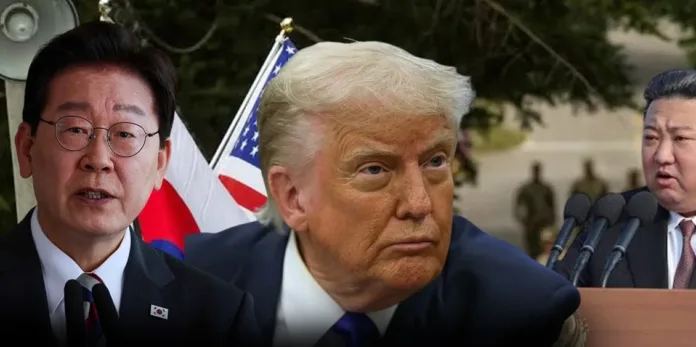

Trump orders major cuts to joint drills after Seoul refuses an Iran role, citing ties with Kim
Donald Trump has ordered the United States to substantially scale back military exercises with South Korea, linking the decision to his relationship with North Korean leader Kim Jong Un and Seoul’s refusal to become involved in the US war with Iran.
The US president announced the move on Sunday, only hours before the annual Ulchi Freedom Shield exercises were due to begin.
Trump said cancelling the drills entirely was no longer practical because preparations were too advanced. Instead, he instructed the Pentagon to reduce US participation.
South Korea, however, said the exercises would continue according to schedule.
The 11-day Ulchi Freedom Shield exercise began on Monday and had been expected to involve about 18,000 South Korean troops, alongside US forces. Roughly 28,500 American military personnel are permanently stationed in South Korea.
Trump argued that the exercises cost Washington too much and send what he considers an unnecessarily hostile signal towards Pyongyang. He also highlighted what he described as his strong personal relationship with Kim.
The president had drawn fresh attention to those ties less than a day earlier by posting a photograph of himself with the North Korean leader from their 2019 diplomacy.
Trump also connected his decision to another dispute with Seoul.
He said he had recently asked South Korean President Lee Jae Myung whether his country wanted to join US efforts concerning the denuclearisation of Iran. According to Trump, Lee’s government declined.
That refusal comes as Washington’s relationships with several traditional allies face pressure over the Iran conflict. Trump has also expressed frustration with Japan, France and the UK over their reluctance to participate directly.
His decision on the Korean drills arrives at a particularly sensitive moment.
North Korea conducted ballistic missile tests this month, including launches detected by South Korea, the US and Japan. Pyongyang has continued expanding its nuclear and missile capabilities since Trump’s earlier diplomatic push with Kim collapsed in 2019.
North Korea’s foreign ministry also condemned the latest joint exercises before they began, describing them as preparation for aggression.
Military officials in Washington and Seoul had presented this year’s training as an important response to changing threats from the North.
US military spokesperson Ryan Donald said the exercises were designed partly around lessons North Korean forces may have gained while supporting Russia’s war in Ukraine.
Experts have warned that reducing the drills could create military costs without delivering a diplomatic breakthrough.
Leif-Eric Easley, a professor at Ewha University in Seoul, said combined exercises are important for maintaining the ability of US and South Korean forces to operate together. He warned that scaling them back could weaken coordination and deterrence while producing only limited financial savings.
Trump has taken similar action before.
During negotiations with Kim in 2018, he suspended major exercises, arguing that the drills were provocative and expensive. Training was later reduced again in 2020 during the Covid-19 pandemic.
For South Korean President Lee Jae Myung, the latest announcement presents both an opportunity and a risk.
Lee has encouraged renewed diplomacy between Washington and Pyongyang. On 15 August, he called for talks aimed at replacing the armistice that halted fighting in the Korean War with a lasting peace arrangement.
Trump’s renewed praise for Kim could therefore increase hopes of another diplomatic opening.
At the same time, his criticism of Seoul over Iran and military spending places fresh strain on an alliance that South Korea considers central to its national security.
Trump has repeatedly complained about the cost of defending South Korea and questioned whether Washington receives enough in return.
Seoul has attempted to ease those tensions through major economic and defence commitments, including plans for large-scale investment in the United States.
For now, the military exercises are going ahead.
What happens to their scale after Trump’s order, and whether his softer approach towards Kim produces any response from Pyongyang, remain unresolved.