
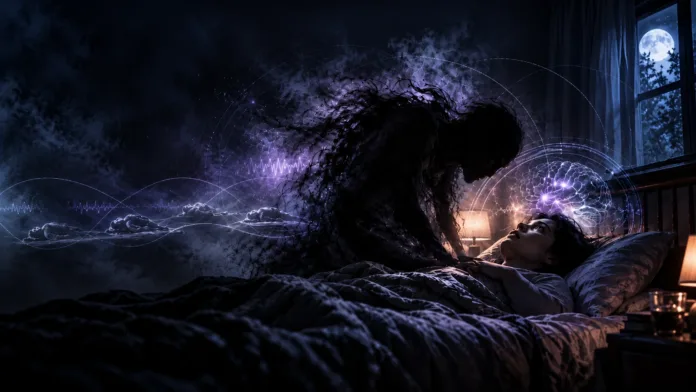

The 3am version
- A sleep paralysis demon is a hallucination. Your brain wakes up before your body does, and the part of you that scans for danger fills the dark with a figure.
- Sleep paralysis is common. Estimates run from about 1 in 13 people to nearly 1 in 3, and around seven in ten people who get it never see anything at all.
- The figure is old. People have named it, painted it and blamed it for centuries, from a 1781 painting to the real deaths that gave us Freddy Krueger.
- Is sleep paralysis dangerous? No. The NHS says it can be scary, but it’s harmless, and there are things that make it less likely.
You wake up in the middle of the night. You can’t move. You can’t shout. And there is someone standing in the corner of the room, or sitting on your chest, or leaning over the bed. That someone is what the internet calls a sleep paralysis demon, and if you’ve met yours, you’ll know it’s one of the most frightening things a body can do to itself.
Here’s the strange part. People who have never met, in countries that have never compared notes, describe the same visitor. A dark figure. A weight on the chest. A feeling of being watched. They have given it different names for centuries, and one of those stories ended up on cinema screens as Freddy Krueger.
This is the story of that figure: what is actually happening in your head, why it looks so similar everywhere, and how a 1781 painting, a Japanese word, alien abduction stories and a cluster of real deaths in America all turn out to be about the same thing.
Up to 1 in 3
people have had sleep paralysis, according to the biggest review so far
7 in 10
people who get it never see anything at all
1781
the year Henry Fuseli painted the demon on the sleeper’s chest
1984
the year Freddy Krueger arrived, inspired by real deaths in sleep
What is a sleep paralysis demon?
It’s a hallucination that happens when your mind is awake, but your body is still switched off for sleep.
Sleep paralysis means being unable to move or speak while you’re waking up or falling asleep. The NHS describes feeling awake but unable to move, speak or open your eyes, feeling as if someone is in the room or pushing you down, and feeling scared. It can last up to several minutes. The “demon” is the part your brain adds.
Your body switches off
During REM sleep, the stage where most vivid dreams happen, your muscles are paralysed so you don’t act out what you’re dreaming.
Your brain wakes up first
In sleep paralysis, that paralysis carries on for a short while after you’ve woken up. You’re aware, but your body hasn’t caught up.
The threat detector fills the gap
Researchers think the brain’s alarm system kicks in, and because you’re still half-dreaming, it supplies the threat it expects to find: a presence, a figure, a weight.
How common is it? Estimates vary a lot. A 2011 review of 35 studies put it at 7.6% of the general population, rising to 28% of students. The biggest review so far, published in 2024, pooled 76 studies from 25 countries and came out at about 30%, though its authors warn that smaller studies may have pushed that up, and their corrected figure was 17%. Either way, if it has happened to you, you’re far from alone.
And the demon isn’t guaranteed. In that 2024 review, about seven in ten people who had sleep paralysis reported no hallucinations at all. Around a quarter saw and heard things.
Why does everyone’s sleep paralysis demon look the same?
Because the same three brain glitches produce the same three kinds of experience, wherever you live.
In 1999, a team led by J.A. Cheyne in Canada studied several large groups of people with sleep paralysis and found the visions were remarkably consistent across time and cultures. They sorted them into three groups, the closest thing science has to a list of sleep paralysis demon types.
Type 1
The intruder
A sense that someone is in the room, with fear, footsteps, voices or a shadowy figure. The researchers think it starts with a hypervigilant, on-guard state in the midbrain.
Type 2
The incubus
Pressure on the chest, trouble breathing and pain, as if something is sitting on you. This one is linked to how the paralysis changes the way you sense your own breathing.
Type 3
The floating feeling
Floating, flying or out-of-body sensations, sometimes even bliss. These come from mixed-up signals about where your body is and which way it’s facing.
The first two share something important: they both imply an “other”, someone who isn’t you. Give that sensation to a person in medieval England, rural Japan or a 21st-century bedroom with a phone on the bedside table, and each will reach for the scariest “other” their culture offers. The details change. The shape stays the same.
What is the sleep paralysis demon called around the world?
Almost every culture has a name for it, and nearly all of them describe being pressed, held down or sat on.
Newfoundland, Canada
The Old Hag
A withered crone who sits on sleepers
Japan
Kanashibari
“Bound in metal”
Brazil
Pisadeira
“She who steps”
Turkey
Karabasan
“The dark presser”
Mexico
Se me subió el muerto
“A dead body climbed on top of me”
Germany
Hexendrücken
“Witch’s pressing”
Nigeria (Yoruba)
Ogun oru
“Nocturnal warfare”
Hong Kong
Ghost oppression
Reported by 37% of 603 students in one 1994 survey
Old English
Mære
The spirit that gave us the word “nightmare”
The names come from a roundup of sleep paralysis names and the studies behind the 2024 review. The Old Hag is the one that got scientists interested. Folklorist David Hufford had his own terrifying episode as a student in 1963, then found people in Newfoundland describing exactly the same thing as a visit from the Old Hag. His 1982 book, The Terror That Comes in the Night, argued that the Old Hag and her cousins around the world grow out of a real, shared experience, not just a shared story.
What you believe still changes how it feels. A 2013 study compared Egypt and Denmark. In Egypt, 44% of people had experienced sleep paralysis, against 25% in Denmark. Egyptians also had about three times as many episodes, more often feared they were going to die, and those who blamed the supernatural were more frightened and stayed paralysed longer.
Where does the word nightmare come from?
A nightmare was originally the demon itself, not the bad dream.
The “mare” in nightmare has nothing to do with horses. According to the Oxford English Dictionary, as Grammarphobia explains, it comes from the Old English mære, an evil spirit believed to settle on a sleeper’s chest and suffocate them. The earliest English use, from around 1300, means that spirit. By 1562 it meant the feeling of suffocation in sleep, by 1675 a bad dream that brought those feelings on, and only by 1826 did it settle into the meaning we use today.
So when you say you had a nightmare, you’re using a word that originally described a sleep paralysis demon.

Which brings us to the most famous picture of one. Henry Fuseli’s The Nightmare, painted in 1781, shows a sleeping woman draped over the end of her bed while an ape-like demon crouches on her chest and stares straight out at you. A horse with blank eyes pushes its head through the curtains, a visual pun on the word. When it was shown at the Royal Academy in London in 1782, critics were horrified and fascinated in equal measure, and it became Fuseli’s first big commercial success. It now hangs in the Detroit Institute of Arts.
Look at it again with the incubus type in mind: the weight on the chest, the helpless sleeper, the watcher. Fuseli painted a sleep paralysis demon more than two centuries before anyone called it that.
Who is the Hat Man, and what about aliens?
They’re the same visitor in modern clothes.
Ask people online what their sleep paralysis demon looks like and one figure keeps turning up: the Hat Man. One account in the University of Southern California’s Digital Folklore Archives describes him as tall and faceless, in a trench coat and a wide-brimmed hat, standing in the corner and watching without speaking, then leaving after a few minutes. The person who reported him had read about the Hat Man on Reddit and YouTube. The archive raises the obvious question: do so many people see him because of how the brain works, or partly because they’ve already heard what he looks like?
Aliens are the other modern version. Harvard psychologist Susan Clancy studied people who believed they had been abducted, and in her 2005 book Abducted she linked many of those experiences to sleep paralysis: waking unable to move, with vivid sights, sounds and sensations that feel completely real. In the 1700s it was a demon on the chest. By the late 20th century it was an alien by the bed.
Film-makers noticed too. Rodney Ascher’s 2015 documentary The Nightmare, which premiered at Sundance, follows eight people with sleep paralysis and recreates their visits from “shadow men” as a horror film.
The sleep paralysis demon through time
- c.1300
“Nightmare” first appears in English, meaning the spirit itself.
- 1781
Henry Fuseli paints The Nightmare.
- 1826
“Nightmare” settles into its modern meaning, a bad dream.
- 1977 to 1981
Healthy young Hmong refugees in the US start dying in their sleep.
- 1982
David Hufford publishes his study of the Old Hag.
- 1984
A Nightmare on Elm Street introduces Freddy Krueger.
- 1999
Cheyne’s team maps the three types of sleep paralysis visions.
- 2005
Susan Clancy links alien abduction stories to sleep paralysis.
- 2015
The Nightmare documentary premieres at Sundance.
- 2024
The biggest review so far puts sleep paralysis at about 30% of people.
Can sleep paralysis kill you? The real story behind Freddy Krueger
No. The NHS says sleep paralysis is harmless. But a cluster of real deaths in the 1970s and 80s, blamed on a sleep paralysis demon, is where Freddy Krueger came from.
From 1977, doctors in the United States began seeing something they couldn’t explain. Healthy refugees from Laos, mostly Hmong men in their thirties, were dying in their sleep, sometimes after what looked like violent nightmares. An Associated Press report in December 1981 counted 38 cases between July 1977 and October 1981, and by the time the deaths tailed off in the late 1980s, at least 117 people had died, all but one of them men. Autopsies found no clear cause. The condition was given a name, Sudden Unexpected Nocturnal Death Syndrome, or SUNDS, and in the Philippines similar deaths are known as bangungot.
In 1981 the Los Angeles Times reported on the deaths, and Wes Craven read the articles. He later told Rolling Stone the question that started it, as Mental Floss reports:
What if the dreams were actually killing these men?
Wes Craven, speaking to Rolling Stone in 1988
The answer was a killer who only exists in dreams. A Nightmare on Elm Street came out in 1984.
The Hmong had their own explanation. Elders blamed dab tsog, a spirit believed to attack sleepers and press the life out of them, a close cousin of the Old Hag. Researcher Shelley Adler spent 14 months with Hmong communities in California’s Central Valley, surveying 118 people, and her 1991 PhD study argued that the encounter with dab tsog was a local version of the same night-time experience people describe everywhere. Her conclusion was not that the spirit killed anyone. It was that terror of the spirit, piled on top of the upheaval of refugee life and being cut off from the traditional healing that once protected against it, created the kind of extreme stress that can cause sudden death. She later set out the idea in her 2011 book Sleep Paralysis: Night-mares, Nocebos, and the Mind-Body Connection, the nocebo effect being the darker twin of the placebo effect.
Doctors still debate what was really behind the deaths, and heart rhythm problems such as Brugada syndrome are among the suspects for sudden night-time deaths of this kind. The NHS is clear that sleep paralysis itself is harmless. The demon can’t hurt you. It just feels as if it can.
How to stop sleep paralysis (and the demon)
You can’t switch it off for good, but steady sleep makes it less likely, and staying calm during an episode can make it pass more easily.
The NHS says it isn’t clear exactly why sleep paralysis happens, but it has been linked to insomnia, disrupted sleep from shift work or jet lag, narcolepsy, post-traumatic stress disorder, generalised anxiety disorder, panic disorder and a family history of it. As for how to prevent sleep paralysis, the NHS suggests changing your sleeping habits. A 2024 research review gives the practical version:
- Keep to a regular sleep schedule and aim for 7 to 9 hours a night.
- Keep the bedroom dark, cool and quiet.
- Avoid caffeine and alcohol before bed.
- Try sleeping on your side. Sleeping on your back has been linked to more episodes.
- Find a way to manage stress before bed.
If it happens again, try this
Researcher Baland Jalal proposed a four-step method in a 2016 paper, built from case examples rather than a full trial:
- Remind yourself what this is: sleep paralysis, which is common and harmless.
- Keep your distance from it emotionally, and don’t engage with the figure.
- Turn your attention inwards, as you would in meditation.
- Relax your muscles.
When to see a GP
According to the NHS, you don’t normally need medical help. See a GP if you have sleep paralysis often and feel very anxious or scared to go to sleep, or if you’re tired all the time because of it. They may treat an underlying problem such as insomnia, or refer you to a sleep specialist.
So what is the sleep paralysis demon, really?
It’s one of the oldest characters humans have ever invented, and we invented it from a real experience. The weight on the chest, the watcher in the corner and the voice you can’t answer come from a brain caught halfway between dreaming and waking. Every culture dressed that experience in its own costume: a hag, a witch, a dead body, a spirit, a demon, an alien, a man in a hat. Fuseli painted it, Hufford traced its pattern, Craven turned a real tragedy into a film villain, and the internet gave it a meme.
The good news hasn’t changed in 700 years of stories. However real it feels, nobody is there.
Like your mysteries with real explanations?Abandoned places UK: why they stand empty and which you can visitKey takeaways
- A sleep paralysis demon is a hallucination that happens when you wake from REM sleep before the muscle paralysis of dreaming has worn off.
- Estimates of how many people get sleep paralysis range from 7.6% to about 30%, and around seven in ten never see a figure at all.
- Researchers sort the visions into three types: the intruder, the incubus and floating or out-of-body feelings.
- Cultures around the world have named the same experience, from the Old Hag and kanashibari to the Old English mære behind the word nightmare.
- Freddy Krueger was inspired by real deaths among Hmong refugees in the US, which the community blamed on a pressing night spirit called dab tsog.
- The NHS says sleep paralysis is harmless, and steady sleep habits can make it less likely.
Sleep paralysis demon FAQs
What is a sleep paralysis demon?
A sleep paralysis demon is a hallucination of a figure or presence that some people see when they wake up unable to move. The paralysis from dreaming hasn’t worn off, and the brain fills the room with a threat.
Can sleep paralysis kill you?
No. The NHS says sleep paralysis can be scary but it’s harmless. An episode can last up to several minutes.
Can your sleep paralysis demon touch you?
It can feel like it. Pressure on the chest, a weight on the body and even pain are recognised sleep paralysis hallucinations, but nothing is actually there.
Why can’t you scream during sleep paralysis?
The muscle paralysis that stops you acting out your dreams hasn’t switched off yet, so you can’t move or speak until your body catches up with your brain.
How do you stop sleep paralysis?
Regular sleep, avoiding caffeine and alcohol before bed and sleeping on your side can make it less likely. See a GP if it happens often and you’re scared to go to sleep.
Why do I get sleep paralysis?
It isn’t clear exactly why. The NHS links it to insomnia, disrupted sleep from shift work or jet lag, narcolepsy, post-traumatic stress disorder, anxiety, panic disorder and a family history of it.
Who is the Hat Man in sleep paralysis?
The Hat Man is a figure many people report during sleep paralysis: tall, faceless and wearing a wide-brimmed hat. He is a modern version of the intruder described in folklore for centuries.
What is the famous sleep paralysis demon painting?
The Nightmare by Henry Fuseli, painted in 1781. It shows a demon crouching on a sleeping woman’s chest and hangs in the Detroit Institute of Arts.
Was Freddy Krueger inspired by sleep paralysis?
Partly. Wes Craven was inspired by 1981 reports of Hmong refugees dying in their sleep. The Hmong blamed dab tsog, a pressing night spirit much like a sleep paralysis demon.
How common is sleep paralysis?
Very. A 2011 review put it at 7.6% of people and a 2024 review of 76 studies at about 30%, or 17% after adjusting for bias from small studies. Students and people with mental health conditions get it more often.