
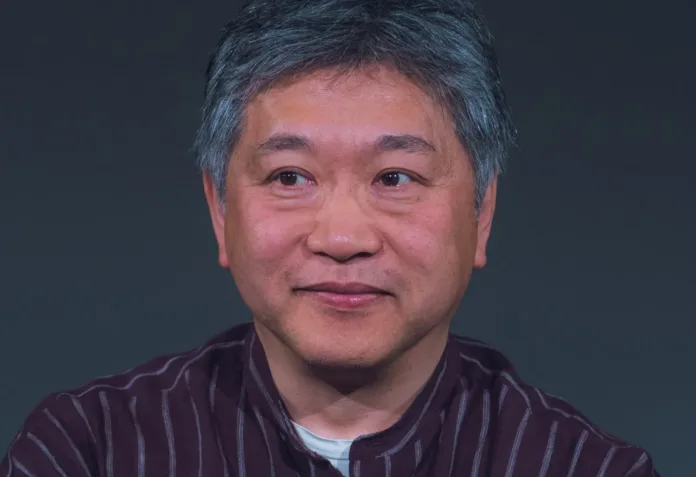


A Cannes review brands Hirokazu Kore-eda’s AI family drama confusing and unsatisfying
Hirokazu Kore-eda’s latest film has arrived at Cannes carrying ambitious ideas about grief, artificial intelligence and family loss, but one major review argues the experiment collapses into confusion rather than emotional power.
Sheep in the Box, screened at the Cannes Film Festival, pushes the acclaimed Japanese director into unfamiliar territory with a futuristic story built around humanoid robot children, bereaved parents and unsettling corporate technology. Yet the film’s attempt to blend sci-fi concepts with intimate human tragedy has drawn sharp criticism for what has been described as a muddled and emotionally distant execution.
At the centre of the story sits a grieving couple struggling after the death of their seven-year-old son. Two years earlier, the child, Kakeru, died in a hit-and-run incident, with the driver never identified.
His mother, Otone, an architect, and father, Kensuke, a carpenter, find themselves approached by a company called REbirth.
The proposition sounds extraordinary.
Using photographs, videos and collected memories, the corporation offers to create a hyper-realistic humanoid replica of their dead child. The robotic duplicate would stay with the family as they attempt to navigate grief and emotional recovery.
Embed from Getty Images
But according to the review, the film struggles almost immediately with the emotional consequences of its own premise.
Instead of explosive grief, disbelief or emotional collapse, the parents reportedly respond to the arrival of the artificial child with striking calmness. Their reactions are described as strangely restrained, closer to receiving an advanced piece of consumer technology than confronting a recreated version of their dead son.
That tonal uncertainty becomes one of the review’s central criticisms.
The film appears torn between two identities: a dystopian science-fiction narrative about artificial intelligence and a deeply personal story about parental bereavement. Rather than strengthening one another, those competing styles are said to undermine the film’s emotional and dramatic impact.
Within the story, Kensuke remains uneasy about the replica child and resists fully embracing the arrangement.
One subplot sees him telling the robotic “Kakeru” not to call him “daddy”, a decision that later triggers an awkward encounter involving police suspicions in public. The review portrays the scene as neither successfully comic nor convincingly dramatic, reinforcing the film’s uneasy tonal balance.
Several narrative ideas emerge, but, according to the critique, fail to develop fully.
At one stage, Kensuke brings the AI child back to the scene of the fatal crash in the hope that memories or hidden clues might surface. Elsewhere, he uses the robot as a form of emotional confessor to confront his own guilt surrounding his son’s death. The review argues that both concepts hint at richer possibilities but remain largely unexplored.
The story expands further into stranger territory.
The artificial child reportedly encounters other abandoned or feral robot children, leading toward what resembles a growing replicant uprising driven by a desire for autonomy and freedom. By this point, the film appears to shift again in tone and thematic direction, broadening its ambitions while deepening the sense of narrative disorientation described by the reviewer.
The criticism concludes that Sheep in the Box remains baffling and unsatisfying until its final moments, despite its gentle soundtrack and serious artistic intentions.
The review acknowledges that filmmakers taking creative risks should not be discouraged. However, it argues that Kore-eda’s quiet, understated style does not fit comfortably with the film’s sci-fi ambitions. It also compares the project unfavourably with other works exploring related themes, including After Yang and Swan Song.
For a director celebrated for emotionally nuanced storytelling, Sheep in the Box appears, at least through this early Cannes reaction, to represent a bold leap that failed to find stable ground.