


COLD CASE · SAWNEY BEAN
Was Sawney Bean real?
No record
- No evidenceSawney Bean and his 48-strong cannibal clan. No trial record, court entry or eyewitness account of them has ever been found.
- RealThe cave. A sea cave north of Ballantrae on the Ayrshire coast carries his name, and you can walk to it.
- RealThe Hills Have Eyes link. Wes Craven said the film started with an article about the Sawney Bean family that he found in a New York library.
- DebatedThe smear theory. “Sawney” was an English nickname for Scots, and some historians think the story was spread to mock them.
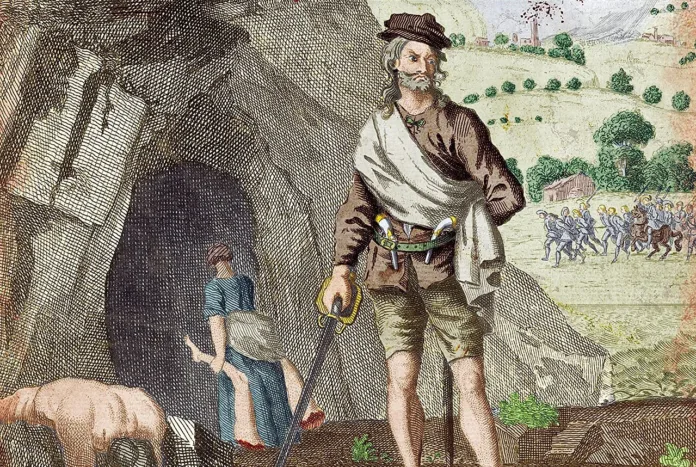
Sawney Bean is Scotland’s most famous cannibal: the head of a cave-dwelling clan said to have ambushed, killed and eaten more than 1,000 travellers on the south-west coast, until the king’s soldiers dragged the whole family to Edinburgh. The story has been retold for about 300 years. It has inspired horror films, novels and a scare show at the Edinburgh Dungeon.
There’s just one problem. Nobody has ever found a single record that he existed.
So we opened the file to find the Sawney Bean true story. We went back to the oldest printed version, the court records historians have searched, the cave you can still walk into, and the American horror director who read about the Sawney Bean family in a New York library.
Exhibit A
Was Sawney Bean real?
No evidenceProbably not. The story only appears in print in the 18th century, and nothing from the time it’s set in mentions him.
The legend comes with names, numbers and an ending, which makes it feel like history. But the people who have gone looking keep coming back empty-handed. Undiscovered Scotland concludes it is probably fiction. Future Museum, a heritage project backed by the councils of south-west Scotland and Museums Galleries Scotland, says there is absolutely no evidence for it.
The scale is the giveaway. A clan that killed 1,000 people over 25 years would have left behind hundreds of missing persons, a royal manhunt and a mass execution. Any one of those should have turned up somewhere in Scotland’s records. None of them has.
Exhibit B
What did Sawney Bean do, according to the legend?
LegendHe hid in a sea cave for 25 years, raised a clan through incest and lived on the people he ambushed.
The best-known version is in the Newgate Calendar, the London collection of criminals’ lives that made the story famous. In it, Sawney Bean is born in East Lothian, eight or nine miles east of Edinburgh, to parents who worked at hedging and ditching. He and his wife set up home in a cave on the Galloway shore. The Newgate Calendar never names Sawney Bean’s wife, but later retellings call her Black Agnes Douglas and say she was believed to be a witch. At high tide the sea floods two hundred yards inside, and the cave runs almost a mile underground.
They live by robbing and murdering travellers, then eating them, and pickling what they can’t eat. Over more than 25 years the Sawney Bean clan grows to eight sons and six daughters, who in turn produce eighteen grandsons and fourteen granddaughters. That’s 27 men and 21 women in all. The calendar says it was generally computed that they killed at least a thousand people. In later retellings, body parts wash up on nearby beaches and innocent innkeepers are hanged for the disappearances.
The end comes when they attack a man and his wife riding home from a fair. They murder the wife, but before they can finish off the man, twenty or thirty people coming from the same fair arrive and the clan retreats. He reaches Glasgow, and in later retellings the city’s chief magistrate takes the case to the king. King James himself leads about four hundred men and a pack of bloodhounds to the coast. The dogs find the cave.
The whole clan is taken to the Tolbooth in Edinburgh, then to Leith. The men are mutilated and left to bleed to death while the women and children watch. Then the women and children are burned in three fires.
Modern retellings even hand Sawney a dramatic last line, “It isn’t over, it will never be over.” It doesn’t appear in the Newgate Calendar’s account.
“They all in general died without the least signs of repentance.”
The Newgate Calendar
Three versions, three different stories
1700s · Newgate Calendar
The kingJames VI, before he took England’s throne in 1603
The caveThe Galloway shore, almost a mile deep
The endExecuted at Leith
Today · Undiscovered Scotland
The kingJames I, around 1430
The caveBennane Head, near Ballantrae
The endA brief trial in Edinburgh, then execution
2016 · The Scotsman
The kingJames VI
The caveBennane Head or the Mull of Galloway
The endExecuted without trial, in Glasgow or Leith
Two kings more than a century apart, two possible caves, and an ending that changes depending on who is telling it. Real cases don’t usually drift like that. Legends do.
Exhibit C
Why can’t historians find Sawney Bean?
No evidenceBecause the places a real case would show up are empty.
If the Newgate Calendar’s date is right, the case would fall inside the years covered by Robert Pitcairn’s Criminal Trials in Scotland, published between 1829 and 1833. It collects cases heard before Scotland’s High Court of Justiciary from 1488 to 1624. A mass execution ordered by the king would be hard to miss. It isn’t there.
Historian Stephen Basdeo reports the view of an Ayrshire local historian who looked for the Beans and found nothing: no entry in Pitcairn, no mention in family papers or letters of the time, and no record of the innkeepers the legend says were hanged by mistake for the clan’s crimes. That historian thinks the story is almost certainly fictional, while allowing that a real family might lie somewhere behind it. Writing in the Scottish studies journal Scotia, Tom Doran adds that court records have been searched by others, with no mention of the case.
Cold case file · What’s missing
- The trial: not in Pitcairn’s Criminal Trials in Scotland, which runs from 1488 to 1624.
- The wrongly hanged innkeepers: no record of their trials either.
- Letters and family papers: no mention of a cannibal clan, a manhunt or an execution.
- The caves: Future Museum says no trace of the family has been found in the many caves along the Ayrshire and Galloway coast.
- Early versions: the story first appears in print in London, in the 18th century, long after the events it describes.
Exhibit D
Was Sawney Bean anti-Scottish propaganda?
DebatedIt’s a popular theory with real evidence behind it, but not everyone agrees.
Start with the name. “Sawney” was an English nickname for a Scot, a version of Alexander, used much as “Jock” is today. It turned up in English cartoons. One print mocking a Highlander, now held by the British Museum, was published in 1745, just over a month before Charles Edward Stuart landed in Scotland to start the Jacobite rising.
Then look at where the story was printed. The versions Basdeo cites come from London collections of highwaymen’s lives published in 1719 and 1734, not from Scottish sources. Historian Julie Gammon, in a 2019 chapter published by the University of Arkansas Press, argues the tale was used to cast rebellious Scots as greedy, stupid and brutish.
The case for a smear
The name“Sawney” was English slang for any Scot
The printingLondon collections, not Scottish ones
The timingThe century of the Union and the Jacobite risings
The case against
Same booksEnglish criminals got equal coverage in the same publications, as writer Sean Thomas pointed out in Fortean Times in 2005
Older rootsScotland’s own cannibal legend, Christie Cleek, is centuries older
Even if it wasn’t invented to smear Scotland, it’s easy to see why English readers enjoyed it. A family of Scots living like animals in a cave, finally destroyed by a king, fitted neatly with what many of them already believed.
Exhibit E
Was there a real Scottish cannibal before Sawney Bean?
Partly documentedPossibly. Christie Cleek turns up in a chronicle written around 1420, about three centuries before Sawney Bean appears in print.
The chronicle is Andrew of Wyntoun’s Orygynale Cronykil, written around 1420. It mentions a man called Chwsten Cleek who set traps for travellers, and the Christie Cleek legend places him in a famine in the mid-14th century. Later tellings turned him into Andrew Christie, a butcher from Perth, who used a hooked pole called a cleek to drag riders from their horses. The Scotsman dates the case to 1339.
The overlap with Sawney Bean is hard to ignore: a hideout, ambushes on travellers, a band living on human flesh. Undiscovered Scotland suggests the two stories may share a source, or that one is a retelling of the other for a new audience. Christie Cleek has one thing Sawney Bean has never had, though. Someone wrote him down within about 80 years of the famine.
Scotland’s other cannibal legends
Also on file · Scottish cannibals
- The Attacotti, around 380: Robert Chambers’ Book of Days repeats St Jerome’s claim that a people from what is now Scotland preferred eating shepherds to their flocks.
- Christie Cleek, 1339: the Perth butcher of Wyntoun’s chronicle, who trapped travellers during a famine.
- Queensberry House, 1707: the legend that the Duke of Queensberry’s son, locked away on the night the Act of Union was signed, roasted a kitchen boy on a spit. The house is now part of the Scottish Parliament.
All three come from The Scotsman’s round-up of Scottish cannibal stories. Like Sawney Bean, none comes with a trial record.
Exhibit F
Where is Sawney Bean’s cave, and can you visit it?
RealYes. It’s a sea cave at the north end of Balcreuchan Bay, about 3 miles north of Ballantrae on the A77.
Search for the Sawney Bean cave and this is where you’ll end up: a dark slot in the cliffs of South Ayrshire. Tom Doran notes that it’s marked on Ordnance Survey maps, but that it’s far too small to have housed a family of 48. The guide site Showcaves adds that it’s often confused with nearby Snib’s Cave.
The size gap says a lot. The legend’s cave runs almost a mile underground. The real one goes back a couple of hundred metres.
Balcreuchan BaySawney Bean’s Cave
Free, always open, tides permitting.
Car park grid reference NX 100875, via Scotland Off the Beaten Track
How to find the Sawney Bean cave
Step 1 · Park
Off the A77
A car park about 3 miles north of Ballantrae, between Ballantrae and Girvan.
Step 2 · Walk
10 to 15 minutes
A faint path along the cliffs, then a very steep, often muddy scramble to the shore.
Step 3 · Go in
Bring a torch
A couple of hundred metres deep and pitch black at the back.
According to Scotland Off the Beaten Track, the entrance sits just below the high-tide mark, and you have to climb over a large boulder to get in. Check the tide times before you set off. Expect graffiti and pigeons rather than bones.
Exhibit G
Is The Hills Have Eyes based on a true story?
LegendIt’s based on the Sawney Bean legend, which has never been proven.
Wes Craven’s 1977 horror film follows a family stranded in the desert and hunted by a clan of cannibals living in the hills. Craven said the idea started with the Scottish story. In an interview quoted by Far Out, he traced it back to a single article.
“…an article I saw in the New York library about the Sawney Bean Family.”
Wes Craven, quoted in Far Out, 2023
His memory of the details was hazy. In the same account he placed the story in the 1700s and the cave on the coast of the English Channel. What stuck with him, according to the film’s Wikipedia entry, citing author Joseph Maddrey, was how the clan was treated once caught. The tortures and burnings carried out in the king’s name were as brutal as anything the Beans had done. In the film, the stranded family ends up fighting back with the same kind of violence. So is The Hills Have Eyes a true story? Only as true as the legend it borrowed from.
The Hills Have Eyes premiered on 22 July 1977. It’s set in the Nevada desert but was shot near Victorville, in the Mojave Desert. Craven made a sequel, The Hills Have Eyes Part II, in 1985. Alexandre Aja’s 2006 remake, produced by Craven, moved the story to New Mexico and turned the clan into mutants blamed on nuclear testing. It took $70 million worldwide.
The Hills Have Eyes family and the Bean clan
The Bean clan · Legend
LeaderSawney Bean
HomeA sea cave on the Scottish coast
Family48, by the Newgate Calendar’s count
EndingExecuted at Leith on the king’s orders
Papa Jupiter’s clan · 1977 film
LeaderPapa Jupiter, played by James Whitworth
HomeThe hills of the Nevada desert
FamilyMama, Mars, Mercury, Ruby and Pluto, played by Michael Berryman
EndingMost are killed by the surviving Carters and their dog, with Ruby’s help
Exhibit H
Is there a Sawney Bean movie?
RealYes. Sawney: Flesh of Man (2012) is about him directly, and The Hills Have Eyes films grew out of his legend.
1977
The Hills Have Eyes
Wes Craven moves the clan to the American desert
1985
The Hills Have Eyes Part II
Craven’s own sequel
2006
The Hills Have Eyes
Alexandre Aja’s remake, produced by Craven
2012
Sawney: Flesh of Man
David Hayman plays Sawney Bean in modern Scotland
2013
Attack on Titan
Two captured Titans are named Sawney and Beane
Today
Cannibal’s Cave
A live show at the Edinburgh Dungeon
Sawney: Flesh of Man was written and directed by Ricky Wood, and it’s also listed under the title Lord of Darkness. At the Edinburgh Dungeon, Cannibal’s Cave walks visitors through the Bean clan’s lair. The attraction gives it 5 out of 5 on its own scare scale.
The legend reached anime too. In Attack on Titan, scientist Hange names two captured Titans Sawney and Beane. Both are killed in the night, and Armin later works out that Annie Leonhart did it, which leads to her unmasking as the Female Titan.
Long before film, the story was a print staple. Basdeo notes it was reworked for Victorian penny dreadfuls, including The New Newgate Calendar of 1863 to 1865.
Case closed?
Real or not? The Sawney Bean verdicts
| The claim | Verdict |
|---|---|
| Sawney Bean was a real personNo trial, court record or eyewitness account | No evidence |
| His clan ate more than 1,000 peopleA number from the 18th-century legend | No evidence |
| King James led 400 men to catch themNot in Scotland’s court records | No record |
| There’s a real Sawney Bean’s CaveIt exists, but nothing links it to a clan | Real |
| The story was anti-Scottish propagandaStrong clues, but historians disagree | Debated |
| Christie Cleek came firstMentioned in a chronicle around 1420 | Partly documented |
| The Hills Have Eyes is based on itWes Craven said so himself | Real |
More from the case files
Sawney Bean FAQs
Was Sawney Bean real?
There’s no evidence he was. The story first appears in print in the 18th century, and no court record, trial or contemporary account of the Bean clan has been found.
Where is Sawney Bean’s cave?
The cave named after him is at the north end of Balcreuchan Bay, about 3 miles north of Ballantrae on the A77, in South Ayrshire.
Can you visit Sawney Bean’s cave?
Yes. It’s free and always open, tides permitting. It’s a 10 to 15 minute walk from the A77 with a very steep descent, so take a torch and check the tide times.
How many people did Sawney Bean eat?
The legend claims at least 1,000 victims over 25 years. There’s no record of any of them.
Who was Sawney Bean’s wife?
The Newgate Calendar never names her. Later retellings call her Black Agnes Douglas and say she was believed to be a witch.
How did Sawney Bean die?
In the legend, King James’s men took the clan to Edinburgh, then to Leith, where Sawney and the men had their hands and legs cut off and bled to death. No record of the executions exists.
Is The Hills Have Eyes based on a true story?
It’s based on the Sawney Bean legend. Wes Craven said the idea came from an article about the Sawney Bean family that he read in a New York library.
What films are based on Sawney Bean?
Sawney: Flesh of Man (2012), also known as Lord of Darkness, stars David Hayman as Sawney Bean. Wes Craven’s The Hills Have Eyes (1977) was inspired by the legend.
Who killed Sawney and Beane in Attack on Titan?
Annie Leonhart. Armin works out that she killed the two captured Titans, which leads to her being unmasked as the Female Titan.
Who was Christie Cleek?
A legendary 14th-century Scottish cannibal, mentioned in Andrew of Wyntoun’s chronicle around 1420. He’s often seen as a model for Sawney Bean.
Sources we checked
- Sawney Bean, The Newgate Calendar (Ex-Classics edition)
- Criminal Trials in Scotland, Robert Pitcairn, 1829 to 1833 (HathiTrust catalogue record)
- The “True” Story Behind The Hills Have Eyes (1977), Stephen Basdeo, Reynolds’s News and Miscellany
- In the Lair of the Cannibal King, Tom Doran, Scotia
- Retelling the Legend of Sawney Bean, Julie Gammon, in To Feast on Us as Their Prey, University of Arkansas Press, 2019
- Sawney Bean, Future Museum
- Alexander “Sawney” Bean, Undiscovered Scotland
- Was Scotland once home to cannibals?, The Scotsman, 24 March 2016
- Sawney, Christie Cleek, Sawney Bean and The Hills Have Eyes (1977 film), Wikipedia
- Sawney Bean’s Cave, Scotland Off the Beaten Track and Showcaves
- The Scottish cannibals who inspired a classic 1970s horror movie, Far Out, 11 November 2023
- Sawney Bean, Scotland’s most famous cannibal, Historic UK
- The Hills Have Eyes (2006 film), Wikipedia and Sawney, Attack on Titan Wiki
- Sawney: Flesh of Man, Rotten Tomatoes, The Numbers and Cannibal’s Cave, The Edinburgh Dungeon
Last checked: 26 October 2026.