
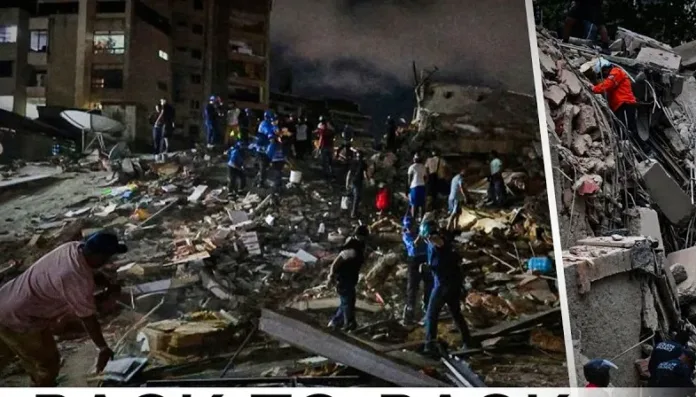

Nations across the world pledge rescue teams and aid as Venezuela battles devastation after twin earthquakes
Countries from across the globe have pledged emergency assistance to Venezuela after two devastating earthquakes struck within minutes of each other, killing at least 164 people, injuring nearly 1,000 and leaving widespread destruction across the country’s northern regions.
The powerful tremors, measuring 7.2 and 7.5 in magnitude, hit on the evening of 24 June, making them the strongest earthquakes to strike Venezuela since 1900. Buildings collapsed in Caracas and surrounding areas, while rescue workers and residents spent the night searching through shattered concrete in a desperate effort to find survivors trapped beneath the rubble. The disaster prompted the Venezuelan government to declare a state of emergency as fears remain that the death toll could continue to rise. Recent reports indicate casualties have increased in some affected areas as rescue operations continue.
International support arrived almost immediately as governments from Latin America, Europe, North America and Asia promised personnel, equipment and humanitarian assistance to reinforce Venezuela’s emergency response.
US Secretary of State Marco Rubio said Washington would launch a “whole-of-government” operation to support rescue efforts. Speaking during a visit to Bahrain, Rubio said the response would be extensive, rapid and effective, adding that the US Department of War would play a significant logistical role in delivering aid and coordinating operations.
Neighbouring countries were also quick to offer assistance. Mexico, Brazil, El Salvador, Ecuador, the Dominican Republic and Cuba all expressed solidarity with Venezuela and pledged support.
Cuba confirmed that its medical teams were already working in affected communities. Foreign Minister Bruno Rodríguez said Cuban health workers had been fully mobilised and were providing medical treatment to those injured by the earthquakes.
European nations also committed substantial resources. The Netherlands announced funding of around €2 million to deploy specialist rescue personnel, search dogs and emergency equipment. Spain and France confirmed they would send dozens of rescuers, while Germany pledged six military transport aircraft to help move supplies and personnel. Switzerland also committed emergency response teams and rescue dogs to assist with search operations.
Support extended beyond Europe and the Americas. Iran announced its readiness to provide any assistance required for rescue and relief work. Foreign ministry spokesman Esmaeil Baqaei expressed solidarity with the Venezuelan government and its people, while China also confirmed it was prepared to provide whatever help was needed.
The United Nations has begun coordinating the international response. UN humanitarian chief Tom Fletcher said specialist search-and-rescue teams were travelling to Venezuela and praised the swift offers of assistance from countries around the world.
Fletcher warned that the coming days would require an enormous international effort to support government-led rescue operations and affected communities. He stressed that sustained financial and humanitarian support would be essential as emergency teams continue searching for survivors and caring for those displaced by the disaster.
The earthquakes have struck a country already struggling with a prolonged humanitarian crisis. According to the United Nations, approximately 7.9 million people, nearly 28% of Venezuela’s population of 28.5 million, already required humanitarian assistance before the disaster. Many communities continue to face shortages of healthcare, clean water, education and reliable energy supplies.
Tommaso Della Longa, spokesman for the International Federation of Red Cross and Red Crescent Societies, said the earthquakes had placed enormous additional pressure on a system already dealing with economic hardship, flooding and public health challenges. He warned that the large number of injuries alone would overwhelm almost any healthcare system.
Aid organisations also highlighted severe funding shortages. Jan Egeland, Secretary General of the Norwegian Refugee Council, said the earthquakes had deepened the suffering of millions who were already living through an ongoing humanitarian emergency. He urged international donors to increase support without delay, noting that Venezuela’s humanitarian response plans have remained significantly underfunded for several years.
As rescue crews continue searching collapsed buildings during the critical first days after the disaster, hopes remain that more survivors can still be found. At the same time, the growing international response reflects the scale of the catastrophe and the urgent need for continued global cooperation to help Venezuela recover from one of the deadliest natural disasters in its modern history.