

The short version
- Most abandoned places in the UK are former asylums and military sites, emptied by two government decisions: closing the county asylums, and cutting the armed forces after the Cold War.
- They stay empty for years mainly because knocking them down costs more than the land is worth.
- Walking into one isn’t usually a crime in England and Wales, but damaging anything to get in is, and some sites make entry alone an offence.
- Plenty of abandoned places can be visited legally, from Tyneham in Dorset to the Cold War test site at Orford Ness.
Scroll through enough photos of abandoned places in the UK and you start to notice something odd. The pictures all look the same.
Not similar. The same. A corridor a hundred metres long with a vaulted ceiling and arched windows down one side. Peeling institutional green paint, applied to a height of about four feet, with cream above it. A water tower through a broken pane. A clock tower with the hands stopped. Cast-iron radiators. A ballroom, of all things, with a sprung floor and a stage at one end.
Photographers in Lancashire, Sussex, Surrey and Yorkshire are all shooting what appears to be the same building, because in a meaningful sense they are. Those buildings went up to a common specification, under the same legislation, for the same purpose. And they were emptied within a few decades of each other by the same policy.
Once you see that, the map of derelict Britain stops looking like decay and starts looking like administration. These places are not where things went wrong. They are where things were decided.
Most lists of abandoned places are sorted by where they are: 56 abandoned places in England, 45 abandoned places around the world, abandoned places near me. Location tells you nothing about why a building is empty. Sort them by what emptied them instead and there are only about seven causes, and they repeat everywhere.
Seven ways a place dies
Every abandoned place in this guide fits one of these.
- The institution closedCane Hill, Whittingham, Severalls
- The army leftRAF Upper Heyford, Orford Ness
- The industry diedMillennium Mills, London
- The land was takenTyneham, Imber, Capel Celyn, Varosha
- The ground turned against itHallsands, Mam Tor road, Pripyat
- The resource ran outKolmanskop, Bodie
- It was built and never filledBurj Al Babas, Turkey
Abandoned places in the UK at a glance
Sixteen of Britain’s best-known abandoned places, what emptied them and what is there now.
| Place | Where | What emptied it | Emptied | What’s there now |
|---|---|---|---|---|
| Cane Hill Hospital | Coulsdon, south London | Asylum closures | 1991 | Cane Hill Park housing, chapel and water tower kept |
| Hellingly Hospital | East Sussex | Asylum closures | 1994 | Housing estate, chapel survives |
| Whittingham Hospital | Near Preston, Lancashire | Asylum closures | 1995 | Demolished, homes being built, listed church survives |
| Severalls Hospital | Colchester, Essex | Asylum closures | 1997 | About 730 new homes, some buildings converted |
| Lennox Castle | Lennoxtown, East Dunbartonshire | Hospital closure | 2002 | Fire-gutted listed ruin |
| RAF Upper Heyford | Oxfordshire | End of the Cold War | 1994 | Heyford Park village, Cold War shelters protected |
| Orford Ness | Suffolk | End of military testing | 1987 | National Trust nature reserve |
| Royal Observer Corps posts | Across the UK | End of the Cold War | 1991 to 1995 | Many survive, most derelict |
| Millennium Mills | Silvertown, London | Closure of the Royal Docks | 1981 | Still empty, restoration planned |
| Tyneham | Dorset | Taken for army ranges | 1943 | Ruined village, open most weekends |
| Imber | Salisbury Plain, Wiltshire | Taken for army training | 1943 | Military training village, open a few days a year |
| Derwent | Derbyshire | Flooded for a reservoir | 1940s | Under Ladybower Reservoir |
| Capel Celyn | Gwynedd, Wales | Flooded for a reservoir | 1965 | Under Llyn Celyn |
| Hallsands | Devon | Storms after dredging | 1917 | Ruins, closed to the public |
| St Kilda | Outer Hebrides | Islanders chose to leave | 1930 | National Trust for Scotland, visited by boat |
| Mam Tor road | Castleton, Derbyshire | Landslips | 1979 | Broken road on a walking route |
119
county asylums built in England and Wales
1,500
or so Cold War monitoring posts dug into British fields
4,891
entries on Historic England’s 2025 Heritage at Risk Register
754,264
empty homes in England in October 2025
Why are there so many abandoned places in the UK?
Three reasons stack up behind the number of abandoned places in the UK, and they compound: Britain built huge single-purpose institutions, two government decisions emptied them, and knocking them down often costs more than the land is worth.
Built for one purpose
Britain built an enormous amount of large-scale public institutional architecture in the nineteenth and twentieth centuries: asylums, infirmaries, workhouses, barracks, airfields, mills. Buildings designed for one purpose and effectively useless for any other.
Emptied in a short window
Two government decisions emptied a great deal of it in a short window. The county asylum system was wound down from the 1960s onward and largely finished by the early 2000s. The armed forces were cut sharply after 1990, releasing a great deal of land and buildings at once.
Cheaper to do nothing
The one nobody writes about, and the one that decides whether a building stands empty for thirty years or is gone within two. Demolition costs money, and quite often it costs more than the cleared site is worth. A building is not abandoned because nobody wants it. It is abandoned because, for the person who owns it, doing nothing is cheaper than doing anything.
Everything else is detail on those three.
Why were Britain’s asylums abandoned?
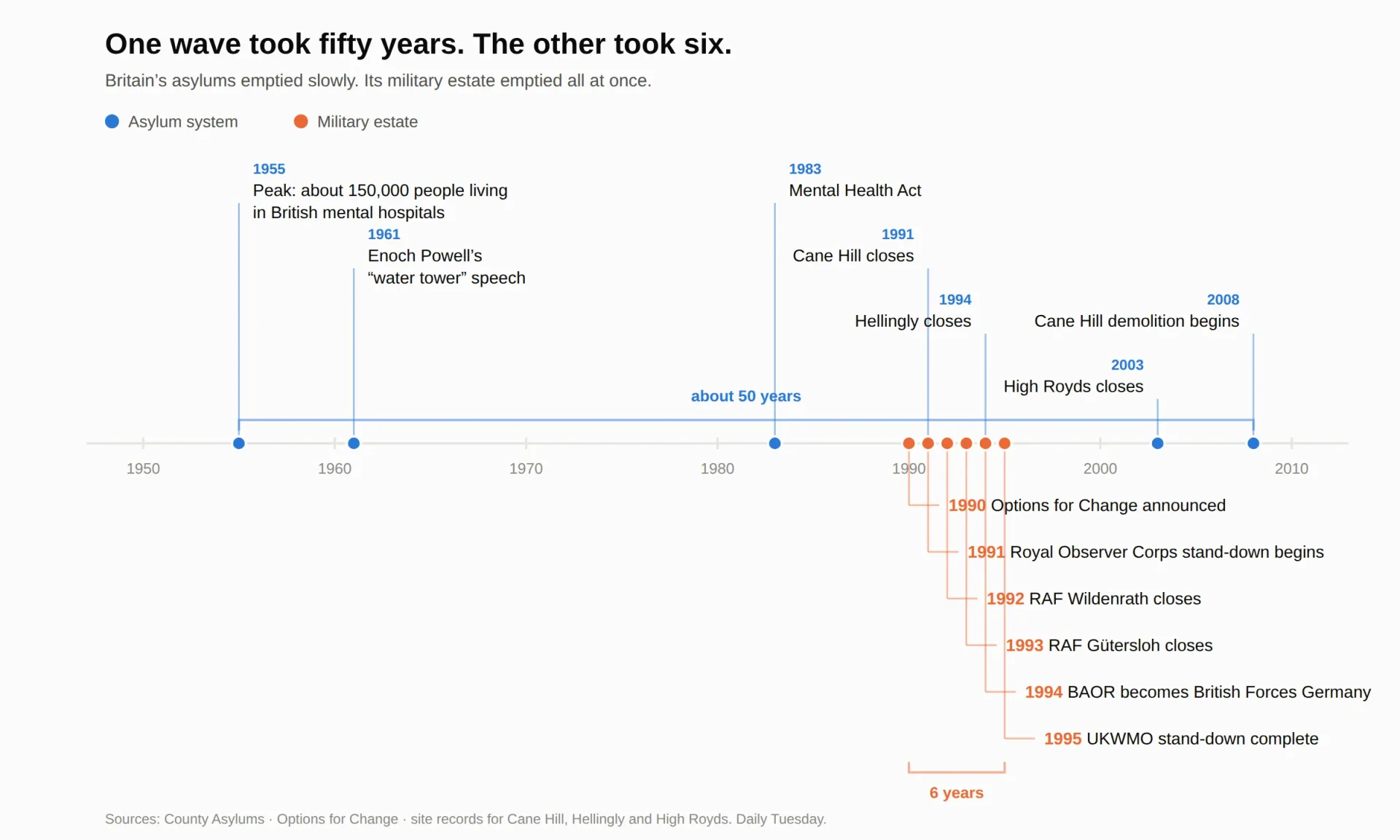
The 1961 decision to close the county asylums emptied most of the 119 built in England and Wales over the next forty years, and many then sat empty for a decade or more.
From 1845 every county in England and Wales had to provide an asylum, and around 119 county asylums were eventually built. They were sited outside towns, on large estates, with their own farms, water supplies, gasworks, chapels, mortuaries and burial grounds. They were designed to be self-sufficient, because they were designed to be permanent. By the mid-1950s more than 150,000 people were living in mental hospitals in England and Wales.
The turn came from several directions at once. Goffman, Foucault and Szasz dismantled the intellectual case for the institution. New drugs made other approaches possible. And on 9 March 1961 the Minister of Health, Enoch Powell, gave what became known as the water tower speech, describing the asylums as “isolated, majestic, imperious, brooded over by the gigantic water-tower and chimney combined”, and committing the government to closing them.
It took forty years. By the late 1980s bed numbers had more than halved, and the community care policies that followed finished the job. What that left behind was a hundred-odd enormous Victorian estates with no economic purpose and, frequently, listed status. The pattern that followed, closure, a decade or more of nothing, arson, then demolition, became the standard life cycle.
Cane Hill, Coulsdon
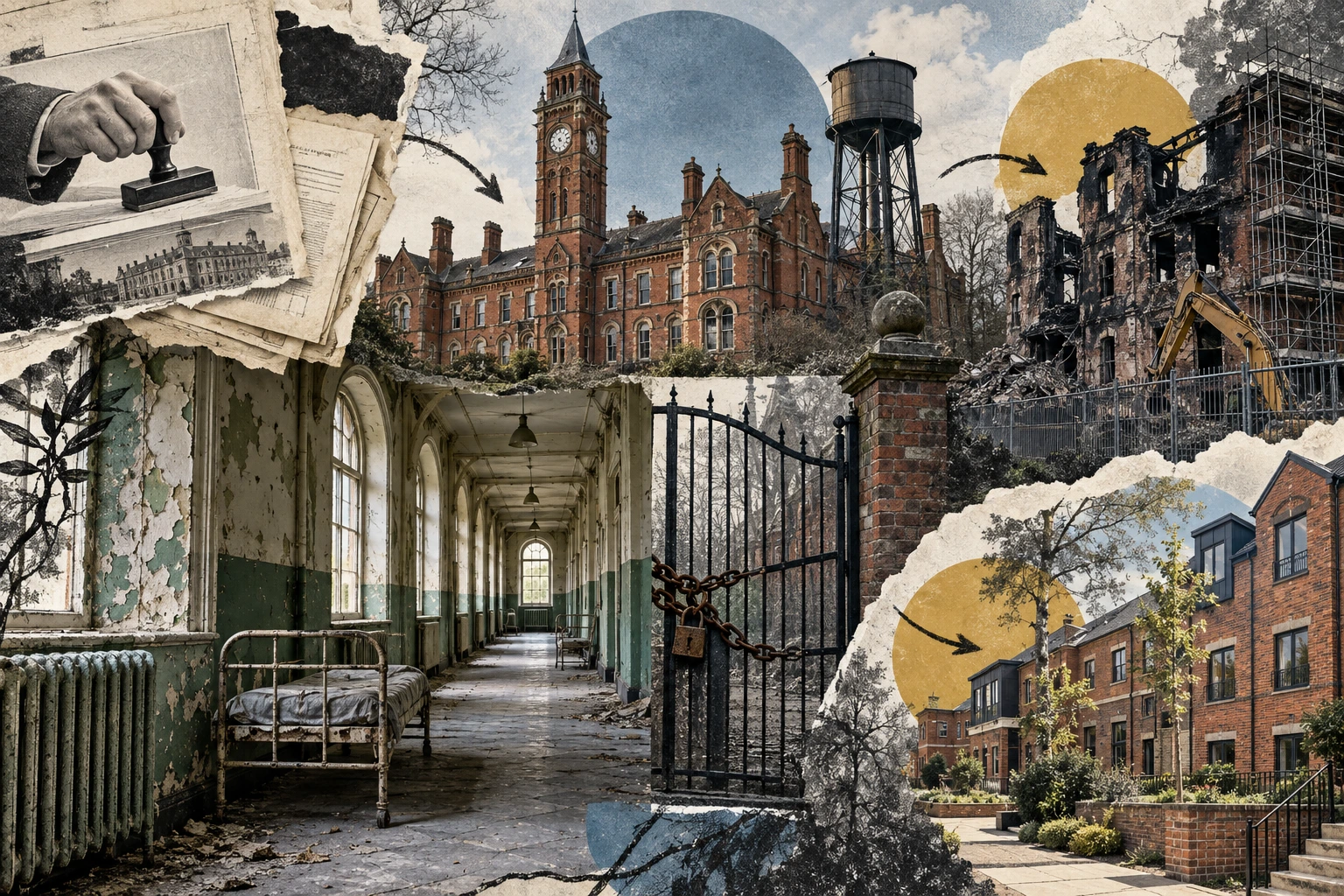
Cane Hill held around 2,500 patients at its wartime peak. The main hospital closed in March 1991 and then stood for seventeen years. Between 2000 and 2002 it was repeatedly set on fire. Demolition began in 2008, and on 13 November 2010 one last fire destroyed the clock tower and gutted the administration block. The site is now Cane Hill Park, with the chapel and water tower kept.
Hellingly, East Sussex
Housing proposals came and went, and the site sat empty for well over a decade. Arson took the main hall, the kitchen and the stores in 2008. Clearance ran from 2010 to 2013. It is a housing estate now. The chapel survived.
Whittingham, Lancashire
Opened on 1 April 1873 as the Fourth Lancashire County Lunatic Asylum, Whittingham became the largest mental hospital in Britain, with more than 3,500 patients at its wartime peak. It closed in 1995 and was demolished by 2016. The Grade II listed St John’s Church survives, and around 750 homes have consent on the grounds.
Severalls, Colchester
Opened in May 1913 as the Second Essex County Asylum, Severalls closed in stages ending in March 1997. It sat abandoned for nearly twenty years until its sale to developers in 2016. Some original buildings have since been converted and about 730 new homes built alongside. The administration building is Grade II listed.
West Park, Epsom
Planned in 1906 and delayed by the First World War, West Park took its first patients in 1921 and had room for around 2,000. It closed in 2003, stood empty for seven years, and demolition started in November 2010. The wards, water tower and administration block were kept and turned into flats.
High Royds, near Leeds
High Royds opened in 1888 as the West Riding Pauper Lunatic Asylum and closed in 2003. It is now the Chevin Park housing estate. The whole hospital complex is Grade II listed and still has its patterned terrazzo corridor floor, and the ballroom is now a residents’ lounge.
What happened to Britain’s military sites?
The defence cuts announced in July 1990 released airfields, bunkers and test sites almost at once, and few of them had any civilian use.
On 25 July 1990, with the Berlin Wall down, the Defence Secretary Tom King announced Options for Change. It cut service manpower by about 18 per cent, from 310,000 to some 255,000, and roughly halved British forces in Germany. Airfields are the hardest legacy: hundreds of acres of reinforced concrete, hangars built to a scale nothing civilian requires, contamination from decades of fuel and solvents, and frequently a location chosen precisely because it was nowhere near anything.
RAF Upper Heyford, Oxfordshire
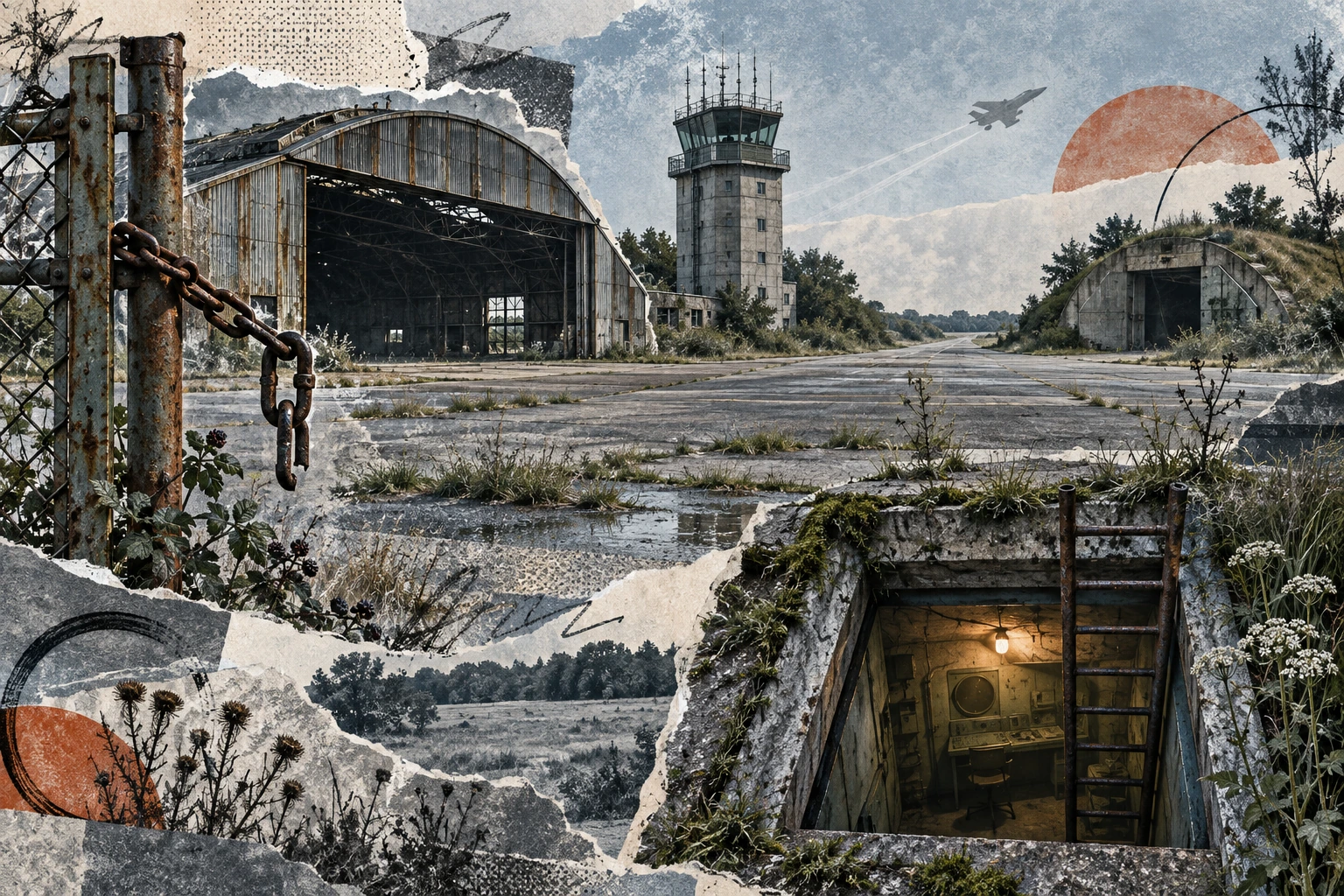
Home to the US Air Force’s F-111s from 1970, Upper Heyford saw its last aircraft leave on 7 December 1993 and went back to the Ministry of Defence in 1994. Nine hardened aircraft shelters and other Cold War structures were scheduled as monuments in 2006. About 2,500 people now live at Heyford Park, and a plan for up to 9,000 more homes has been waiting for a decision since September 2025.
Orford Ness, Suffolk
Radar experiments began here in 1935. Between 1953 and 1966 the concrete “pagodas” that still stand on the Ness were built for environmental tests on atomic bomb parts. The last service personnel left in 1987, and the National Trust now runs it as a nature reserve.
Royal Observer Corps posts
The strangest category of all. The Royal Observer Corps had to confirm a nuclear burst, pin down where it was, estimate its power and track the fallout. To do it, they built a network of small underground monitoring posts across the country, each reached by a 4.6m (15ft) shaft and a single ladder. Most volunteers were stood down on 30 September 1991 and the last on 31 December 1995. Many posts survive, most of them derelict, scattered across British fields.
Abandoned mills, factories and hospitals
Industrial buildings follow regional economics rather than national policy, and their fate depends almost entirely on where they are.
General hospitals were consolidated through the same decades into fewer, larger, newer sites, leaving Victorian infirmaries behind on valuable urban land. That is why these tend to be converted rather than left, and why they are less prominent in urbex photography. Then there is the industrial estate: mills, collieries, foundries and warehouses emptied by deindustrialisation from the 1970s onward. A mill in Manchester becomes flats. The same mill in a town with no housing pressure stays a mill-shaped hole in the ground for forty years.
Millennium Mills, Silvertown
The first mill on the site went up in 1905 and was damaged in the 1917 Silvertown explosion. Spillers replaced it in 1933 with the ten-storey Art Deco block that stands today. It fell silent when the Royal Docks closed in 1981 and has been derelict ever since, in London, a few miles from the City. Its afterlife has been mostly on screen, in films including The Last of England and Paddington 2. A £12 million government grant in January 2015 paid to strip out the asbestos, and a revised masterplan was approved in December 2025, but no date has been set to restore the mill itself.
Millennium Mills is the clearest possible demonstration that abandonment isn’t about desirability. This is prime London riverside, and it has stood empty for four decades because the cost of dealing with it has been greater than what anyone could make from it.
Abandoned villages and ghost towns in the UK
Britain doesn’t have many true ghost towns, but it does have villages that were emptied on purpose, usually because somebody needed the land.
Tyneham, Dorset
Notice came on 16 November 1943: the War Office needed the valley for firing ranges. By 19 December, 225 people had left from 102 properties. The last to leave pinned a note to the church door.
Please treat the church and houses with care; we have given up our homes where many of us lived for generations to help win the war to keep men free. We shall return one day and thank you for treating the village kindly.
Note left on the church door at Tyneham, December 1943
They never did. After the war the land was bought compulsorily and kept for the Lulworth ranges. The church and the schoolhouse now hold exhibitions about the village.
Imber, Wiltshire
On 1 November 1943 Imber’s residents, about 150 of them, were given 47 days to leave so the land could be used for military training. The Ministry of Defence still controls the village, and it opens to the public only on a handful of days a year, usually around Easter, in August and in December.
Derwent, Derbyshire
Derwent was pulled down in the early 1940s to make way for Ladybower Reservoir, which began filling in 1944 and 1945. The church spire was left standing above the water until it was blown up on 15 December 1947. In dry summers, including 1976, 2018 and 2022, the ruins have reappeared. They can be seen from the shore when the water is low, but walkers have been warned about deep mud.
Capel Celyn, Gwynedd
The Liverpool Corporation Act, passed on 1 August 1957, allowed the valley to be flooded to supply Liverpool with water. Llyn Celyn reservoir opened on 28 October 1965, drowning a village of 12 houses and farms, a chapel, a school and a post office. The “Cofiwch Dryweryn” (Remember Tryweryn) slogan, first painted near Llanrhystud in Ceredigion, has since been copied on walls across Wales.
Hallsands, Devon
Between 1897 and 1902, shingle was dredged offshore to build the Devonport Dockyard extension, leaving the village without its natural sea defence. Storms on 26 and 28 January 1917 destroyed it. The old viewing platform closed in 2024 because of erosion, and the ruins are now seen from an interpretation point at Start Point car park.
St Kilda, Outer Hebrides
The last 36 islanders voted to leave and were taken off on 29 August 1930. The islands have belonged to the National Trust for Scotland since 1957 and are the UK’s only dual World Heritage Site, for both nature and culture.
Wharram Percy, North Yorkshire
A much older ghost village. Wharram Percy was abandoned soon after 1500, and the ruined church and the outlines of its houses can still be walked today, free of charge.
Abandoned places in Scotland
Many of Scotland’s best-known abandoned places are castles and country houses, several of them roofless and on the Buildings at Risk Register.
Lennox Castle, Lennoxtown
Lennox Castle became a hospital for people with learning disabilities in 1936, with about 1,200 patients at its peak. It closed in April 2002, the castle was gutted by fire in 2008, and the rest of the site is now housing and Celtic’s training ground.
Buchanan Castle, Drymen
Built for the Duke of Montrose, Buchanan Castle was a military hospital in the Second World War, where Rudolf Hess was briefly treated in 1941. Its roof was taken off in 1954. It is Category B listed, fenced off and on the Buildings at Risk Register, so look from outside only.
Dalquharran Castle, South Ayrshire
Designed by Robert Adam and Category A listed, Dalquharran has been a roofless ruin since its roof was removed in 1970. It is privately owned and not open to visitors.
Crawford Priory, Fife
Built in 1809 and enlarged by James Gillespie Graham, Crawford Priory has been empty since 1968 and a roofless ruin since a fire in July 1995. The Buildings at Risk Register rates its risk as high.
Why don’t these buildings just get demolished?
Most abandoned places in the UK are still standing for one reason, and it is money: demolition often costs more than the cleared land is worth.
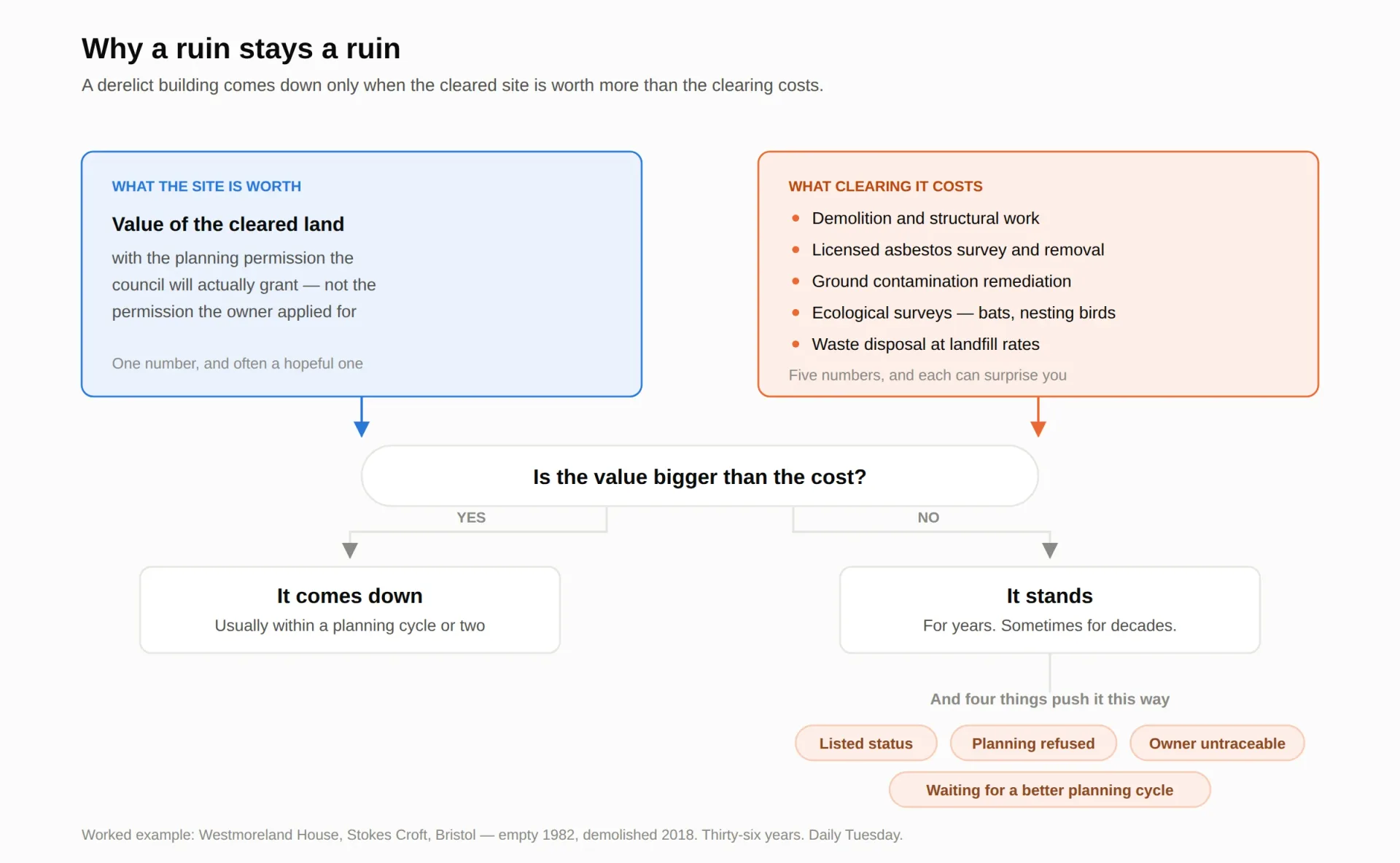
What knocking down a big old building really costs
For a large institutional building, demolition is very expensive, and the costs are front-loaded and unpredictable:
- Asbestos surveys and licensed removal
- Structural work
- Waste disposal at landfill rates
- Cleaning up contaminated ground
- Ecological surveys for bats and nesting birds
Set against that is whatever the cleared land is worth, minus whatever planning permission the council will actually grant. When that number is smaller, nothing happens. Not out of neglect, but as a rational decision, made every year, by an owner who would lose money by acting.
Then layer on the complications. Listed status blocks clearance and forces expensive sympathetic restoration instead. Councils refuse schemes the owner wants and approve schemes the owner cannot finance. Ownership changes hands between developers who each hope the next planning cycle will be kinder. And in some cases the owner simply cannot be identified.
Westmoreland House on Stokes Croft in Bristol is the perfect specimen. It was the headquarters of Regional Pools Promotions and stood empty from 1982, when the firm couldn’t pay a £250,000 tax bill. Scheme after scheme failed, including a regional development agency plan dropped after budget cuts in 2009. Demolition was delayed again by asbestos in the summer of 2018, and the machines finally went in on 21 November 2018. Thirty-six years, in the middle of a city, on a main road. Nobody forgot about Westmoreland House. It stood because every individual decision about it was rational and none of them added up to anything.
The same logic keeps a long list of historic buildings in limbo: Historic England’s 2025 Heritage at Risk Register has 4,891 entries.
Not every abandoned place in the UK ends as a ruin, and the good conversions are invisible precisely because they worked. The ones that get saved, like High Royds, tend to be close enough to a city for the flats to sell, intact enough that conversion beats demolition on cost, and listed enough to make anyone try. Cane Hill had two of those three. Hellingly had one. The margin between a ruin and a conversion is usually not architectural merit. It’s a postcode.
Which abandoned places in the UK can you visit legally?
Quite a few, and they are often better than the ones people break into. Check opening times before you travel, because military land in particular can close at short notice.
Ghost village
Tyneham, Dorset
Most weekends and public holidays, every day in the summer holidays and over Christmas, 9am to dusk
Ruined cottages, the church and the schoolhouse, inside the Lulworth ranges. Range information line 01929 404714.
Ghost village
Imber, Wiltshire
A few open days a year, usually around Easter, in August and in December
The evacuated village on Salisbury Plain, still used for military training.
Cold War test site
Orford Ness, Suffolk
National Trust ferry from Orford Quay on selected days, May to September, booked ahead
The atomic test “pagodas” and a shingle spit nature reserve.
Cold War bunker
Hack Green, Cheshire
Wednesday to Sunday, 10am to 4pm, plus Mondays and Tuesdays in school and bank holidays
A former radar station turned regional government nuclear bunker, now a museum.
Cold War bunker
Kelvedon Hatch, Essex
Daily from 1 March to 31 October, Thursday to Sunday from November to February
A 1950s RAF operations centre under a farm, later a regional government headquarters.
Medieval ghost village
Wharram Percy, North Yorkshire
Free, any reasonable time in daylight
A three-quarter-mile walk from the car park, steep and muddy in places.
Abandoned road
Mam Tor road, Derbyshire
Any time, on foot
The A625 was closed for good in 1979 after repeated landslips. The broken tarmac is now part of a circular walk.
Abandoned island
St Kilda, Outer Hebrides
Boat trips in season, with Trust staff on the island from April to October
Crossings from the Western Isles take three to six hours each way, weather permitting.
What is urbex?
Urban exploration, usually shortened to urbex, means visiting derelict or disused structures: hospitals, factories, tunnels, bunkers, drains.
It is mostly a photographic hobby with a strongly held ethic: take nothing but pictures, leave nothing but footprints. That ethic matters more than it sounds. For buildings that have since been demolished, photographs taken by explorers are sometimes among the few records of what the interiors looked like. The urbex community is an accidental archive. The legal position, though, is more complicated than most explorers assume.
Is it illegal to explore abandoned places in the UK?
Not usually in England and Wales, but it becomes a crime the moment you damage anything, go onto a railway or enter a protected site.
In England and Wales, simply being on someone’s land or in their building without permission is usually trespass, which is a civil wrong rather than a crime. That is the sentence urban explorers quote, and it is true as far as it goes. The owner’s remedy is through the civil courts, and police usually won’t act on trespass alone. It stops being true quickly.
| What you do | Crime? | The law | Maximum penalty |
|---|---|---|---|
| Walk into an empty building without permission | No, usually civil | Civil law of trespass | The owner can get a court order to remove you |
| Force a door, cut a fence or break a window | Yes | Criminal Damage Act 1971 | 3 months and/or a £2,500 fine for damage up to £5,000, up to 10 years above that |
| Go in intending to damage the building | Yes, burglary | Theft Act 1968, section 9 | 10 years, or 14 for a home |
| Walk onto a working railway | Yes | British Transport Commission Act 1949, section 55 | £1,000 fine |
| Disrupt or obstruct people working there | Yes, aggravated trespass | Criminal Justice and Public Order Act 1994, section 68 | 3 months and/or a £2,500 fine |
| Enter a nuclear site or designated government site | Yes, entry alone | Serious Organised Crime and Police Act 2005, section 128 | 6 months and/or an unlimited fine |
| Enter a military base or other prohibited place | Yes, if you know or ought to know you can’t | National Security Act 2023, section 5 | 6 months and/or a fine |
| Live in an empty house you got into as a trespasser | Yes, squatting | LASPO Act 2012, section 144 | 6 months and/or an unlimited fine |
In Scotland the rules are different
- Trespass on its own generally isn’t a crime in Scotland either, but the Trespass (Scotland) Act 1865 makes it an offence to lodge in premises or camp on private land without consent, with a fine of up to £200.
- Scotland’s right to roam doesn’t cover buildings or structures, so the Land Reform (Scotland) Act 2003 gives you no right to go inside an abandoned building.
- Damaging property to get in is the crime of vandalism, and Scotland has no squatting offence like England’s.
Then there is the part the law doesn’t cover. Derelict institutional buildings contain asbestos in quantity, floors that have been taking water for twenty years, unguarded lift shafts and no lighting. The arson at Cane Hill and Hellingly did not leave the surviving structures safer. People are seriously injured doing this, and a rescue from a collapsed asylum floor is a difficult job for the people who have to do it.
Can you live in or claim an abandoned house in the UK?
Living in one is a crime in England and Wales, and claiming one through adverse possession rarely works, because the owner can block it simply by objecting.
Section 144 of the Legal Aid, Sentencing and Punishment of Offenders Act 2012 came into force on 1 September 2012 and made it a crime to squat in a residential building in England and Wales. The prosecution has to show that the person entered as a trespasser, knows or ought to know they are trespassing, and is living there or intends to. Being present is not enough on its own. Conviction can bring up to six months in prison, an unlimited fine, or both, and police can arrest without a warrant. It covers buildings designed or adapted for living in, not commercial or industrial premises, and it excludes former tenants who stay on after their agreement ends.
How adverse possession works on registered land
- You need ten years of adverse possession. On unregistered land, the old rule of 12 years under the Limitation Act 1980 still applies.
- You then apply to HM Land Registry, under the Land Registration Act 2002.
- The registered owner, and any mortgage lender, is told and has 65 working days to object.
- If they object, the application fails unless one of three narrow exceptions applies, and the only realistic one is a reasonable mistake about a boundary.
- If they object but still don’t remove you within two more years, a second application will normally succeed.
This is adverse possession, and it is far harder than its reputation suggests. In practice it mostly succeeds in disputes about where a garden fence sits, not in claims over abandoned buildings, and any owner who is paying attention can stop it with a letter. Living in an abandoned house to build up those ten years is itself the squatting offence, although the Court of Appeal ruled in Best v Chief Land Registrar in 2015 that the offence doesn’t automatically stop the time counting. It is a narrow point, and not a strategy. In Scotland there is no equivalent at all: a squatter without a deed can never gain ownership.
How do you find abandoned places in the UK?
To see one, start with the places that open to the public and the official heritage registers. To buy one, start with HM Land Registry.
To see one
Start with the places above that open to the public. Historic England’s Heritage at Risk Register is searchable by area. Scotland’s Buildings at Risk Register is no longer updated, but you can still search it.
To buy one
There are legitimate routes, and they are more productive than walking around looking. HM Land Registry will tell you who owns a given title for a small fee, which is the first step for anything. Many councils have an empty homes officer whose job is bringing long-term vacant property back into use. Property auctions are where repossessed, probate and problem buildings are actually sold. And local planning portals show which derelict sites have live applications, which tells you who is already circling.
The scale is larger than most people assume. In October 2025 there were 754,264 empty homes in England, and 303,185 of them had been empty for more than six months.
Beyond Britain: the world’s most famous abandoned places
The same seven causes repeat everywhere. These are the best-known examples of the ones Britain has few of.
Swipe to see all eight
The ground turned against it
Pripyat, Ukraine
Built from 1970 for Chernobyl plant workers, Pripyat had almost 50,000 residents when it was evacuated on the afternoon of 27 April 1986, the day after the explosion. The exclusion zone has been closed to tourists since February 2022.
The ground turned against it
Centralia, Pennsylvania
A coal seam fire has burned under the town since May 1962. Putting it out was estimated at $663 million in 1983, so Congress found $42 million to buy residents out instead. Five people were counted there in 2020.
The ground turned against it
Wittenoom, Western Australia
Blue asbestos was mined here until 1966, and more than 2,000 former workers and residents have since died of asbestos-related disease. The town was taken off official maps in 2007 and demolished from May 2023. The contaminated area remains off limits.
The land was taken
Varosha, Cyprus
Famagusta’s fashionable resort district was fenced off after Turkish troops took it in August 1974 and stayed sealed for 46 years. Since October 2020 visitors have been allowed onto the beachfront and some streets, but most of it is still closed.
The land was taken
Oradour-sur-Glane, France
On 10 June 1944, SS troops killed 643 people here, about 205 of them children. The ruins were kept exactly as they were found and a new village was built beside them. It is the one place in this guide that was left empty deliberately, as a memorial.
The resource ran out
Kolmanskop, Namibia
The town grew up after a diamond was found in 1908, then emptied after richer deposits turned up about 270km south. It was abandoned in 1956, sand now fills its houses, and it is open for guided tours.
The resource ran out
Bodie, California
A gold rush town with about 8,000 people at its peak, Bodie was being called a ghost town by 1915 and mining ended in 1942. It is now a State Historic Park, kept in what the park calls “arrested decay”.
Built and never filled
Burj Al Babas, Turkey
Work on 732 château-style villas near Mudurnu began in 2014. The developer was declared bankrupt in 2018 with 587 villas part-built, and as of mid-2026 none had been finished or lived in.
What happens to Britain’s abandoned places now?
Housing pressure is turning more of them into homes, so the derelict ones are disappearing.
Sites that made no financial sense to convert in 1995 make sense now, and permitted development rights have made some changes of use easier. Most of the famous asylums are gone or going. Which gives the photography a function nobody intended. When a building has been demolished, an unauthorised photograph is not a lesser record than an authorised one. Sometimes it’s the only one.
The buildings were a map of what the state decided to stop doing. The photographs are what’s left of the map.
Key takeaways
- Abandoned places in the UK cluster around two policy decisions: closing the county asylums from 1961, and cutting the armed forces after July 1990.
- Around 119 county asylums were built in England and Wales, and more than 150,000 people lived in mental hospitals at the mid-1950s peak.
- Buildings stay derelict because demolition, asbestos and planning often make doing nothing cheaper than doing anything. Westmoreland House in Bristol stood empty for 36 years.
- You can visit plenty of abandoned places legally, including Tyneham, Imber, Orford Ness, Wharram Percy and two Cold War bunkers.
- In England and Wales simple trespass is civil, but criminal damage, railway trespass, aggravated trespass and protected sites are crimes, and squatting in a home has been a crime since September 2012.
- There were 754,264 empty homes in England in October 2025.
Abandoned places UK: FAQs
Is it illegal to explore abandoned buildings in the UK?
Not usually in England and Wales, where simple trespass is a civil matter. It becomes a crime if you damage anything to get in, go onto a working railway, enter a protected or military site, or disrupt people working there.
Which abandoned places in the UK can you visit?
Tyneham in Dorset, Imber on its open days, Orford Ness by National Trust ferry, Wharram Percy, the old Mam Tor road, St Kilda, and the Cold War bunkers at Hack Green and Kelvedon Hatch.
Are there any abandoned villages in the UK?
Yes. Tyneham in Dorset and Imber in Wiltshire were emptied for army training in 1943, Derwent and Capel Celyn were flooded for reservoirs, and St Kilda’s islanders left in 1930.
What is urbex?
Urban exploration: visiting and photographing derelict or disused buildings. The community’s rule is to take nothing and leave nothing.
Can you claim an abandoned house in the UK?
Rarely. On registered land you need ten years’ adverse possession before applying, and the owner can block the claim by objecting. Living there to build up the time is also the crime of squatting.
Why do so many abandoned asylums burn down?
Empty Victorian buildings with no security and open access are very vulnerable to arson. Cane Hill and Hellingly both had major fires while waiting for a decision on their future.
Are the old nuclear monitoring bunkers still there?
Many are. About 1,500 Royal Observer Corps posts were built, the corps was stood down between 1991 and 1995, and many posts were simply left, most of them now derelict.
How many empty homes are there in England?
754,264 in October 2025, of which 303,185 had been empty for more than six months.
What is the most famous abandoned place in the world?
Pripyat in Ukraine, evacuated after the Chernobyl disaster in 1986, is one of the best known. Its exclusion zone has been closed to tourists since 2022.