
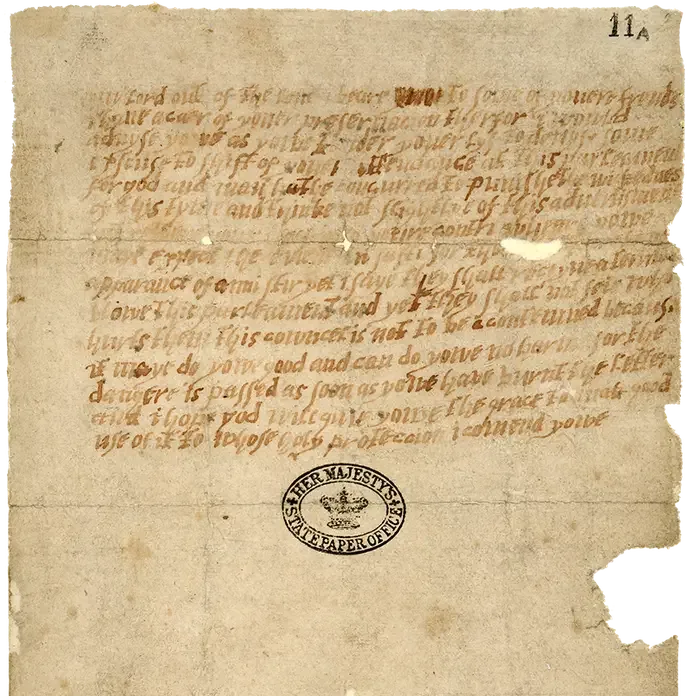

FILE NO. 1605: THE MONTEAGLE LETTER
Quick look
Unsolved
- RealThe Monteagle letter is an anonymous warning that reached Lord Monteagle at his house in Hoxton on 26 October 1605. The National Archives still holds it.
- RealIt is why the Gunpowder Plot failed. Monteagle handed it to the government, and Guy Fawkes was caught beneath the House of Lords on the night of 4 November.
- SuspectFrancis Tresham, a plotter and Monteagle’s brother-in-law, is the writer UK Parliament’s history of the plot thinks most likely. He denied it, and died in the Tower that December.
- UnprovenThe other theories, that Monteagle wrote it himself or that the government planted it, have never been proved either.
On the evening of 26 October 1605, a stranger handed one of Lord Monteagle’s servants a letter, and it reached Monteagle at supper in his house in Hoxton. It had no signature and no date, and the handwriting was disguised. It told him to stay away from the opening of Parliament. That note, now known as the Monteagle letter, is the reason the Gunpowder Plot failed.
Just over a week later, around midnight on 4 November, the King’s men found Guy Fawkes in the vaults beneath the House of Lords with 36 barrels of gunpowder. Every Bonfire Night since has marked a plot that collapsed because somebody talked. But who wrote the Monteagle letter has never been proved.
So who betrayed Guy Fawkes? We opened the file. Going back to The National Archives, UK Parliament’s own history of the plot and Historic Royal Palaces, we found a prime suspect who died in the Tower, a lord who was rewarded for passing the letter on, a theory that the government planted it, and two old books that each claimed to have solved it.
Exhibit A
What was the Monteagle letter?
RealAn unsigned warning telling Lord Monteagle to skip the opening of Parliament, because it would receive “a terrible blow”.
The letter runs to about 160 words, with no signature, no date and disguised handwriting, History Hit says. It told Monteagle to find an excuse not to attend Parliament, to retire to his country estate, and to burn the letter once he had read it, according to The National Archives.
“…they shall receive a terrible blow this parliament and yet they shall not see who hurts them.”
The Monteagle letter, 1605, as quoted by Historic Royal Palaces
Monteagle didn’t burn it. He took it straight to Robert Cecil, Earl of Salisbury, the King’s most important minister, UK Parliament says.
Exhibit B
Why did the Gunpowder Plot fail?
RealBecause someone leaked it. The Monteagle letter warned the government ten days before Parliament was due to open on 5 November.
- 26 Oct
The letter reaches Lord Monteagle at supper in Hoxton. He takes it to Robert Cecil.
- 1 Nov
King James sees the letter. The plotters confront Francis Tresham, who denies writing it.
- 4 Nov
A first search of the vaults finds a pile of firewood and a man calling himself John Johnson.
- 5 Nov
A second search, around midnight, finds him again with fuses and matches. He is Guy Fawkes.
The plotters knew about the letter before any of this. They decided to go ahead anyway, trusting that their explosives expert, Fawkes, was unknown to the authorities, The National Archives says.
The government didn’t raid the vaults the moment the letter arrived. King James agreed to try to catch the conspirators in the act, The National Archives says. The first search found Fawkes, calling himself John Johnson, guarding wood he said belonged to his master, the plotter Thomas Percy, according to Royal Museums Greenwich. He was only arrested on the second search.
Another British legend that’s harder to pin down than it looksSawney Bean: the cannibal clan that may never have existedExhibit C
Who wrote the Monteagle letter?
UnsolvedNobody knows. Francis Tresham is the usual suspect, but it has never been proved, and there are several other answers.
UK Parliament’s history of the plot says the author is unknown and names Tresham as the most likely candidate. Here is the line-up.
Suspect 1
Francis Tresham
Why him: He was Monteagle’s brother-in-law, and the plotters only told him about the plan in October 1605 because they doubted they could trust him. Robert Catesby and Thomas Winter suspected him of the leak.
But: He denied it. In the Tower he signed statements insisting he had opposed the plot, yet never mentioned the letter, which History Hit finds odd if he wrote it.
Suspect 2
Lord Monteagle
Why him: A Catholic with a record. He had taken part in the Earl of Essex’s failed rebellion and was friends with several of the plotters. A warning he could hand to the government was a way to prove his loyalty, History Hit suggests.
But: History Hit calls this conjecture, and nobody has produced evidence for it.
Suspect 3
Robert Cecil
Why him: The letter went straight to him. One theory is that Cecil already knew of the plot and had someone write the letter, so he could expose it without revealing his sources.
But: It rests on suspicion. History Hit calls this conjecture too.
Suspect 4
Thomas Winter
Why him: A plotter who was well known in Monteagle’s household, which is why UK Parliament says his name has also been linked to the letter.
But: He was one of the two plotters who accused Tresham of the leak.
Long shots
Two old books
In 1902, solicitor Henry Hawkes Spink published a book claiming to prove the author “with moral certitude”: plotter Christopher Wright, with Monteagle’s servant Thomas Ward passing it on and the Jesuit priest Edward Oldcorne writing it.
A 1916 book named William Vavasour, Tresham’s serving man, as the writer, and Tresham as the sender.
Thomas Winter is also spelled Wintour in some records, including The National Archives’ copy of his confession.
Exhibit D
Who betrayed Guy Fawkes?
UnsolvedWhoever wrote the Monteagle letter. The most likely name is Francis Tresham, but it has never been proved.
The betrayal ran both ways. Under questioning in the Tower of London, Fawkes held out for several days before naming his fellow plotters, Historic Royal Palaces says. One of the names he gave was Tresham’s, and Tresham was arrested on 12 November, UK Parliament says.
Tresham later claimed he had tried to stop the plot and had been planning to leave the country. He died in the Tower of a natural illness on 23 December 1605, weeks before the surviving plotters were tried in Westminster Hall.
Exhibit E
Was the Gunpowder Plot a set-up?
UnprovenThere’s no proof it was. But the way the government handled the letter has kept the theory alive.
Why some suspect it
The waitKing James saw the letter on 1 November, but the vaults weren’t searched until 4 November.
The first searchIt found a man guarding a pile of firewood. He was only arrested on the second.
The planThe King agreed to try to catch the plotters in the act, The National Archives says.
Why it may not be
The suspectUK Parliament still names Tresham, one of the plotters, as the most likely writer.
The plottersCatesby and Winter suspected Tresham at the time, not the government.
The evidenceHistory Hit calls the planted letter theory conjecture.
A planted letter would certainly have suited the government. UK Parliament notes that some have argued it came from someone in or connected to the government, possibly Cecil himself, which would have turned the discovery into a major propaganda win. Whether that’s what happened has never been settled. For why theories like this stick around, read why intelligent people believe conspiracy theories.
Exhibit F
Who was Lord Monteagle?
RealWilliam Parker, 4th Baron Monteagle, a Catholic peer who was married to Francis Tresham’s sister and lived in Hoxton.
Monteagle came from a Catholic family, but his allegiance under James I was “somewhat equivocal”, Sean Gubbins writes in The Hackney Terrier, the Hackney History Society’s journal. His wife Elizabeth was the daughter of Sir Thomas Tresham and the sister of Francis.
Passing on the letter paid off. He was rewarded with £500 and lands worth £200, the journal says.
Exhibit G
Where is the Monteagle letter now?
RealAt The National Archives in Kew, catalogued as SP 14/216/2.
The National Archives has published its full text online, in the original spelling and in modern English. The original spelling takes some reading, with words such as “preservacion”.
You can also stand where it arrived. A plaque on Hoxton Street, opposite Falkirk Street, marks the site of Monteagle’s house, according to The Hackney Terrier.
Exhibit H
What does the Monteagle letter have to do with Bonfire Night?
RealBonfire Night marks the plot’s failure, and the letter is why it failed.
In the months after the plot, Parliament passed the Observance of 5th November Act, which made a yearly thanksgiving compulsory, with church attendance required that day, Royal Museums Greenwich says. The first Gunpowder Treason Day was marked in November 1606, The National Archives says. Today’s bonfires and fireworks grew out of that tradition, according to Royal Museums Greenwich.
The plot still shapes the State Opening of Parliament, too. Before the monarch arrives, the Yeomen of the Guard search the cellars of the Palace of Westminster, a ceremony that commemorates the plot, UK Parliament says.
So when the fireworks go up on 5 November, they’re celebrating a leak. We just don’t know whose.
The verdict
What’s proven about the Monteagle letter, and what isn’t
| The claim | Verdict |
|---|---|
| The Monteagle letter is realHeld at The National Archives | Real |
| It stopped the Gunpowder PlotThe vaults were searched after the King saw it | Real |
| Francis Tresham wrote itUK Parliament’s most likely candidate | Unproven |
| Lord Monteagle wrote it himselfCalled conjecture by History Hit | Unproven |
| The government planted itCalled conjecture by History Hit | Unproven |
| Guy Fawkes wrote itNot named as a suspect in any source we checked | No evidence |
Monteagle letter FAQs
When was the Monteagle letter delivered?
On 26 October 1605, at Lord Monteagle’s house in Hoxton, ten days before Parliament was due to open on 5 November.
What did the Monteagle letter say?
It warned Lord Monteagle to make an excuse to miss the opening of Parliament, which would receive “a terrible blow”, and told him to burn the letter.
Was the Monteagle letter signed?
No. It was unsigned and undated, and the handwriting was disguised.
Did Guy Fawkes write the Monteagle letter?
None of the sources we checked names him as a suspect. Fawkes was the plotter guarding the gunpowder, and the letter led to his arrest.
Who was the Monteagle letter sent to?
William Parker, 4th Baron Monteagle, a Catholic peer and the brother-in-law of the plotter Francis Tresham.
What happened to Francis Tresham?
He was arrested on 12 November 1605 and died of a natural illness in the Tower of London on 23 December, before the surviving plotters were tried.
Can you see the Monteagle letter?
The original is held by The National Archives in Kew, as SP 14/216/2, and its full text is published on The National Archives website.
Sources we checked
- The Monteagle Letter, The National Archives
- The Gunpowder Plot teaching resource, The National Archives
- Discovery and flight, UK Parliament
- Francis Tresham, UK Parliament
- State Opening: elements unseen by the public, UK Parliament
- Guy Fawkes and the Gunpowder Plot, Historic Royal Palaces
- What was the Gunpowder Plot?, Royal Museums Greenwich
- What Was the Monteagle Letter’s Role in the Gunpowder Plot’s Downfall?, History Hit, 6 November 2023
- 1605 Hoxton: Non-Conforming Catholics and the Gunpowder Plot, Sean Gubbins, The Hackney Terrier, Autumn 2025
- The Gunpowder Plot and Lord Mounteagle’s Letter, Henry Hawkes Spink, 1902 (Project Gutenberg)
- The Identification of the Writer of the Anonymous Letter to Lord Monteagle in 1605, 1916 (Project Gutenberg)
Last checked: 2 November 2026.