

What happens when you die is the one question every person who has ever lived will eventually answer, and yet it remains the mystery we understand the least. For most of human history the answer belonged to religion and folklore alone.
Today, thanks to intensive-care medicine, brain scanning and the testimony of people revived from the very edge, science can finally describe a surprising amount of what happens when you die.
The picture that emerges is stranger, and in some ways more comforting, than you might expect. Death is not a sudden switch that flicks off, but a process that unfolds in stages, and your brain may perform one last extraordinary act on the way out.
Key takeaways
Here is the short version of what happens when you die, before we explore each stage in depth.
- Death is a process, not a single moment. The heart stopping is only the beginning; the body’s cells shut down gradually over minutes, hours and days.
- Your brain may surge rather than simply fade. Researchers have recorded bursts of high-frequency activity in the dying brain, in the same patterns linked to memory and conscious experience.
- Hearing appears to be the last sense to go, so a dying person may still register familiar voices even when they can no longer respond.
- The famous tunnel and bright light have plausible biological explanations rooted in an oxygen-starved brain.
- Science can map the shutdown in remarkable detail, but the question of what, if anything, comes next still lies beyond its reach.
What happens to your body the moment you die?
What happens when you die comes down, above all, to oxygen. In the vast majority of deaths the heart ceases to pump, blood pressure collapses, and within about ten to twenty seconds the brain, starved of the oxygen it craves more than any other organ, slips into unconsciousness. You would not feel this happen. By the time the brain loses power, the capacity to feel anything at all is already switching off.
Doctors draw a crucial distinction here between clinical death and biological death. Clinical death is the point at which the heartbeat and breathing stop, and for a few precious minutes it can sometimes be reversed, which is exactly what CPR and defibrillators are racing to do. Biological death is different and final. Once brain cells have been without oxygen for roughly four to six minutes, they begin to suffer damage that cannot be undone, and the window for revival quietly closes.
This is why those first minutes matter so enormously, and why the boundary between life and death is less a wall than a narrowing corridor.
Does your brain stay active after you die?
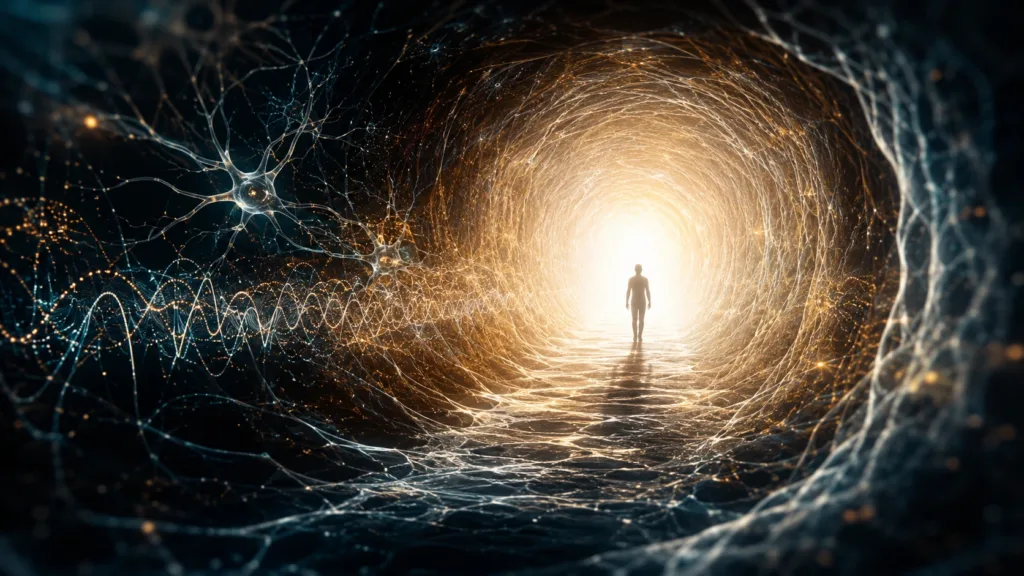
Perhaps the most astonishing recent discovery about what happens when you die is that the brain does not necessarily go quiet. Instead, in its final moments it can erupt into a burst of highly organised electrical activity. In a widely reported 2022 case study, scientists were recording the brain of an 87-year-old man being treated for a seizure when he unexpectedly suffered a fatal heart attack.
For the first time, they captured a human brain in the act of dying, and what they saw was remarkable: a surge of gamma waves, the same high-frequency rhythms associated with concentration, dreaming and memory recall.
That single case echoed earlier work at the University of Michigan, where researchers found that dying rats produced a similar flare of gamma activity after their hearts stopped, and a later 2023 study that observed comparable surges in dying human patients. This reframes what happens when you die at the level of the mind.
The tantalising implication is that the phrase “your life flashes before your eyes” might not be pure poetry. As oxygen drains away, the brain may replay a cascade of memories in a final, vivid rush. The science is still young and the findings hard to interpret, since no one in these studies could report back on the experience.
Even so, the evidence points towards something few of us expected: the possibility that the dying brain is not fading into darkness but blazing, briefly, into life. You can read more about this research from Michigan Medicine’s account of the dying brain.
What does dying actually feel like?
When it comes to what happens when you die in terms of raw sensation, there is real reassurance to be found, because the physical act of dying is, for most people, not thought to be painful. As the body shuts down it releases a flood of endorphins, its own natural painkillers, and consciousness usually recedes gently rather than snapping shut.
Doctors and hospice nurses who sit with the dying often describe the final hours as a slow drifting away, closer to falling asleep than to any dramatic struggle. Pain, where it exists, tends to come from the illness or injury that causes death rather than from death itself, which is why palliative care can do so much to ease the passage.
There is also a curious and tender phenomenon known as terminal lucidity, or the end-of-life rally, in which a person who has been confused, unresponsive or barely conscious suddenly becomes clear, alert and able to speak with loved ones, sometimes only hours before the end. Alongside this, research suggests that hearing may be the very last sense to fade.
A 2020 study monitored the brain responses of dying patients and found that they continued to react to sound even in their final unresponsive hours. The practical message is a moving one. If you are ever sitting with someone as they die, it is worth speaking gently to them, because they may still be listening long after they can no longer answer.
Why do people see tunnels and bright lights?
The tunnel, the brilliant light, the feeling of floating above your own body: these near-death experiences are among the most haunting parts of what happens when you die, reported so consistently across cultures and continents that they demand an explanation. Science offers several, and they all point back to a brain under extreme stress.
As blood drains from the eyes, vision typically fails from the edges inwards, which may create the classic sensation of a darkening tunnel with a bright centre. Meanwhile, an oxygen-starved visual cortex can fire off flashes of light, and disruption to a region called the temporoparietal junction, which helps stitch together our sense of where our body is in space, may explain the eerie feeling of leaving it altogether.
There is intriguing research here too. The AWARE study, led by resuscitation expert Dr Sam Parnia, documented cases in which patients reported awareness and even accurate observations during the period when their hearts had stopped. Some scientists suspect a role for naturally occurring chemicals released under extreme stress, which may flood the brain in its final moments.
None of this proves that a near-death experience is a glimpse of somewhere else, but nor does it dismiss how profoundly real these experiences feel to the people who have them. What it does show is that part of what happens when you die can include experiences of startling intensity and beauty, generated by the dying brain itself.
What happens to your body in the days after you die?
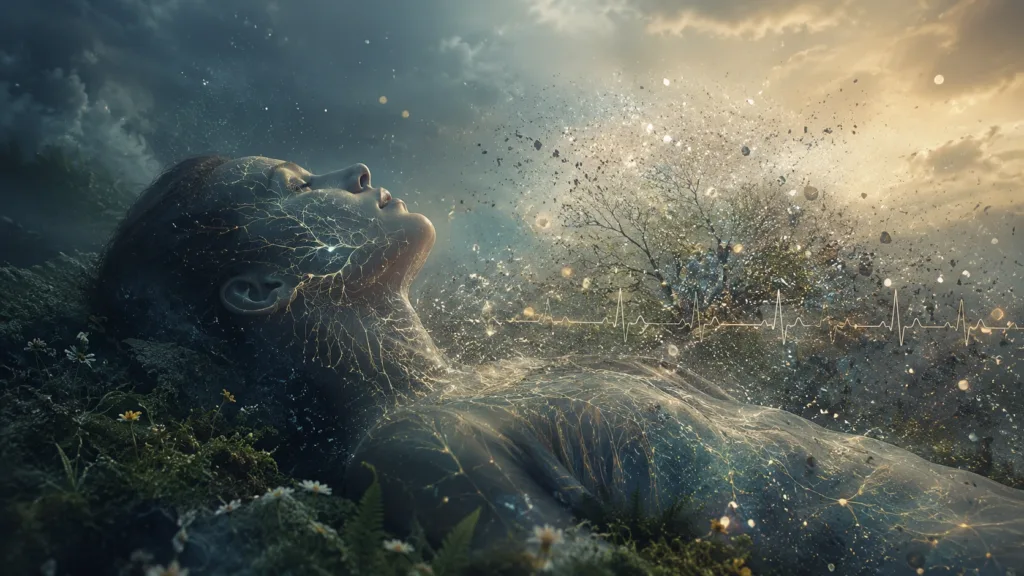
Much of what happens when you die physically only unfolds once biological death is complete, as the body begins a series of well-understood changes. Within minutes the skin pales as circulation stops, a change known as pallor mortis. The body then starts to cool towards room temperature, roughly a degree or so each hour, in a process called algor mortis, long used by pathologists to estimate a time of death. Gravity draws the settled blood downwards, pooling it into purplish patches on the lowest parts of the body, which is termed livor mortis.
Between around two and six hours after death, the muscles begin to stiffen into the familiar rigor mortis, reaching their most rigid at roughly twelve hours before gradually relaxing again over the following day or two. Beyond this, the body’s own enzymes and bacteria begin the slower work of decomposition.
It is not a comfortable subject to dwell on, but there is something quietly profound in it: the same natural processes that built and sustained the body eventually return it, atom by atom, to the world it came from. For anything you might be wondering about on the practical rather than the biological side, such as what happens to your pension when you die, that is a separate matter we cover elsewhere.
Is there scientific evidence of life after death?
This is where honesty about what happens when you die matters most. There is currently no scientific evidence that consciousness survives the death of the brain. Everything researchers have measured, from the gamma surge to near-death experiences, can so far be explained as the product of a brain in its final extremity rather than proof of a soul departing. What remains genuinely unresolved is the deeper riddle that philosophers call the hard problem of consciousness: science still cannot fully explain how the electrical chatter of neurons gives rise to the felt experience of being you in the first place, which leaves the ultimate question tantalisingly open.
It is worth being clear and respectful about the limits here. Science can tell us, in growing detail, what happens when you die inside the body and the brain. It cannot tell us whether anything of us continues, and it may never be able to. That is precisely the space that faith, philosophy and personal belief have always occupied, and the evidence we now have neither confirms nor erases them. For many people, the discovery that the dying brain may light up rather than simply switch off is strangely reassuring, whatever they take it to mean.
So, what happens when you die?
What happens when you die, as far as science can tell, is that you cross from a life sustained by oxygen into a process of gradual shutdown, and that somewhere in the middle of it your brain may give one last, brilliant performance. The heart stops, the senses close down in their own order, hearing lingering longest of all, and the mind, rather than fading meekly, may surge with the electrical signature of memory and awareness. Beyond that threshold, science falls silent and leaves the rest to us. Perhaps that is fitting. The most human question of all deserves to keep at least a little of its mystery.
Frequently asked questions
How long does the brain stay alive after you die?
Brain cells begin to sustain irreversible damage after roughly four to six minutes without oxygen, which is why rapid CPR can sometimes save a life. Some limited cellular activity may persist a little longer, but meaningful consciousness is thought to end within seconds of the brain losing its oxygen supply.
Is dying painful?
For most people the act of dying itself is not believed to be painful. The body releases endorphins, and consciousness usually fades gently. Any pain generally comes from the underlying illness or injury, which is what palliative and hospice care work to relieve.
What is the last sense to go when you die?
Research suggests hearing is the last sense to fade. Studies have found that dying people continue to register sound in their final hours, even when they can no longer move or respond, so spoken reassurance may still reach them.
How long does it take to die?
It varies enormously with the cause. Clinical death, when the heart and breathing stop, can happen in seconds, while the full biological shutdown of the body’s cells unfolds over minutes to days. There is no single fixed timeline.
Can you be aware after your heart stops?
Some research, including Dr Sam Parnia’s AWARE study, has documented apparent awareness during the brief period after cardiac arrest. The dying brain can remain active for a short window, though whether this amounts to true conscious experience is still debated.