
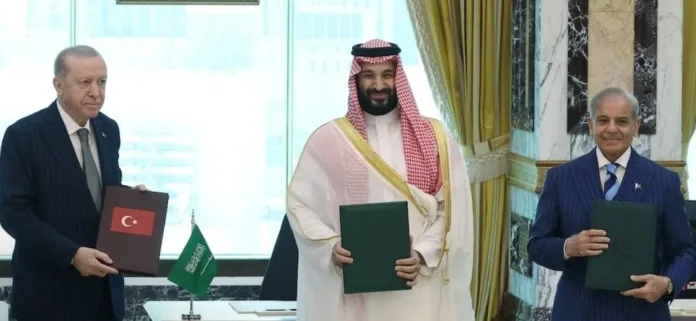

Saudi Arabia, Turkey and Pakistan say an attack on one will be treated as an attack on all
Saudi Arabia, Turkey and Pakistan have signed a joint defence agreement, declaring that an attack on one of the three countries will be treated as an attack on all of them.
The pact was announced in Mecca after talks between Saudi Crown Prince Mohammed bin Salman, Turkish President Recep Tayyip Erdogan and Pakistani Prime Minister Shehbaz Sharif.
The Mecca defence pact brings together three of the most powerful Muslim-majority nations at a time of growing instability across the Middle East and South Asia.
In a joint statement, the countries said the agreement was designed to strengthen collective deterrence against any act of aggression. It also promised deeper defence co-operation between the three states.
The wording is significant. By saying that an armed attack on one member will be regarded as an attack on all three, the pact creates a mutual defence guarantee. But it does not spell out exactly what each country would be required to do in a crisis.
A Turkish official quoted in the report described the agreement as purely defensive in nature.
The deal comes after months of regional tension following the US and Israeli attacks on Iran in February. Since then, Tehran and its allies have struck targets in Saudi Arabia and other Gulf states, while shipping through the Strait of Hormuz and the Red Sea has faced severe disruption.
Iran reacted sharply to the announcement. Ebrahim Rezaei, a member of Iran’s National Security Commission, dismissed the deal and said a paper agreement with Turkey and Pakistan would not bring Saudi Arabia security.
Saudi Arabia already signed a joint defence pact with Pakistan last year, but this new agreement widens the arrangement by bringing Turkey into the fold.
For Riyadh, the pact offers another layer of protection at a time when the Gulf’s security landscape has been shaken by the war with Iran. Saudi Arabia has also faced threats from Yemen’s Iran-backed Houthi movement, which announced a maritime embargo against Saudi Arabia last month and targeted airports, oil facilities and tankers.
The memory of Israeli strikes on Doha last year has also shaped Gulf thinking. Across the region, governments have been reassessing how much they can rely on old security arrangements and what new partnerships might be needed.
For Pakistan, the agreement offers political and strategic value. Its long-running tensions with India erupted into open conflict in May 2025, and although a wider war was avoided, Islamabad is likely to see closer ties with Saudi Arabia and Turkey as a major advantage.
Pakistan has also taken on a larger diplomatic role in recent months, including acting as an intermediary between Iran and the US and hosting ceasefire negotiations. The new pact strengthens its position as a regional player.
Turkey’s interests are different. The agreement could create new opportunities for its defence industry through joint production, military technology partnerships, procurement and closer interoperability with Saudi and Pakistani forces.
But the practical meaning of the Mecca defence pact remains uncertain. Mutual defence agreements sound simple in public statements, but they can become complicated when real conflicts begin.
One question is whether Turkey would be expected to support Saudi Arabia if a full-scale war with the Houthis resumed. Another is whether Saudi Arabia would be drawn into a future India-Pakistan conflict if fighting broke out again.
Those scenarios would involve difficult political calculations. Each government would have to balance alliance commitments, regional risks and the danger of escalation.
That uncertainty may be part of the design. The pact is less about immediately sending troops into battle and more about deterrence. Any country considering action against one of the three now has to think about the possibility of facing all of them.
For Saudi Arabia, Turkey and Pakistan, the message is clear: they want to show unity, raise the cost of aggression and build a stronger defence front in an increasingly unstable region.