
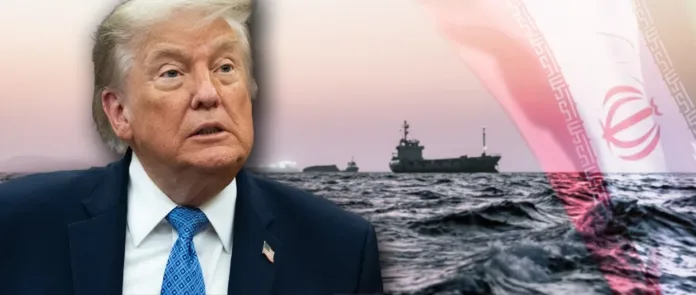

US strikes Iranian sites after a cargo ship attack deepens fears over the fragile ceasefire
The US military has launched strikes on Iranian targets after a drone attack hit a cargo ship in the Strait of Hormuz, raising fresh fears that a fragile ceasefire between Washington and Tehran could be breaking apart.
US Central Command said it struck missile and drone storage facilities and coastal radar positions on Friday. It described the operation as a forceful response to Thursday’s attack on a commercial vessel in one of the world’s most important shipping lanes.
The cargo ship, the Ever Lovely, is a Singapore-flagged vessel. British maritime security agency UKMTO said it was hit 7.5 nautical miles south-east of Oman’s port of Dahit. Its owner, Evergreen, said the vessel had been following UKMTO’s recommended route through the strait when it was struck.
Evergreen said all crew members were safe, along with the ship and its cargo.
The strike on the vessel disrupted a planned evacuation of more than 11,000 sailors who have been stranded in the region since the conflict began. The UN’s International Maritime Organisation paused the operation after the attack.
President Donald Trump accused Iran of a “foolish violation” of the ceasefire. Speaking at the White House on Friday, he refused to say how far the US response might go, telling reporters, “You’ll find out.” He added that he did not like the fact that Iran had “taken a shot” at the ship.
US Central Command said Iranian aggression against commercial shipping had violated the ceasefire and threatened freedom of navigation. It also said the US military would continue to support safe passage for commercial vessels moving through the Strait of Hormuz.
Iran rejected the US version of events and blamed what it called the “treaty-breaking US regime”. The Islamic Revolutionary Guard Corps said the US had launched an airstrike on Iran’s coast under the pretext of a ship violating an unauthorised route.
The IRGC also claimed its navy had retaliated by striking US military positions in the region, although it did not provide further details. The BBC said it contacted the Pentagon for comment.
“If the aggression is repeated, our response will be more extensive than this,” the IRGC said.
The clash comes after the US and Iran agreed on 17 June to end hostilities under a 14-point memorandum of understanding. That agreement called for Iran to use its best efforts to allow safe passage for commercial vessels without charge for 60 days.
Vice-President JD Vance said after the US strikes that Iran could use diplomatic channels if it disagreed with how the agreement was being applied. But he warned that violence would be met with violence.
Iranian officials gave a very different account. Ebrahim Azizi, head of the Iranian parliament’s national security commission, said the US had attacked Iran “in the middle of negotiations once again”. He said the ceasefire violation would lead to “retreat and regret” for Washington.
The Strait of Hormuz has remained at the centre of the crisis. Tehran effectively closed the waterway after US and Israeli attacks against Iran began at the end of February. The shutdown pushed up global oil prices and disrupted shipments of other crucial goods, including fertiliser.
Recent talks had focused on whether vessels would face charges for passing through the strait. Trump said on Truth Social that Iran had told the US there would be no tolls, insurance costs or other charges. He warned that negotiations would end immediately if that proved false.
Omani and Iranian officials also met in Muscat to discuss the future management of navigation. Oman’s Foreign Minister Badr Al-Busaidi said both sides supported toll-free safe passage.
Iran’s chief negotiator, Mohammed Bagher Ghalibaf, told state-affiliated outlets that the administration of the Strait of Hormuz would not return to how it was before the war.
For now, the US-Iran strikes have turned one attack on a cargo ship into a much wider test of the ceasefire, commercial shipping security and control of a vital Gulf route.