
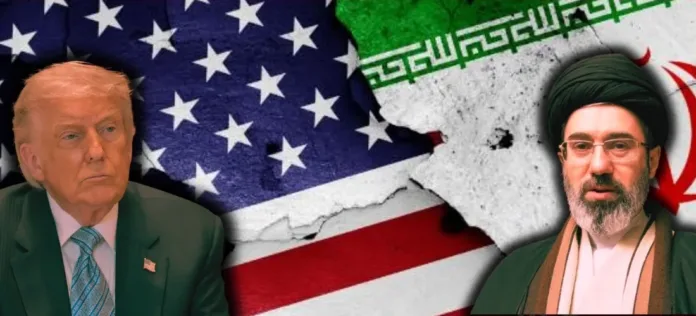

Washington and Tehran move closer to a 60-day agreement amid lingering distrust
Hopes for a diplomatic breakthrough between the United States and Iran have grown after President Donald Trump signalled that a potential agreement could be within reach.
On day 91 of the conflict, attention has shifted from the battlefield to the negotiating table as Washington and Tehran move closer to a proposed 60-day memorandum of understanding aimed at easing tensions and restoring shipping through the Strait of Hormuz.
The strategic waterway remains one of the world’s most important energy routes, making any agreement a matter of global significance.
Trump said the US naval blockade of the Strait of Hormuz would be lifted if Iran agreed to a series of conditions. Those conditions include permanently abandoning any pursuit of nuclear weapons, reopening the waterway to unrestricted commercial shipping, removing remaining naval mines and cooperating with international inspectors to recover and eliminate buried enriched uranium stockpiles.
The US president is expected to review the proposal with his national security team before making a final decision.
Despite growing optimism, significant obstacles remain.
Iran’s chief negotiator, Mohammad Bagher Ghalibaf, said Tehran would judge any agreement by actions rather than promises. He stressed that Iran would not take meaningful steps until Washington demonstrated its commitment first.
His remarks highlighted the deep mistrust that continues to define relations between the two countries.
Further uncertainty emerged after Iran’s semi-official Tasnim news agency reported that the draft framework had recently undergone revisions and had not yet received formal approval.
While negotiators continue discussions, signs of cautious progress have appeared in the Gulf.
Maritime tracking data shows an increase in foreign vessels travelling through the Strait of Hormuz. Ships linked to countries including Singapore, the United Arab Emirates, South Korea and Norway have resumed using the route despite months of disruption and security concerns.
The increase in shipping activity suggests that some operators believe the risk of escalation may be easing.
Meanwhile, nuclear diplomacy has taken a potentially significant turn.
Rafael Grossi revealed that Kazakhstan has indicated a willingness to store Iran’s near weapons-grade enriched uranium as part of a possible agreement.
According to Grossi, Kazakhstan’s existing uranium bank, which operates under international oversight, could offer a secure solution acceptable to both Tehran and Washington.
Such an arrangement could help address one of the most sensitive issues in the negotiations.
Regional tensions, however, remain far from resolved.
In the Gulf, both Kuwait and the United Arab Emirates condemned what Kuwait described as Iranian aggression after a ballistic missile was intercepted.
The two countries reaffirmed Kuwait’s right to protect its sovereignty and security.
Iran did not directly state that Kuwait was the target. However, the Islamic Revolutionary Guard Corps said it had struck a military base used by US forces involved in recent operations against southern Iran.
Diplomatic efforts are also continuing elsewhere in the region.
Sheikh Tamim bin Hamad Al Thani held discussions with Trump regarding the latest developments and ongoing efforts to reduce tensions. Qatar has continued to play a central role in facilitating dialogue and supporting the fragile ceasefire between Washington and Tehran.
At the same time, concerns persist along the Israel-Lebanon front.
Military delegations from Lebanon and Israel are meeting in Washington as Beirut seeks an end to escalating attacks. Israel has also issued evacuation orders for several towns in southern Lebanon, prompting further displacement and raising fears of additional instability.
For now, the prospect of a US-Iran agreement remains alive.
Negotiators appear closer to a framework than at any point in recent months. Yet unresolved disputes, mutual suspicion and wider regional tensions continue to cast a shadow over the process.
The coming days may determine whether the region moves towards de-escalation or returns to confrontation.