
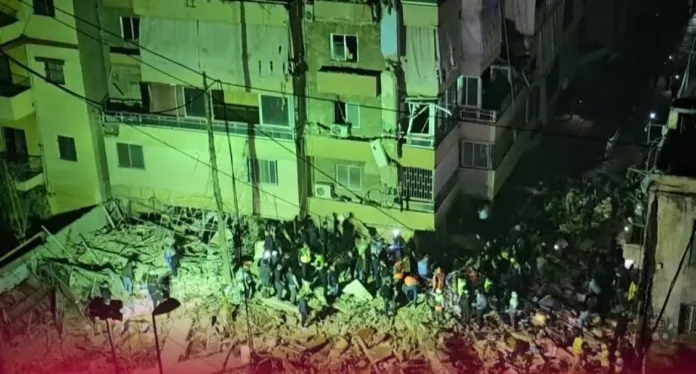

Israeli strike on Beirut’s southern suburbs sparks fears of a dangerous new escalation
Beirut was shaken by explosions once again after Israel launched its first strike on the Lebanese capital since agreeing to a ceasefire with Hezbollah last month. The attack targeted Dahieh, the southern suburbs of Beirut known as Hezbollah’s stronghold, reigniting fears that the fragile truce between both sides may be collapsing.
The strike hit at around 20:00 local time on Tuesday evening. Videos shared online showed flames tearing through the area as thick smoke rose above damaged buildings. At least one structure suffered severe destruction while emergency workers rushed towards the blast site. Residents nearby watched in panic as the sound of the explosion echoed across the capital.
Israeli Prime Minister Benjamin Netanyahu confirmed he personally authorised the operation. According to Israel, the strike targeted a commander from Hezbollah’s elite Radwan Force, a unit accused by Israel of organising attacks on Israeli soldiers and border communities.
Local Lebanese media reported that members of the Radwan Force were meeting inside the building when the missile struck. Hezbollah has not yet issued an official response to the attack or confirmed whether any senior figures were killed.
The assault marks the first strike on Dahieh since US President Donald Trump announced a ceasefire agreement between Israel and Lebanon on 16 April. The deal was intended to reduce tensions and halt months of fighting that devastated parts of southern Lebanon and northern Israel.
Despite the agreement, violence has continued almost daily. Israel has repeatedly carried out air strikes in southern Lebanon, saying it is targeting Hezbollah fighters, infrastructure and weapons sites. Hezbollah, meanwhile, has continued launching rockets and drones towards Israeli troops and northern Israeli communities. Both sides accuse each other of violating the ceasefire.
Lebanon’s health ministry says Israeli attacks have killed more than 120 people across the country during the past week alone. Officials stated that women and children are among the dead, although the ministry does not separate civilians from combatants in its figures.
The wider conflict has already left devastating consequences across Lebanon. More than 2,700 people have reportedly been killed since 2 March. Entire villages near the border have been reduced to rubble as fighting intensified over recent months. Israeli forces continue occupying a strip of land along the Lebanese border, describing it as a security zone aimed at preventing Hezbollah fighters from approaching Israeli communities.
Rights groups have raised concerns over the scale of destruction in southern Lebanon, with some organisations warning that certain attacks could amount to war crimes. The destruction has drawn comparisons to tactics used by the Israeli military in Gaza, where neighbourhoods have also suffered widespread devastation.
Hezbollah has continued responding with attacks on Israeli forces. Last week, a drone strike killed an Israeli defence ministry contractor operating an excavator in southern Lebanon. The armed group had previously signalled that it would respect the ceasefire agreement if Israel also complied with its terms.
For many residents of Dahieh, Tuesday night’s strike confirmed their worst fears. Once one of Beirut’s busiest and most densely populated districts, large parts of the suburb have remained nearly deserted since the ceasefire began. Families who fled the area during earlier fighting have hesitated to return, worried that Israeli strikes could resume without warning.
Netanyahu defended the latest operation by claiming the targeted commander had been responsible for attacks against Israeli civilians and soldiers. In a strongly worded statement, he warned that Israel would continue pursuing its enemies wherever they are located.
Meanwhile, diplomatic talks between Israel and Lebanon remain tense and limited. Discussions supported by the United States have largely continued through ambassadors and lower-level officials rather than direct meetings between leaders. Lebanese President Joseph Aoun has rejected the possibility of meeting Netanyahu in the near future.
The latest strike has deepened uncertainty across the region. Although the ceasefire officially remains in place, continuing attacks from both sides have raised growing fears that the conflict could spiral into a far wider war.