

Four astronauts abandon ISS mission early after illness sparks Nasa’s first medical evacuation
Four astronauts have begun an unexpected journey back to Earth after a medical issue aboard the International Space Station forced their mission to end weeks earlier than planned, marking the first medical evacuation in the history of Nasa’s human spaceflight programme.
The crew undocked from the orbiting laboratory at 22:20 GMT on Wednesday following five months in space. The return was prompted by a health concern affecting one of the astronauts, though space officials have stressed that the situation is not considered an emergency.
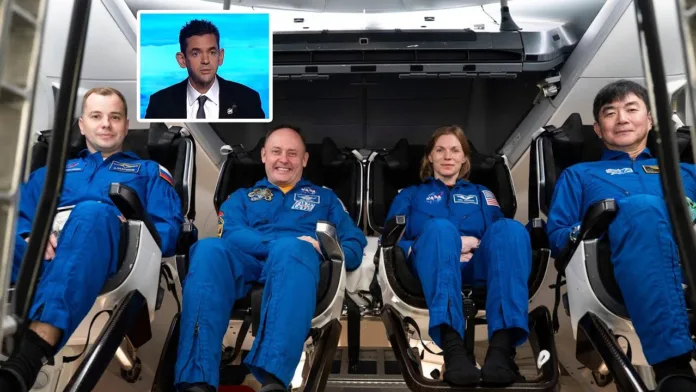
American astronauts Mike Fincke and Zena Cardman, Russian cosmonaut Oleg Platonov and Japanese astronaut Kimiya Yui are travelling home inside a SpaceX Dragon capsule. The spacecraft is scheduled to splash down off the coast of California at approximately 08:40 GMT on Thursday.
Before departure, Cardman acknowledged the emotional weight of the early return, calling the timing “unexpected”. She reflected on how the crew rallied together during the ordeal, describing how they became a close-knit family in the face of uncertainty. Her remarks underscored the personal toll of a decision that cut short months of preparation and a mission intended to run until mid-February.
Space officials have declined to identify which crew member experienced the medical issue or to provide specific details about the condition. However, they have repeatedly emphasised that the affected astronaut was, and remains, in a stable condition.
“This was a deliberate decision,” Fincke said in a recent social media message, reassuring the public that everyone on board was safe and well cared for. He explained that returning to Earth would allow doctors access to a full range of diagnostic tools not available in orbit. While he described the decision as “bittersweet”, he said it was ultimately the right call.
Medical modelling has long suggested that a space station evacuation could be expected roughly once every three years. Despite this, no such evacuation has occurred in Nasa’s 65-year history of human spaceflight until now. By contrast, Soviet-era missions experienced several early returns due to illness, including a serious infection aboard a space station in 1985.
The Crew-11 astronauts arrived at the station in early August and had trained extensively to handle unexpected medical scenarios. Senior officials praised how the team responded, noting their professionalism and calm under pressure.
The early departure leaves a reduced crew aboard the station. An American astronaut and two Russian cosmonauts who arrived in November will remain on board. Until another crew is delivered, officials said routine and emergency spacewalks would be suspended due to the limited number of astronauts available to provide internal support.
The station, continuously occupied since 2000, remains one of the few areas of ongoing cooperation between the United States and Russia. The two space agencies continue to exchange crew seats, ensuring each nation maintains a presence on the orbiting complex.
Nasa’s chief health and medical officer said the decision to evacuate was driven by lingering uncertainty surrounding the diagnosis and the risks of continuing the mission without comprehensive testing. Bringing the crew home early, he said, eliminated unanswered medical questions that could not be resolved in space.
As the capsule begins its descent, the mission will be remembered not only for its scientific work, but also for a historic first: the moment when caution, health and human limits took precedence over schedule in orbit.