
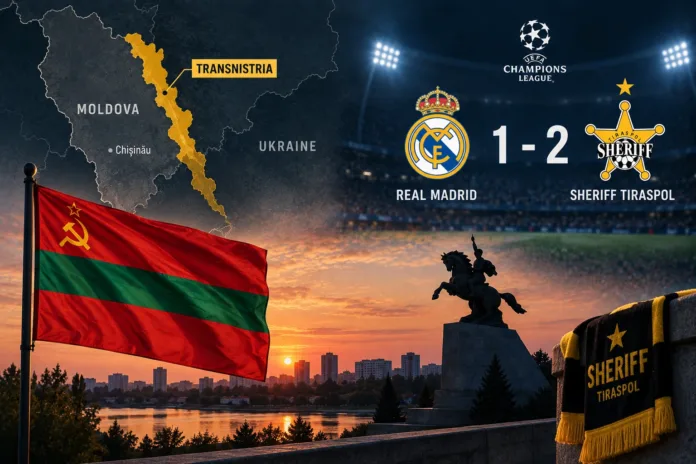

Quick answer: Transnistria is a self-declared state on a narrow strip of land between Moldova and Ukraine. It has its own government, army, currency, flag and border posts, but no United Nations member state recognises it. Around 367,000 people live there. Moldova regards it as Moldovan territory under separatist control.
On 28 September 2021, Real Madrid lost at home to a club from a country that does not exist.
Sheriff Tiraspol arrived at the Bernabéu having already beaten Shakhtar Donetsk, which everyone assumed was a fluke. Jasurbek Yakhshiboev headed them in front. Karim Benzema equalised from the spot. Then, in the 89th minute, a Luxembourgish midfielder named Sébastien Thill hit a shot from twenty-five yards that went in off the underside of the bar, and a club with an annual budget of roughly $4.7 million beat the most decorated side in European football.
Most of the coverage that week called it a fairytale. Almost none of it asked the obvious question, which is how a team from a territory that no government on Earth recognises had ended up in the Champions League at all.
The answer to that question is also the answer to what Transnistria is. And it is not really a story about a frozen conflict. It is a story about a company.
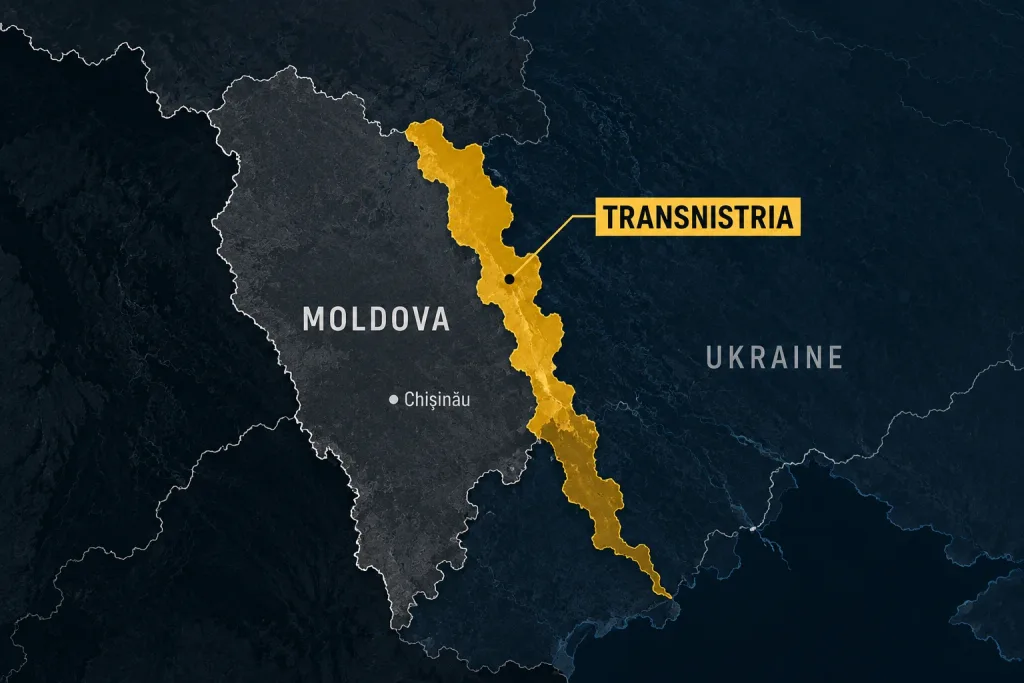
Where is Transnistria?
Transnistria occupies a sliver of land on the eastern bank of the Dniester river, wedged between the rest of Moldova and the Ukrainian border. It is roughly 400 kilometres long and, in places, barely twenty wide. The total area is 4,163 square kilometres, which is smaller than Norfolk.
The capital is Tiraspol. The population, by Moldova’s March 2024 count, is 367,776, down sharply from the half-million or so who lived there when the Soviet Union collapsed. Russian, Romanian and Ukrainian are all official languages, though Romanian is written there in the Cyrillic alphabet, a script Moldova abandoned in 1989 and which now survives almost nowhere else on Earth.
Moldova does not use the name Transnistria in law. Officially, the territory is the “Administrative-Territorial Units of the Left Bank of the Dniester”, which is the sort of phrase governments reach for when they refuse to concede a point.
Is Transnistria a real country?
This is the question everyone actually arrives with, and the honest answer is that it depends what you think a country is.
The most widely used test comes from the 1933 Montevideo Convention, which sets out four criteria for statehood: a defined territory, a permanent population, a government, and the capacity to enter into relations with other states.
Transnistria has a defined territory, marked by checkpoints you pass through with a migration card. It has a permanent population. It has a government, a parliament, a supreme court, a central bank, a constitution and a standing army. It issues passports and licence plates. It prints its own money, the Transnistrian rouble, and in August 2014 it became the first place in the world to issue circulating coins made of composite plastic, in denominations of one, three, five and ten roubles. They are small coloured discs, and they work.
By the Montevideo test, Transnistria passes.
What it lacks is the thing not on that list: anyone willing to say so out loud.
Does any country recognise Transnistria?
Two entities recognise Transnistria. Neither of them is a country either.
Abkhazia and South Ossetia, both breakaway territories of Georgia backed by Russia, recognise Transnistria’s independence, and Transnistria recognises theirs. The three of them belong to an organisation called the Community for Democracy and Rights of Nations, which is sometimes described, not entirely unfairly, as a club for states nobody else will speak to.
No United Nations member has ever recognised Transnistria. Not one. Including Russia, which funds it, arms it, staffs it with troops and has done for three decades.
That last point is worth sitting with, because it is the most misunderstood thing about the place. Russia’s position is not that Transnistria is a country. Russia’s position is that Transnistria is a lever.
How did Transnistria break away from Moldova?
In the late 1980s, as Soviet control loosened, Moldova began moving back towards Romanian: the language, the Latin alphabet, and for some, the idea of unification with Romania itself. On the eastern bank of the Dniester, where the population was more heavily Russian and Ukrainian and the Soviet-era factories were concentrated, that prospect went down badly.
Transnistria declared independence on 2 September 1990, more than a year before the Soviet Union formally dissolved. Fighting escalated into open war on 2 March 1992 and ran until 1 July. Around 700 people were killed.
What settled it was the Russian 14th Guards Army, which was already stationed in the territory and intervened on the separatist side. A ceasefire was signed on 21 July 1992. It has held, more or less, for thirty-four years.
That is the whole war. Four months, seven hundred dead, and a line on a map that nobody has moved since.
Does Russia own Transnistria?
Not formally. Practically, it has held the deeds for a long time.
Roughly 1,500 Russian troops are stationed in Transnistria under the Operational Group of Russian Forces, the successor to the 14th Army. A separate, smaller contingent operates under a peacekeeping mandate. The OGRF’s main job is guarding a village called Cobasna.
Cobasna holds what is thought to be the largest ammunition dump in Europe: up to 20,000 tonnes of Soviet-era ordnance, much of it hauled back from East Germany and Czechoslovakia as the Warsaw Pact wound down, and much of it long past its safe shelf life. Outside observers, the OSCE included, are refused access, so nobody outside Russia and Tiraspol genuinely knows what condition it is in. In 2015 the Academy of Sciences of Moldova estimated that a full detonation would release energy comparable to the atomic bombings of Hiroshima and Nagasaki. That figure is an estimate rather than a measurement, and it should be read as one. It is also the reason nobody is in a hurry to force the issue.
But the harder leverage was never the ammunition. It was the gas.
For years, Russia sent natural gas to Transnistria and simply did not collect payment. The gas was formally supplied to Moldova, and the resulting bill, which has run into billions of dollars, accumulated against Moldova’s national gas company. Transnistria burned it, heated its homes with it, ran its steel mill on it, and generated cheap electricity that it sold back across the river to the country being invoiced.
That arrangement subsidised the entire Transnistrian economy for thirty years. And on 31 December 2024, at ten to eight in the evening, it stopped.
Who actually runs Transnistria?
Here is where the football club stops being a curiosity and becomes the point.
Sheriff was founded on 24 June 1993 by Viktor Gushan and Ilya Kazmaly, two former security service officers, who struck a deal with Transnistria’s first leader, Igor Smirnov, to take over the state-controlled supermarkets. Thirty-three years later, Sheriff owns or operates the supermarket chain, the petrol stations, the mobile phone network, a television channel, a publishing house, a construction firm, an advertising agency, a Mercedes-Benz dealership, a cognac distillery, two bread factories, and a five-star hotel.
RFE/RL has reported that the group accounts for around 60 per cent of the region’s economy, and that by 2015 roughly a third of all money leaving the separatist state budget was flowing to Sheriff-owned companies.
It also runs the politics. The ruling Renewal party, Obnovlenie, took 23 of 43 parliamentary seats in 2005 and has held power since; RFE/RL’s assessment is that every member of parliament is connected to Sheriff to some degree, Gushan’s own son among them.
So when people describe Transnistria as a Soviet theme park, frozen in 1989, they have it backwards. The hammer and sickle is still on the flag and Lenin is still outside the parliament building, but the thing those symbols are decorating is not a communist state. It is a privately held conglomerate with a border, an army and a seat in its own legislature.
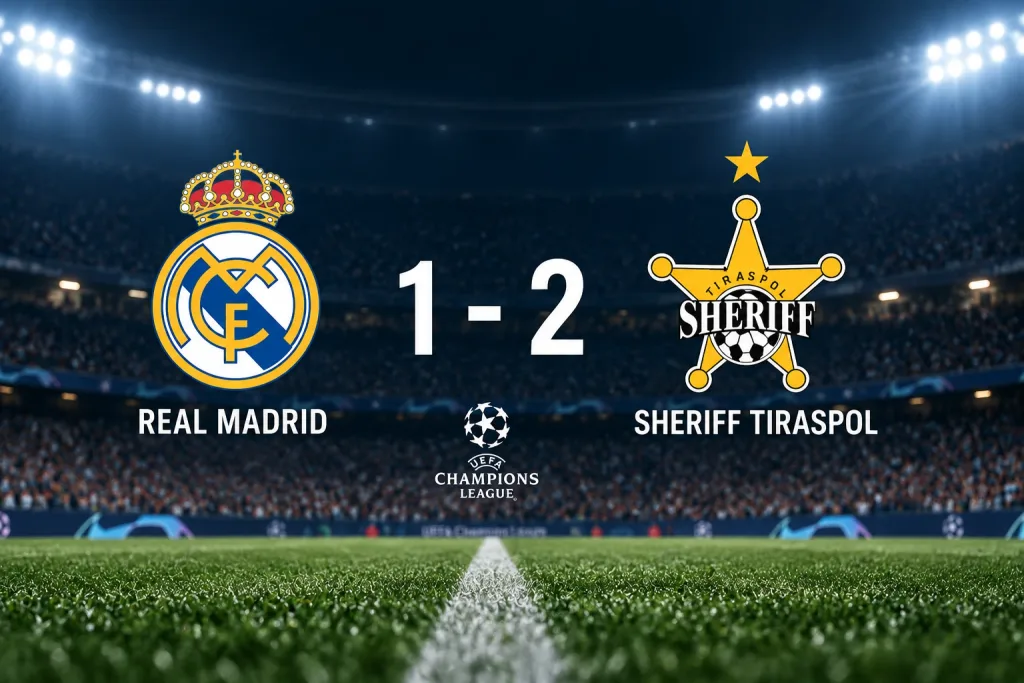
How did Sheriff Tiraspol beat Real Madrid?
On the night, with a header, a set of bodies in front of the goal, and a shot from Sébastien Thill that Thibaut Courtois did not reach.
But the more interesting question is how they were on the pitch at all, and the answer is a piece of institutional sleight of hand that says more about Transnistria than any amount of analysis about frozen conflicts.
FIFA only admits football associations from internationally recognised states, with a handful of negotiated exceptions such as Kosovo. Transnistria is not recognised, so a Transnistrian football association could never join, and a Transnistrian league could never feed into the Champions League.
Every other comparable territory has responded to that by building its own competition anyway. Abkhazia, South Ossetia, Nagorno-Karabakh and Northern Cyprus all joined CONIFA, the federation for teams that FIFA will not have, where they play each other in tournaments nobody televises and win trophies nobody counts. It is a statement of nationhood, and it costs them access to everything.
Transnistria did the opposite. It never founded a league. Under an arrangement with Chișinău, Transnistrian clubs play in the Moldovan league, and Sheriff Tiraspol is registered with the Moldovan Football Federation. On UEFA’s paperwork, Sheriff is a Moldovan club. That registration is the only reason it could enter the Champions League, and the researchers at ZOiS in Berlin note how exceptional it is: an equivalent arrangement in Georgia or Ukraine would be unthinkable.
Read that back slowly. A territory that has spent thirty-five years insisting it is not part of Moldova agreed to compete as Moldovan, because the Champions League pays and CONIFA does not.
Every other unrecognised state chose the symbol. Transnistria chose the revenue. Which is exactly what you would expect from a place run by a supermarket chain.
Is it safe to visit Transnistria?
The UK Foreign, Commonwealth and Development Office advises against all travel to Transnistria, citing military activity in nearby Ukraine and the fact that the territory is outside Moldovan government control. The FCDO also states plainly that its ability to help British nationals there is extremely limited.
That matters more than it does in most places. If something goes wrong in Transnistria, there is no British embassy to call and no recognised government for one to call on your behalf. Travel insurance is generally void against official advice.
For what it is worth, the practical experience most visitors describe is bureaucratic rather than dangerous: you stop at a checkpoint, you fill in a migration card, you state where you are staying and for how long, and you are issued a slip of paper that you must not lose. Your bank cards will not work. Neither will the Moldovan leu, past the first few shops. You will need cash, changed into plastic roubles that are legal tender nowhere else in the world.
None of which changes the advice. The advice is not to go.
Why doesn’t Moldova just take Transnistria back?
For thirty years the answer was the Russian army, the ammunition at Cobasna, and the cost of absorbing a bankrupt region. Chișinău had no military option worth the name and no economic case for one.
What has changed is that Moldova no longer needs one.
When the Ukrainian gas transit deal expired at the end of 2024, the subsidy that held Transnistria up disappeared overnight. Within days, around 75,000 households had no gas. Heating failed in 131 schools, 147 kindergartens and 130 public buildings. Three people died of carbon monoxide poisoning trying to heat their homes. The steel mill at Rîbnița, the single largest export earner, shut down and put more than 2,000 people out of work. By mid-February, industrial activity had fallen by as much as 70 per cent.
Supply resumed on 1 February 2025, but not from Russia. The European Union put up emergency funding, eventually totalling €64 million, and Moldova’s state gas company began buying gas on the Romanian and Bulgarian markets and selling it across the river. Transnistria now heats itself with European gas, bought by the government it does not recognise, paid for in part by the union it has spent three decades facing away from. Household tariffs rose 109 per cent for gas in a single month.
Meanwhile Chișinău has been quietly closing the other exits. Transnistrian firms began paying customs duties to Moldova in 2024, after almost twenty-five years of exemption. VAT and excise on certain imports followed in September 2026, with full tax alignment scheduled for 2030. The revenue goes into a Convergence Fund intended to grow from around €15 million to roughly €200 million a year by the end of the decade, which is to say: Moldova is taxing Transnistria and banking the money to pay for its eventual reintegration.
The economic picture behind that is stark. Transnistrian GDP fell 18 per cent in 2025. Industrial output dropped 30 per cent and now sits at about three quarters of its 1989 level. Wages and pensions are roughly half those in the rest of Moldova. And around 77 per cent of Transnistrian exports go to the European Union, not to Russia.
That last figure is the one that ends the argument. The territory is politically oriented towards Moscow and economically dependent on Brussels, and it has been for years.
What happens to Transnistria now?
Moldova’s pro-European governing party won an outright parliamentary majority again in September 2025, and the country’s EU accession process continues. Neither Chișinău nor Brussels has any appetite for a military resolution, and neither needs one.
The strategy now visible is patience. Let the subsidy stay dead. Keep selling the gas. Keep extending the tax base. Let wages, pensions and population continue to drift west across the river, as they have been doing for twenty years. At no point does anyone have to fire a shot, and at no point does Russia get a crisis it can usefully exploit.
Whether that works is an open question, and one that will not be settled quickly. Sheriff still owns the shops, the fuel, the phones and the parliament, and a conglomerate with that much to lose does not concede quietly. But the thing that made Transnistria viable was never the ideology or the army or the ammunition at Cobasna. It was free gas, and the free gas is gone.
The country that does not exist beat Real Madrid because it was willing to be Moldovan for ninety minutes when there was money in it. The question now is how much longer it can afford not to be.
Key takeaways
- Transnistria is a self-declared state between Moldova and Ukraine with its own government, army, currency and borders, recognised by no UN member state.
- It meets every standard criterion for statehood except recognition, and is acknowledged only by Abkhazia and South Ossetia, which are themselves unrecognised.
- Roughly 60 per cent of its economy is controlled by a single conglomerate, Sheriff, whose founders also control the ruling party.
- Sheriff Tiraspol plays in the Moldovan league and is registered as a Moldovan club, which is the only reason it could beat Real Madrid in the Champions League in 2021.
- The Russian gas subsidy that sustained Transnistria for thirty years ended on 31 December 2024, and its economy has contracted sharply since.
- The UK FCDO advises against all travel to Transnistria.
Frequently asked questions
- What currency does Transnistria use?
The Transnistrian rouble, which has no value outside the territory and cannot be exchanged internationally. In 2014 Transnistria became the first place in the world to issue circulating coins made of composite plastic. - What language do they speak in Transnistria?
Russian, Ukrainian and Moldovan (Romanian) are all official. Romanian is written there in the Cyrillic alphabet, which the rest of Moldova dropped in 1989. - Can you fly to Transnistria?
No. There are no commercial flights. Tiraspol’s airfield is not open to civilian traffic, so the only way in is overland, usually from Chișinău or Odesa.
Does Transnistria have its own passport? - It issues one, but it is not valid for international travel because no recognised state accepts it. Most residents also hold Moldovan, Russian or Ukrainian passports.
- Is Transnistria still communist?
No. It keeps Soviet iconography, including the hammer and sickle on its flag and a Lenin statue outside parliament, but its economy is dominated by private monopolies.