
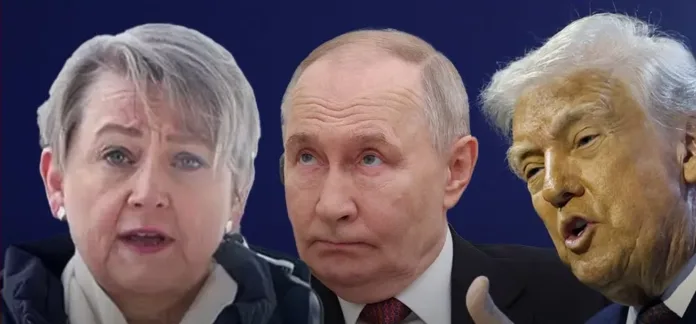

Britain delays joining Donald Trump’s peace board citing serious concerns over Vladimir Putin’s role
The United Kingdom has stepped back from joining a controversial new international body proposed by US President Donald Trump, citing deep unease about the potential involvement of Russian leader Vladimir Putin and the wider implications for global diplomacy.
Speaking to the BBC, Foreign Secretary Yvette Cooper confirmed that Britain had been invited to become a founding member of Trump’s newly announced Board of Peace. However, she made clear that the UK would not be signing up at the launch ceremony held during the World Economic Forum in Davos.
Cooper said the proposal raised significant legal and political questions that went far beyond its original aim of addressing the Israel Hamas conflict in Gaza. She described the initiative as a legal treaty with wide reaching consequences, stressing that the government needed more clarity before committing Britain to such an arrangement.
The Board of Peace is being promoted by the White House as a new international organisation designed to resolve conflicts, with Trump positioned as its chairman and granted broad decision making authority. Critics have raised alarms that the structure could concentrate power in unprecedented ways, sidelining established multilateral institutions.
Concerns have also been fuelled by the absence of any reference to Palestinian territory in the draft charter circulated by the White House. Some observers argue the framework appears designed to take on responsibilities traditionally handled by the United Nations, which has served as the central forum for international diplomacy and conflict resolution since the end of the Second World War.
Britain is not alone in its caution. None of the other permanent members of the United Nations Security Council, including China, France or Russia, have committed to the initiative. This collective hesitation among key global powers has intensified scrutiny of Trump’s ambitions for the board.
Despite the scepticism, Trump used the Davos signing ceremony to defend the project, insisting it was not intended to replace the UN. He told assembled leaders that the Board of Peace could become one of the most consequential bodies ever created and claimed it would help deliver an everlasting peace in the Middle East.
Trump said the initiative began with a vision for Gaza, which he described as needing to be demilitarised, properly governed and rebuilt. He suggested the board would eventually have sweeping authority once fully established, though he added that it would work alongside the United Nations.
Representatives from 19 countries attended the ceremony, including Argentina, Hungary, Morocco, Saudi Arabia and Turkey. Their presence was presented by the White House as evidence of growing international support, even as major Western allies remained on the sidelines.
The proposal became more controversial after Trump announced that Putin had accepted an invitation to join the board. The Kremlin has not confirmed this claim. Earlier on the same day, Putin said Russia was still studying the invitation, signalling uncertainty rather than endorsement.
Adding another layer of complexity, Putin indicated that the question of using Russian assets frozen in the United States as a contribution to the board would be discussed at a meeting with officials from the Trump administration. Russian state media reported that these talks were scheduled to take place later the same day.
For the UK government, the potential involvement of Putin, combined with unanswered questions about governance and accountability, has prompted a pause rather than a rejection. Cooper emphasised that Britain remained committed to international peace efforts but would not rush into an agreement that could undermine existing global institutions or Britain’s foreign policy principles.
As debates continue in Davos and beyond, the Board of Peace faces a rocky path to legitimacy. Whether it evolves into a new diplomatic force or stalls amid international resistance remains uncertain, but for now Britain has chosen caution over commitment.