
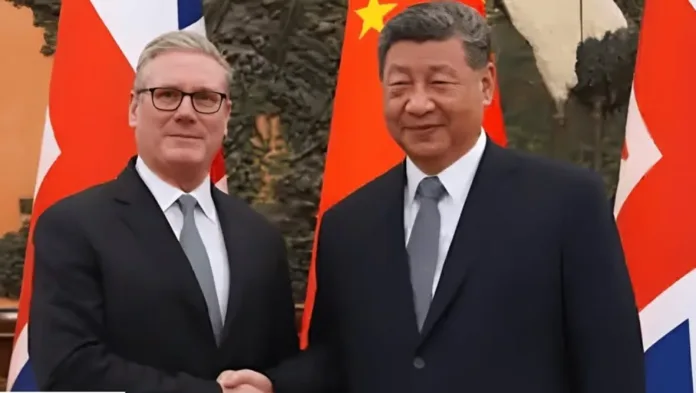

Prime Minister signals cautious reset as UK and China reopen dialogue after years of strain
Sir Keir Starmer has said the UK is seeking a “more sophisticated relationship” with China as he met President Xi Jinping in Beijing, marking the first visit by a British prime minister to the country since 2018.
The meeting came on the first full day of Starmer’s three-day visit, a trip that signals a cautious attempt to stabilise relations after years of diplomatic tension. Speaking during talks with Xi, the prime minister said the UK and China must find “positive ways to work together”, while acknowledging the complexity and sensitivity of the relationship.
President Xi described the state of ties between the two countries as having experienced “twists and turns”, but said engagement was now “unavoidable”. His remarks reflected a recognition on both sides that despite disagreements, dialogue remains necessary amid growing global uncertainty.
The talks took place at Beijing’s Great Hall of the People, where delegations from both countries discussed cooperation and future engagement. After the meeting, Starmer was scheduled to tour the Forbidden City and later witness the signing of agreements alongside Chinese Premier Li Qiang, underscoring the symbolic weight of the visit.
The UK-China relationship has long been characterised by tension behind closed doors, shaped by disagreements over security, trade, human rights and global influence. While a full revival of relations is widely seen as unlikely, the meeting is being viewed as the beginning of a slow diplomatic thaw rather than a dramatic reset.
Starmer’s visit comes as several Western leaders make their way to Beijing amid global political and trade instability. Rising uncertainty caused by international conflicts and tariff pressures has pushed governments to reassess diplomatic strategies, including engagement with China.
Chinese commentators have reacted sharply to the visit. A former editor of a major state media outlet described Britain as a “prodigal son” returning to China, a phrase that captured both scepticism and confidence in Beijing’s position. On Chinese social media, Starmer has been compared to other Western leaders who have recently sought renewed dialogue with Xi.
Earlier in the day, Starmer also met Zhao Leji, the chairman of the Standing Committee of China’s National People’s Congress, adding another layer of political engagement to the visit. Images of handshakes and formal meetings were widely circulated, highlighting the optics of renewed contact between London and Beijing.
The prime minister is the latest in a string of Western leaders to call on China in recent weeks. Similar visits by leaders from Canada, Finland and South Korea have been framed by Beijing as evidence of shifting global dynamics and a recognition that international relationships are evolving rapidly.
Despite the symbolism, expectations remain measured. UK officials have been careful to stress that the visit does not signal a wholesale change in policy, but rather an attempt to manage differences through direct communication. Security concerns and strategic competition remain unresolved, and both sides acknowledge that trust will take time to rebuild.
For Starmer, the challenge lies in balancing economic engagement with national security concerns while navigating public and political scepticism at home. For China, the visit reinforces its message that engagement with major Western powers remains both possible and necessary, even after years of strain.
As the visit continues, attention will focus on whether tangible outcomes emerge or whether the talks simply lay the groundwork for future dialogue. For now, the meeting stands as a clear signal that after years of distance, both countries are testing whether cautious engagement can replace prolonged silence.