

Putin blames Europe for war’s prolongation and signals escalation as U.S. envoys meet in Moscow
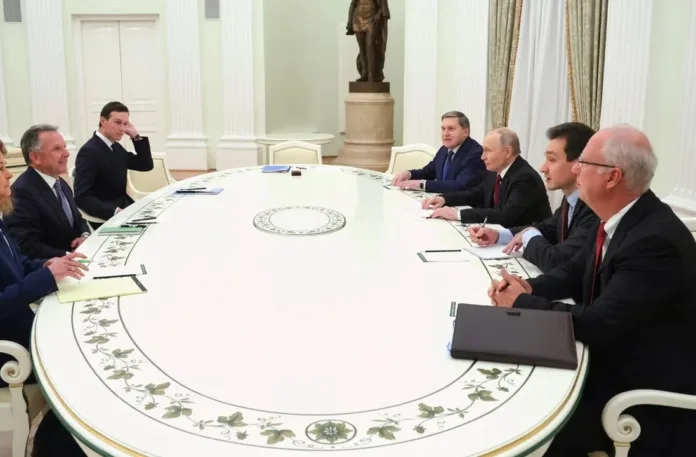
In a meeting that could shape the future of the Ukraine war, Russian President Vladimir Putin showed just how much leverage Russia still holds over peace talks, with a blend of charm, calculated stalling, and pointed threats aimed at Europe. U.S. envoys Steve Witkoff and Jared Kushner, sent by President Donald Trump, arrived in Moscow seeking to reinitiate dialogue over the four-year-long war on Ukraine. However, what followed was a drawn-out spectacle that revealed just how far apart the two sides remain on the issue.
Witkoff and Kushner, representatives of the Trump administration, found themselves cooling their heels in the Russian capital for several hours before their meeting with Putin. The Russian president had initially scheduled the talks for 5 p.m., but they did not begin until nearly three hours later. During this time, the U.S. envoys wandered through Moscow, even enjoying a leisurely lunch, while the Kremlin kept them waiting. It was an unspoken demonstration of Russia’s confidence and control over the situation.
Meanwhile, Putin took to the press at an investment forum, where he sent a pointed message to Europe, effectively blaming it for preventing peace. “We’re not planning to wage a war with Europe, but if Europe decides to start a war, we’re ready right now,” Putin declared, signalling that the diplomatic stalemate could spiral into something far worse. His words, which came after hours of waiting for the U.S. delegation, underscored the growing frustration Russia feels over what it perceives as Europe’s interference in the peace process.
The meeting itself, which stretched late into the night and ended after midnight, was described by Putin’s foreign policy adviser Kirill Dmitriev as “productive.” However, there was no sign that any meaningful breakthrough had been achieved. Yuri Ushakov, another key aide present during the talks, described the meeting as “useful, constructive, and highly substantive” but acknowledged there was still “a lot of work” to be done.
Putin made no secret of his belief that Europe had played a destructive role in the standoff, a sentiment that could see him lay the blame for the war’s continuation squarely at the EU’s feet. The U.S. had been pressing for a peace deal, but the Russian terms were clear any peace agreement would have to heavily favour Moscow. Leaked details from the 28-point ceasefire plan included in Trump’s latest push indicated that it called for Ukraine to cede territory in its east to Russia and to formalise its decision not to seek NATO membership.
These terms were seen as far from acceptable in Kyiv, with Ukrainian President Volodymyr Zelenskyy calling the moment one of the most difficult in Ukraine’s history. While Zelenskyy signalled an openness to dialogue, the specifics of what the U.S. was asking of Russia remain unclear. Russia, on the other hand, continues to insist on Ukraine’s capitulation, with Putin refusing to recognise Zelenskyy as a legitimate leader with whom to negotiate.
The latest round of talks between Putin, Kushner, and Witkoff has only increased the pressure on Kyiv, particularly as Europe watches warily. In the face of such complex negotiations, the future of Ukraine remains uncertain, as each side doubles down on its position. Putin’s calculation appears to be that Europe’s reluctance to engage fully in peace talks may provide him with the opportunity to escalate the conflict further, while Washington seems to be hoping that by involving Trump’s envoys, some form of agreement might be brokered before more damage is done.
Whether or not any meaningful peace emerges from these discussions remains to be seen, but for now, Europe’s involvement or lack thereof appears to be the key factor that could either prolong the war or hasten its end.