
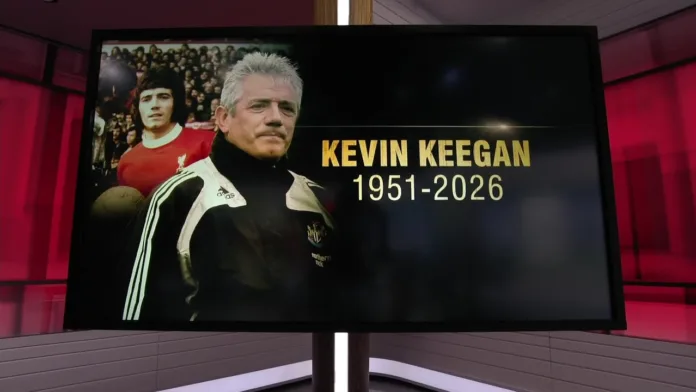

The former Liverpool, Newcastle and England star died aged 75 after a career of passion, trophies and unforgettable moments
Kevin Keegan, one of English football’s most loved and emotional figures, has died aged 75 after cancer.
The former Liverpool, Newcastle and England forward became a symbol of energy, honesty and heart during a career that took him from Scunthorpe United to the highest level of European football. The Kevin Keegan death has brought tributes from across the game, with fans remembering a player and manager who seemed to live every moment in public.
Keegan’s story was built on effort as much as talent. Born in Armthorpe, near Doncaster, he was the son of a miner and started his career far from football’s glamour. After being rejected by Doncaster Rovers, he worked as a tea boy at a brass foundry while continuing to chase the game he loved.
His break came at Scunthorpe United before Liverpool signed him in 1971. At Anfield, Keegan became a relentless forward with a huge appetite for running, pressing and scoring important goals. He helped Liverpool win three league titles, two Uefa Cups, the FA Cup and the club’s first European Cup.
The Kevin Keegan death also recalls one of the boldest moves of his playing career. In 1977, he left Liverpool for Hamburg in a British record transfer. The decision took him out of his comfort zone, but he responded by becoming one of Europe’s most admired players. He won the Ballon d’Or twice while in Germany, confirming his place among the elite.
Keegan later returned to England with Southampton before joining Newcastle United, the club that held a special place in his family history. His farewell as a player in 1984 became one of football’s most memorable exits, with a helicopter landing at St James’ Park to take him away from the pitch while thousands of supporters said goodbye.
That bond with Newcastle did not end there. Years later, Keegan came back as manager and helped revive a club that had fallen into trouble. He led them away from danger, then into the Premier League’s upper reaches with an attacking side that thrilled supporters.
The Kevin Keegan death will inevitably bring back memories of his famous Newcastle team of the 1990s, with players such as David Ginola, Les Ferdinand, Faustino Asprilla and Alan Shearer. They did not win the Premier League, but they gave fans a side that played with courage and ambition.
His most famous managerial moment came during the 1995-96 title race, when he lost his temper in a live interview and said he would “love it” if Newcastle beat Manchester United. The line followed him for the rest of his career, not because it was polished, but because it was pure Keegan.
He also managed Fulham, Manchester City and England. His time with the national team was difficult and ended after a defeat by Germany, when he admitted he had come up short. That honesty, even in failure, was part of what made him so recognisable.
As a player, Keegan won 63 England caps and captained his country. He was not the tallest or most elegant forward, but he turned willpower into greatness. He ran harder, trained harder and pushed himself into places few expected him to reach.
The Kevin Keegan death marks the loss of a footballer who was never distant from the crowd. He cried, shouted, argued, celebrated and suffered openly. Supporters felt they knew him because he rarely seemed to hide what he felt.
For Liverpool, he was part of the team that launched a European dynasty. For Newcastle, he was a hero who understood the club’s emotion. For England, he was both captain and manager. For English football, he was a reminder that greatness can be built from hunger, not just natural gifts.
Kevin Keegan leaves behind a career full of trophies, drama and feeling. More than that, he leaves behind the memory of a football man who gave everything and made people care.