
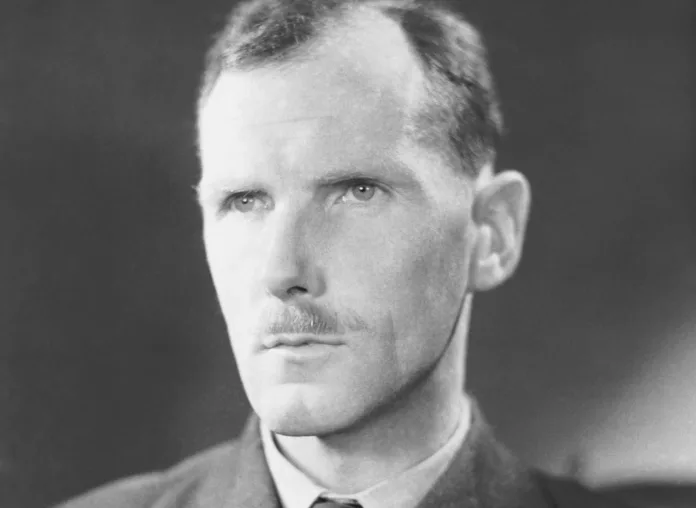
-_D-day_6_June_1944-_Personalities_CH14235.jpg)

A Scottish forecaster made Eisenhower delay D-Day by 24 hours. Andrew Scott plays him in Pressure, in UK cinemas from 9 September
James Stagg was the Scottish meteorologist who told the Supreme Allied Commander that the D-Day landings could not go ahead as planned, and was proved right.
Andrew Scott plays him in Pressure, which opens in UK cinemas on 9 September, with Brendan Fraser as General Dwight D. Eisenhower, Damian Lewis as Field Marshal Montgomery and Kerry Condon as Kay Summersby.
The invasion of Normandy was set for 5 June 1944. Stagg forecast that the weather would break, and persuaded Eisenhower to wait a day.
A storm duly arrived. Had the fleet sailed on the 5th, or waited for the next possible dates later that month, the largest seaborne invasion in history would have met some of the worst Channel weather in two decades.
Stagg had no authority to order anything. His job was to tell the men who did what the sky was going to do, and to be certain enough that they acted on it.
Who was James Stagg?
James Martin Stagg was born on 30 June 1900 in Musselburgh, East Lothian.
He attended Dalkeith High School until he was 15, finished his schooling in Edinburgh, and graduated from the University of Edinburgh in 1921 with an honours MA. He spent his early career teaching science at George Heriot’s School.
He joined the Meteorological Office in 1924 as an assistant, led a British polar expedition to Arctic Canada in the winter of 1932/33, and earned a doctorate from Edinburgh in 1936 for work on terrestrial magnetism. He was appointed superintendent of Kew Observatory in 1939.
On 6 November 1943, he was given an emergency commission as a Group Captain in the RAF Volunteer Reserve. The rank was not ceremonial. It gave a civilian scientist the standing to be listened to by generals.
What did James Stagg forecast before D-Day?
Stagg’s task was to deliver one agreed forecast to the Allied high command, drawing on three separate teams from the Royal Navy, the Met Office and the United States Army Air Forces. They disagreed with each other regularly.
On the afternoon of 4 June 1944, his team picked up rising barometric pressure from a single ship stationed six hundred miles west of Ireland. From that one reading, Stagg concluded there could be a break in the weather on 6 June.
He briefed Eisenhower late that night, forecasting winds of force 3 to 4, rising to force 5 in places, with clear skies and cloud bases high enough for naval gunfire spotting.
At 4.30 am on 5 June, with the high pressure building as he had said it would, the commanders decided to go.
Why was D-Day postponed from 5 to 6 June?
Because Stagg told them the conditions on the 5th would make the landings impossible, and that a narrow window would open the following day.
The Met Office records that Stagg advised conditions on 6 June would be “marginal, but sufficient” to launch the invasion.
Marginal was the strongest word available. Landing craft, paratroopers and naval bombardment each needed different things from the weather, and 6 June barely delivered any of them.
What would have happened if the invasion had gone ahead?
The alternative to going on 6 June was not going on 7 June.
Tides, moonlight and daylight had to align, which left only a handful of workable dates each month. Missing the window meant waiting until the next one.
A major storm battered the Normandy coast from 19 to 22 June 1944, wrecking one of the artificial Mulberry harbours and making beach landings impossible.
Stagg later wrote that had the invasion waited for those next suitable tides, the troops “would have met the worst Channel weather for 20 years”.
Who was Irving Krick and did he disagree with Stagg?
Irving P. Krick, played in the film by Chris Messina, was a real American meteorologist working on the same forecast by a different method.
In the drama, Krick predicts calm conditions for 5 June while Stagg insists the weather will break, and the clash between them drives the story.
The history is messier than a two-man argument. Stagg was co-ordinating three teams who disagreed among themselves, and his job was to reconcile them into a single answer rather than to win a duel with one rival.
The film sharpens that into a personal contest, which is what films do.
Embed from Getty ImagesIs Pressure a true story?
Yes, with the usual caveats about dramatisation.
Stagg was real, the postponement happened, the storm arrived, and the decision was taken on his advice. Dialogue is invented and events are compressed into a tighter span than they occupied.
Andrew Scott is not the first actor to play him. Patrick Barr portrayed Stagg in The Longest Day in 1962.
Is Pressure based on a stage play?
It is, and the play is British.
David Haig wrote Pressure and played Stagg himself, having initially doubted he could portray a Scot convincingly. It premiered at the Royal Lyceum Theatre in Edinburgh on 1 May 2014 before transferring to Chichester Festival Theatre.
It reached the West End at the Ambassadors Theatre in 2018, opening on 6 June, the anniversary of the landings, and running until that September. Malcolm Sinclair, who played Eisenhower, was nominated for a Laurence Olivier Award for the role.
When is Pressure released in the UK?
Pressure opens in UK cinemas on Wednesday 9 September 2026, distributed by StudioCanal and directed by Anthony Maras.
It reached American cinemas in May and digital platforms there in June, so British audiences are seeing it several months behind. No UK streaming date has been announced.
The reviews have been strong, with 87% on Rotten Tomatoes from 97 critics and an A grade from American audiences on CinemaScore. The box office was not strong: around $19 million against a $30 million budget.
Who is in the cast of Pressure?
Andrew Scott leads as Stagg, with Brendan Fraser as Eisenhower, Damian Lewis as Montgomery, Kerry Condon as Kay Summersby and Chris Messina as Irving Krick.
What happened to James Stagg after D-Day?
He was appointed to the US Legion of Merit in October 1945 and made a Companion of the Order of the Bath in 1954.
He served as director of services at the Met Office until 1960, was elected a Fellow of the Royal Society of Edinburgh in 1951, and was president of the Royal Meteorological Society in 1959. He was interviewed for the television series The World at War in 1973.
Stagg died on 23 June 1975, aged 74, and is buried in Dalkeith Cemetery.
On 6 June 2019, seventy-five years after the landings, a crowdfunded plaque was unveiled in his honour at Dalkeith Library and Arts Centre by his son Peter. A second was placed at his childhood home on Dalkeith High Street.
For a man whose judgement shaped the timing of the invasion of Europe, two plaques in a Midlothian town is a modest memorial. Pressure is the first film to put his name above the title.