
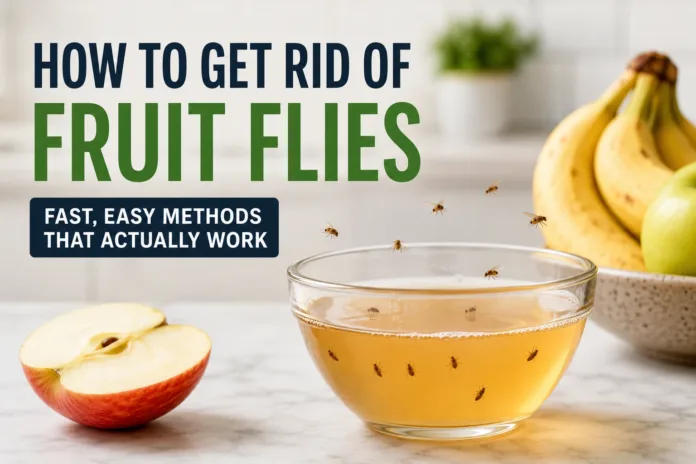

One minute your kitchen is spotless, the next there is a cloud of tiny insects hovering over the fruit bowl. If you want to get rid of fruit flies quickly, the single most effective trick is a simple bowl of apple cider vinegar with a drop of washing-up liquid, which lures them in and traps them within hours. That one trap will handle the flies you can see, but truly getting rid of fruit flies for good means finding where they are breeding and shutting it down, and that is what this guide will walk you through.
Below you will find the fastest traps that genuinely work, the hidden hotspot most people forget, and the simple habits that stop the little pests ever coming back, so you can get rid of fruit flies once and for all.
Key takeaways
Here is the short version of how to get rid of fruit flies before we dig into the detail.
- The fastest fix is a vinegar trap: apple cider vinegar plus a drop of washing-up liquid catches the flies you can see within hours.
- Traps alone are not enough. To get rid of fruit flies for good you must remove what they are feeding and breeding on.
- Check your drains. The plughole is the most common hidden breeding ground, and cleaning it is often the missing step.
- They breed alarmingly fast, so acting quickly matters. A single female can lay hundreds of eggs.
- Prevention is the real cure: refrigerate ripe fruit, empty bins often, and wipe up spills to keep them from ever returning.
Table of Contents
What causes fruit flies in your house?
Fruit flies are drawn to anything ripe, fermenting or rotting, which is why the fruit bowl is usually the first place you notice them. They feed and lay their eggs on the sugary residue of over-ripe bananas, bruised apples, spilled juice and the dregs in the recycling. The reason they seem to appear from nowhere is that they are astonishingly quick to breed. A single female can lay around 500 eggs, and in a warm kitchen those eggs can hatch and mature into new adults in little more than a week, so a couple of stray flies becomes a swarm before you know it.
The uncomfortable truth is that the fruit bowl is often only half the story. Fruit flies also breed in the damp organic gunk that builds up inside drains, in the bottom of bins, in recycling bins that have not been rinsed, and even in a forgotten mop or dishcloth. If you have cleared away every scrap of fruit and the flies are still there, one of these hidden sources is almost certainly the culprit, and you will need to deal with it to get rid of fruit flies completely.
How do you get rid of fruit flies fast?
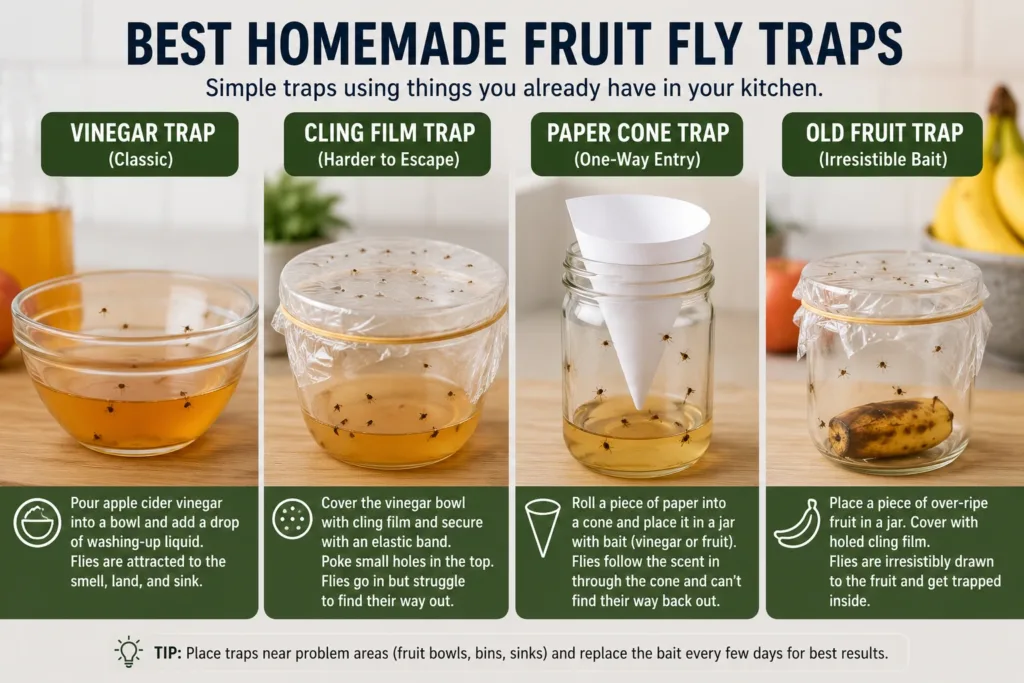
The quickest way to get rid of fruit flies is to set a vinegar trap, and it could not be simpler. Pour a couple of centimetres of apple cider vinegar into a bowl or glass, add a single drop of washing-up liquid, and give it a gentle stir. The smell of the vinegar draws the flies in, while the washing-up liquid breaks the surface tension so that instead of landing and flying off, they sink. Leave it near wherever the flies are gathering and you will usually see results within a few hours.
If you do not have apple cider vinegar to hand, a splash of red wine or beer works just as well, since it is the fermented smell the flies cannot resist. An even neater version is to cover the bowl with cling film, secure it with an elastic band, and poke a few small holes in the top with a cocktail stick. The flies crawl in through the holes, but they struggle to find their way back out. Set two or three of these traps around the kitchen and you will clear the visible swarm remarkably quickly.
What is the best homemade fruit fly trap?
The best homemade fruit fly trap is the apple cider vinegar and washing-up liquid combination described above, because it uses ingredients almost everyone already has and it works reliably. That said, a few variations are worth knowing, so you can use whatever is in the cupboard to get rid of fruit flies.
The cling film trap adds a cover with small holes over your vinegar, which speeds things up by making it harder for the flies to escape. The paper cone trap uses a jar baited with a chunk of ripe fruit or a little vinegar, with a rolled-up paper cone placed point-down in the neck; the flies follow the scent down through the narrow tip and cannot work out how to leave. And the old fruit trap simply exploits what the flies already want: pop a piece of over-ripe banana into a jar, cover it with holed cling film, and let their own appetite lead them in. Whichever you choose, the principle is the same, which is to lure them with a smell they love and then make leaving difficult.
How do you get rid of fruit flies in drains?
If the flies keep coming back no matter how many traps you set, your drains are almost certainly the reason, and clearing them is the step most people miss. The slimy layer of organic matter that builds up inside a plughole is a perfect nursery for fruit flies, and no amount of trapping the adults will help while new ones are hatching below.
To clear a drain, start by pouring a kettle of boiling water down it to flush out loose debris. Follow that with a good scrub using a long drain brush to break up the film clinging to the sides, since this is where the eggs are laid. For a deeper clean, pour in a couple of tablespoons of bicarbonate of soda followed by a cup of white vinegar, let it fizz for around fifteen minutes, then rinse it through with more boiling water. Doing this to every sink, including the bathroom, removes the breeding ground and is often the single move that finally lets you get rid of fruit flies for good.
How do you stop fruit flies coming back?
Getting rid of the flies you can see is only half the battle; keeping them gone is about removing every temptation, so that you get rid of fruit flies permanently rather than on repeat. The good news is that a handful of simple habits will make your kitchen deeply uninviting to them.
Store ripe fruit in the fridge rather than leaving it out on the side, as the cold both slows ripening and keeps it out of reach. Empty your kitchen bin and recycling regularly, and give bottles, cans and jars a quick rinse before they go in, because even a trace of juice or beer is enough to attract a swarm. Wipe up spills straight away, keep your sink clear of food scraps, and do not leave damp cloths or a wet mop lying around. If you keep compost indoors, make sure it has a tightly fitting lid. None of these steps is difficult, but together they remove the food and moisture the flies depend on, and that is what stops them coming back for good.
Do natural deterrents and essential oils work?
Once you have used traps and cleaning to get rid of fruit flies, natural deterrents can help keep them at bay, though it is worth being realistic about them. Fruit flies dislike several strong scents, including basil, mint, lemongrass, eucalyptus and cloves. A pot of fresh basil on the windowsill, or a few drops of peppermint or lemongrass oil in a little water spritzed around the kitchen, can gently discourage them from settling.
The important thing to understand is that these are deterrents, not cures. A pleasant smell will never overpower an actual breeding site, so essential oils are best thought of as the finishing touch after you have removed the fruit, cleaned the drains and set your traps. Rely on scent alone and the flies will simply carry on breeding regardless. For a stubborn infestation that will not shift no matter what you try, it is worth speaking to a professional; you can find reputable, vetted companies through the British Pest Control Association.
Frequently asked questions about fruit flies
Why do I suddenly have fruit flies?
A sudden burst of fruit flies usually means something has started to ripen, ferment or rot, whether that is fruit on the side, a spill you missed, or gunk in a drain. Because they breed so fast, just one or two flies finding that food source can turn into a visible swarm within days.
What smell do fruit flies hate?
Fruit flies dislike strong herbal and minty scents such as basil, peppermint, lemongrass, eucalyptus and cloves. These can act as mild deterrents, but they will not clear an infestation on their own if a breeding source is still present.
How long does it take to get rid of fruit flies?
With traps set and the breeding source removed, most people get rid of fruit flies within a few days to a week. The adults you can see are dealt with quickly, but you need to keep the traps going until any eggs already laid have finished hatching.
Does apple cider vinegar really get rid of fruit flies?
Yes. Apple cider vinegar is one of the most effective baits because the fermented smell strongly attracts fruit flies. Adding a drop of washing-up liquid is the key step, as it makes the flies sink rather than land and escape.
Are fruit flies harmful?
Fruit flies are not dangerous in the way a bite or sting would be, but they can carry bacteria from bins and drains onto your food and surfaces, so they are worth getting rid of promptly for hygiene reasons.
The bottom line
To get rid of fruit flies for good, you need to do two things at once: trap the adults you can see with a simple bowl of apple cider vinegar and washing-up liquid, and cut off whatever is feeding and breeding them, which usually means clearing the fruit bowl and cleaning out your drains. Keep a trap running for a few days, tidy up the temptations that drew them in, and the swarm will be gone. Stick to the prevention habits afterwards and you will not have to think about how to get rid of fruit flies again any time soon.