
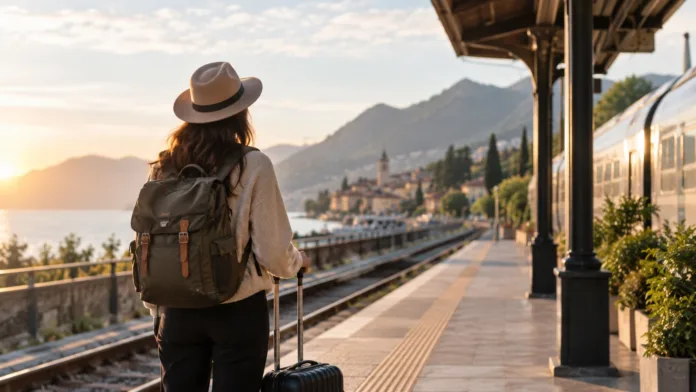

The first strange thing about travelling alone isn’t the silence. It’s how many decisions suddenly belong entirely to you.
Which train do you catch? Where do you eat? Do you spend the morning in a museum, hike somewhere you’ve never been or do absolutely nothing?
And when something goes wrong, there may be no travel companion automatically stepping in to sort it out.
That independence can feel uncomfortable. But it can also be part of what makes travelling alone psychologically rewarding.
Research into solo travel has identified motivations including independence, flexibility and self-development. At the same time, travelling alone can bring its own pressures, from safety concerns and anxiety to loneliness and financial stress.
So the mental health benefits of solo travel aren’t as simple as book a flight and come back happier.
The interesting part is what can happen when, for a while, your time, decisions and company become entirely your own.
Is solo travel actually good for your mental health?
It can be, but it isn’t guaranteed.
Travelling alone can create opportunities for autonomy, confidence, reflection and personal growth. Research into solo travel has repeatedly identified independence and flexibility among the reasons people choose to travel alone.
But being alone isn’t automatically good for us.
Research into everyday solitude suggests that how and why we spend time alone matters. Chosen solitude can support feelings of autonomy and peacefulness, while spending more time alone can also coincide with greater loneliness in some circumstances.
That’s why it’s better to think of solo travel as an opportunity for certain positive experiences, rather than a mental-health treatment or guaranteed reset.
1. You collect proof that you can handle things
Confidence doesn’t always arrive as a dramatic revelation on a mountaintop.
Sometimes it looks more like this:
You get on the wrong train.
Your phone battery is dying.
The hotel is harder to find than Google Maps suggested.
And somehow, you work it out.
When you’re travelling with someone else, responsibility can be shared. Alone, many of those little decisions belong to you.
Each problem you successfully deal with can become another piece of evidence that says:
I can figure things out.
That doesn’t mean solo travellers suddenly become fearless. Some of the most useful moments may happen precisely because you were uncertain and acted anyway.
Research comparing solo-travel behaviour has identified independence and flexibility as important motivations, alongside constraints such as safety and budget.
The potential benefit: Travelling alone gives you repeated opportunities to make decisions and solve manageable problems without immediately handing them to somebody else.
2. For once, nobody else gets a vote
Embed from Getty Images
Travelling with other people involves dozens of tiny negotiations.
Where should we eat?
Are we leaving now?
Does everyone want to visit that museum?
Is this restaurant too expensive?
Can we stay another day?
None of these things is necessarily stressful on its own. But together they mean part of your trip is always being shaped around other people’s preferences.
A question worth asking
What do I actually want to do?
Not what your friends would choose. Not what looks best on Instagram. Not what a travel guide says you have to see. If nobody else got a vote, how would you spend today?
You can wake up early without convincing anyone else.
Spend three hours somewhere everyone you know would find boring.
Change cities.
Stay in.
Eat dinner at 5 pm.
Eat dessert for dinner.
Nobody needs to approve the itinerary.
That freedom is closely related to autonomy, the feeling that your actions are genuinely your own. Research on solitude has found that autonomy during chosen time alone can contribute to more positive experiences of solitude, while another daily-life study found autonomy satisfaction during solitude was associated with more peaceful feelings.
The potential benefit: You temporarily step away from constantly adjusting your choices around other people’s preferences.
And sometimes you discover how many of your everyday decisions aren’t entirely your own.
3. New surroundings can pull you into the present
Think about your normal commute.
How much of it do you genuinely notice?
Probably less than you noticed the first few times you made the journey.
Familiarity allows us to operate partly on autopilot.
Travel interrupts that.
In an unfamiliar place, you have to notice station names. Streets look different. You listen for announcements. You work out transport systems, menus, currencies and cultural cues.
When you’re alone, there may also be no familiar conversation partner filling every quiet moment.
That doesn’t mean solo travel magically puts you into a permanent state of mindfulness.
It simply means novelty can make it harder to move through the entire day without paying attention.
A train platform you’ve stood on 400 times barely registers.
One in a city you’ve never visited before probably does.
The potential benefit: New surroundings can encourage you to pay closer attention to what is happening around you rather than moving through another completely familiar day.
4. You discover what you actually enjoy
Imagine travelling with friends who love nightlife.
You go out because everyone goes out.
Or perhaps your partner loves museums, so museums become part of every city break.
After a while, it can become surprisingly difficult to separate:
what I enjoy
from:
what we enjoy.
Solo travel removes that filter for a while.
Nobody is impressed if you visit the city’s most famous attraction.
Nobody is disappointed if you skip it.
Nobody cares whether you spend two hours in a bookshop instead.
There’s something revealing about making choices when nobody else is watching.
But “self-discovery” doesn’t have to mean returning home with a completely new identity.
Sometimes the discoveries are much smaller:
I actually like mornings.
I hate packed itineraries.
I enjoy eating alone.
I need more quiet than I realised.
I’d rather walk around a neighbourhood than tick off another attraction.
Those aren’t life-changing revelations.
But they are useful things to know about yourself.
The potential benefit: With fewer social compromises, your travel choices can reveal preferences that everyday routines or group decisions normally hide.
5. Small problems become resilience practice
Embed from Getty Images
Solo travel rarely goes exactly according to plan.
A bus doesn’t arrive.
It rains on the day you’ve planned to hike.
A restaurant is closed.
You miss a connection.
The room isn’t what you expected.
When you’re travelling with someone else, frustration can become a shared experience. Alone, you often have to move fairly quickly from:
This is a disaster.
to:
Okay. What do I do now?
That’s not always enjoyable.
But manageable setbacks give you opportunities to practise adapting rather than waiting for somebody else to solve the problem.
There’s an important distinction, though.
Challenge is not the same as danger.
You don’t need to take unnecessary risks, ignore your instincts or put yourself in unsafe situations to prove you’re independent.
This matters particularly for women travelling alone. Research on solo female travel has found that gendered, destination-specific and social-psychological risks can increase anxiety around travelling alone.
The potential benefit: You practise changing plans and solving ordinary problems independently, without pretending genuine safety concerns are somehow character-building exercises.
6. Distance can give you perspective
Sometimes you don’t realise how noisy your routine has become until you leave it.
Work.
Messages.
Appointments.
Housework.
The same commute.
The same conversations.
The same places.
Travel temporarily changes the scenery and interrupts some of those routines.
That distance can create room to notice things you’ve stopped questioning.
Maybe you realise you’re exhausted by an overfilled schedule.
Perhaps you miss someone more than expected.
Maybe you don’t miss something you assumed was important.
Or perhaps you simply realise you need more unstructured time when you get home.
But this is where travel writing often goes too far.
A change of scenery isn’t a cure
A holiday can give you temporary distance from everyday pressures.
It does not automatically resolve whatever created those pressures.
And solo travel should not be presented as a treatment for depression, anxiety or another mental-health condition.
Sometimes the useful part of gaining perspective is recognising what still needs attention when you get home.
The potential benefit: Stepping outside your normal routine may give you enough distance to notice patterns, priorities or pressures that are harder to see when you’re living inside them every day.
7. Travelling alone doesn’t mean being isolated
One of the biggest misconceptions about solo travel is that you have to spend the entire trip by yourself.
You don’t.
You can eat breakfast alone, join a walking tour at lunchtime, chat with another traveller in the afternoon and spend the evening reading by yourself.
Solo travel gives you more control over when you’re alone.
And strangely, being without a companion can sometimes make interaction easier.
When you’re travelling with a friend, you already have someone to talk to. When you’re alone, you may be more inclined to ask somebody a question, join an activity or start a conversation.
That matters because positive solitude and social connection don’t have to compete with one another. Recent research has found relationships between positive solitude, perceived social support, psychological flexibility and psychological well-being, although this research concerns solitude more broadly rather than solo travel specifically.
The potential benefit: Solo travel can give you independence without requiring complete social isolation.
And that distinction matters.
Solitude and loneliness aren’t the same thing
Embed from Getty Images
Being physically alone tells us surprisingly little about how somebody feels.
You can be alone and completely content.
You can also feel lonely in a crowded room.
Research into solitude has found that chosen, autonomous solitude can be experienced more positively, while another daily diary study found that more time alone could coincide with both lower stress and greater autonomy, but also greater loneliness and lower satisfaction on some days.
That’s why “solo” and “lonely” shouldn’t be treated as synonyms.
| Chosen solitude can feel like… | Unwanted loneliness can feel like… |
|---|---|
| Space to recharge | Disconnection |
| Freedom | Isolation |
| Peace | Emptiness |
| Enjoying your own company | Wishing someone were there |
| Choosing when to socialise | Struggling to find connection |
This isn’t a diagnostic checklist. Feelings are far more complicated than two columns.
But it illustrates why two people can spend the same afternoon alone and experience it completely differently.
When solo travel isn’t good for your mental health
This is the part glossy travel articles sometimes skip.
Solo travel isn’t automatically relaxing.
For some people, on some trips, it can be more stressful than travelling with somebody they trust.
You may find travelling alone difficult if:
You feel unsafe. Constantly assessing your surroundings can be exhausting, and safety concerns shouldn’t be dismissed as simply needing more confidence.
You become overwhelmed by decisions. Freedom sounds wonderful until every meal, route, hotel and activity requires another decision.
You expected to love being alone but feel lonely instead. There’s no failure in discovering that you prefer company.
Money becomes stressful. Travelling alone can mean having nobody to split accommodation, taxis and other costs with. Safety and budget have both appeared as meaningful constraints in solo-travel research.
You’re putting pressure on the trip to “fix” you. No destination can guarantee a personality transformation or emotional reset.
You’re travelling alone because social media made it look empowering. Independence doesn’t have to be demonstrated by getting on a plane alone.
A good solo trip is one you want, not one you feel you have to prove you can survive.
How to get the benefits without making yourself miserable
The internet version of solo travel often starts with an airport.
Yours doesn’t have to.
Start smaller than Instagram suggests
Try spending a day somewhere alone.
Visit another town.
Go to a museum.
Have lunch by yourself.
Then perhaps try one night away.
Learning that you enjoy your own company in another city is useful information before committing to a three-week trip thousands of miles from home.
Plan the stressful parts
Spontaneity is much more enjoyable when you’re not wondering how you’ll safely get from an unfamiliar airport to your accommodation at midnight.
Book the logistics that would otherwise make you anxious, then leave flexibility where it feels enjoyable.
Don’t schedule every hour
If your itinerary is packed from breakfast until bedtime, you may recreate the same pressure you were hoping to escape.
Leave some blank space.
Build in optional connection
A walking tour, cooking class, group excursion or social accommodation can provide company without turning the entire trip into group travel.
Keep contact with home
Travelling independently doesn’t mean cutting yourself off from everyone you know.
Checking in with friends or family can provide reassurance and connection, particularly on a longer trip.
Give yourself permission to change the plan
You don’t earn extra solo-traveller points for staying somewhere you dislike.
Move hotels.
Skip the activity.
Join the group tour.
Spend the afternoon in your room.
Go home early if you genuinely need to.
The trip belongs to you.
That’s rather the point.
FAQs
Is solo travel good for mental health?
It can be a positive experience for some people because it creates opportunities for autonomy, independent decision-making, reflection and chosen solitude.
However, research on solitude shows that time alone can have both positive and negative associations with well-being depending partly on factors such as whether the solitude is chosen and whether a person’s social needs are otherwise being met.
Solo travel therefore shouldn’t be treated as a guaranteed mental-health benefit.
Can solo travel help with stress?
Possibly, depending on the person and the trip.
Research on everyday solitude has found that people reported less stress and greater autonomy satisfaction on days when they spent more time alone, although more solitude was also associated with greater loneliness and lower satisfaction on some measures.
A solo holiday can also introduce its own stresses involving transport, safety, money and decision-making.
Does travelling alone build confidence?
It can create opportunities to make decisions and solve unfamiliar problems independently.
Solo-travel research has identified independence and flexibility as important motivations for travelling alone.
Whether that translates into greater lasting confidence will vary between travellers, so it is better described as an opportunity to exercise independence rather than a guaranteed psychological outcome.
Can solo travel make you lonely?
Yes.
Travelling alone and enjoying solitude aren’t the same thing. Research on everyday solitude shows that spending more time alone can sometimes be associated with greater loneliness, while chosen and autonomous solitude can be experienced more positively.
Solo travellers can reduce unwanted isolation by joining activities, speaking with other travellers and maintaining contact with people at home.
Is solo travel good for introverts?
It can suit some introverts, but being introverted doesn’t automatically mean someone will enjoy travelling alone.
Research examining solitude has found that introversion itself did not predict people’s self-determined motivation for solitude in the way researchers might intuitively expect.
A short solo trip is therefore a better test than assuming a personality label has already decided the answer.
Can travelling alone help you “find yourself”?
Perhaps, but don’t expect a movie ending.
Travelling alone can remove some familiar routines and social influences, giving you opportunities to notice your preferences and make decisions independently.
“Finding yourself” might simply mean discovering that you love quiet mornings, hate overplanned holidays or are more comfortable dealing with uncertainty than you thought.
That still counts.
The journey doesn’t have to change your life
Solo travel doesn’t need to cure you, transform you or reveal your life’s purpose to be worthwhile.
Maybe you come home feeling more capable.
Maybe you understand your preferences slightly better.
Maybe you discover that being alone can feel peaceful rather than awkward.
Or maybe you learn that your favourite part of travelling is sharing it with somebody else.
All of those are useful discoveries.
The value of travelling alone may be less dramatic than social media makes it sound. For a while, you become responsible for your own time, choices and company.
What you learn from that may be the most interesting part of the journey.