
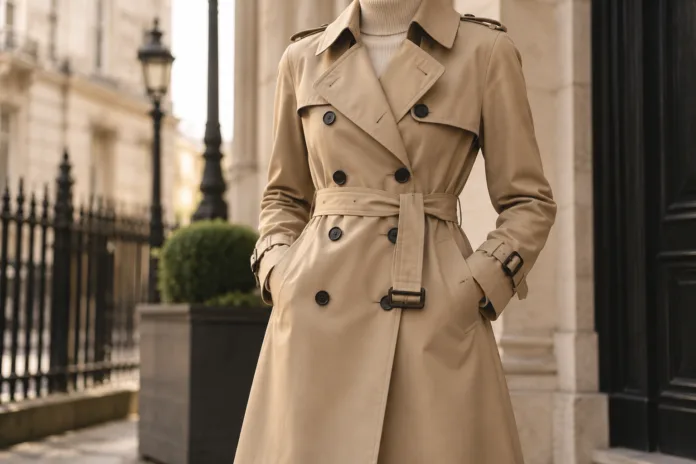

A Burberry trench coat can cost far more than an ordinary trench that looks similar at first glance. So what exactly are you paying for?
Part of the answer is tangible. Burberry’s Heritage trench coats use the brand’s signature cotton gabardine, are made in Yorkshire and include construction details that have evolved from the trench coat’s functional roots. Part of the price, however, comes from something less tangible: more than a century of design heritage and the value attached to the Burberry name.
That distinction matters. A cheaper trench can give you a similar silhouette and may be perfectly good for everyday wear. What it cannot necessarily reproduce is the same combination of fabric, manufacturing, history and brand identity.
Here’s what makes the difference, and what to consider before deciding whether that difference is worth paying for.
What are you actually paying for?
The price of a Burberry Heritage trench isn’t explained by one feature alone.
🧵 Gabardine: Burberry’s signature shower-resistant cotton fabric
✂️ Specialist construction: Heritage coats are cut and finished in Yorkshire
🇬🇧 British manufacturing: Burberry’s Castleford site has produced its Heritage trenches for decades
🧥 Functional details: Epaulettes, storm shields, belts and other features have roots in the coat’s practical history
📜 Heritage: Burberry’s association with gabardine and trench coats stretches back more than a century
♞ The Burberry name: You’re also paying for the recognition and positioning of a global luxury brand
The important part is understanding how much each of those things matters to you.
1. It starts with gabardine
Embed from Getty Images
The fabric is one of the strongest reasons a Burberry trench is different from a generic trench coat.
Thomas Burberry developed gabardine in 1879 as an alternative to the heavier waterproof materials available at the time. Rather than relying on a heavy coating over the finished material, gabardine uses a tightly woven construction designed to provide protection from the elements while remaining breathable. Burberry continues to use cotton gabardine in its Heritage trench coats today.
Burberry currently describes the fabric used in its Heritage trenches as shower-resistant, an important distinction we’ll return to later.
If you want to explore the fabric’s history directly, Burberry explains the development of gabardine and the trench coat in its heritage archive.
So the fabric isn’t simply an expensive cotton chosen for a luxury label. It is part of the reason Burberry became associated with weather-resistant outerwear in the first place.
2. Burberry Heritage trench coats are made in Yorkshire
Embed from Getty Images
This is where precision matters.
It would be inaccurate to say that every Burberry coat is made in England. But Burberry states that its current Heritage trench and car coats are manufactured in Yorkshire.
The cotton gabardine used for the Heritage collection is woven at Burberry’s mill in Keighley. The coats are then cut and finished at its Castleford manufacturing site. Burberry acquired the Castleford factory in 1972, and the site continues to produce its Heritage trench coats today.
There is specialist work involved too. Burberry says the stitching used to construct the Heritage trench collar takes up to a year for a specialist to master, with more than 180 stitches used to create its curve.
That doesn’t tell us what proportion of the retail price comes from manufacturing. Burberry does not publish that breakdown.
It does, however, give us something more concrete than simply saying the coat is expensive because of “craftsmanship”.
3. Those famous trench details weren’t originally just decoration
Embed from Getty Images
Look closely at a classic Burberry trench, and you’ll find details that have become part of the modern trench-coat look:
Epaulettes on the shoulders
Storm shield across the back
Gun flap at the shoulder
Belt and adjustable cuffs
Throat latch
D-rings on some Heritage designs
Burberry Check lining
Many of these elements have roots in the trench’s functional and military history rather than being added simply to make the garment look luxurious.
For example, Burberry’s historical material explains that epaulettes were used to display an officer’s rank, while D-rings could be used to attach equipment.
Today, these details are as much part of the coat’s visual identity as its practical construction.
That creates an interesting difference between Burberry and many cheaper trenches. Other brands can reproduce the look of these details, but Burberry can connect them directly to its own design history.
4. More than a century of history is built into the price
Burberry did not become synonymous with trench coats overnight.
Thomas Burberry founded the company in 1856 and developed gabardine in 1879. The trench subsequently evolved from functional outerwear into one of the brand’s defining garments. Burberry’s Castleford factory has produced Heritage trenches for more than 50 years.
That history matters in luxury fashion because buyers aren’t evaluating the garment solely as fabric stitched into the shape of a coat.
They’re also buying a design with a recognised origin and cultural identity.
Think of it this way:
A less expensive watch can tell the time.
A less expensive handbag can carry the same belongings.
And a less expensive trench can keep you out of the rain.
Luxury products have never been priced solely according to basic function.
Which brings us to the part that shouldn’t be ignored.
5. Yes, you’re also paying for the Burberry name
It would be misleading to explain the price of a Burberry trench entirely through fabric and craftsmanship.
Burberry is a luxury fashion house. Its brand recognition, history, design identity, retail positioning and exclusivity contribute to what consumers are prepared to pay for its products.
That is the brand premium.
There is no reliable public breakdown showing that a specific percentage of a Burberry trench’s retail price pays for material, another percentage for labour and another for the logo. So claims such as “half the price is just the name” aren’t something we can substantiate.
What we can say is that two different kinds of value exist here:
Product value comes from the fabric, construction, finishing and functionality.
Brand value comes from owning a recognised Burberry design with the company’s heritage and identity attached to it.
A buyer deciding whether the coat is worth the money needs to care about both, because the retail price reflects more than utility alone.
So how much of the price is quality and how much is the brand?
There isn’t a defensible percentage.
And that’s important because articles about luxury fashion sometimes make this sound much simpler than it is.
Burberry publicly provides information about its materials, manufacturing and construction, but it doesn’t publish a coat-by-coat cost breakdown showing exactly how the retail price is formed.
What we can verify is that current Heritage trenches involve:
- cotton gabardine woven in Yorkshire
- manufacturing at Castleford
- specialist construction and finishing
- distinctive trench details
- Burberry Check lining
- more than a century of design heritage
What cannot be separated neatly is how much each of those factors contributes to the final retail price.
So if someone tells you a Burberry trench costs what it does only because of quality, that’s too simplistic.
If someone says you’re paying only for the logo, that’s too simplistic too.
The reality sits between the two.
Burberry Heritage trench vs a regular trench coat
This is where the difference becomes easier to understand.
| Burberry Heritage trench | Typical trench coat | |
|---|---|---|
| Main appeal | Craft, heritage, design and brand | Style and everyday function |
| Outer fabric | Burberry cotton gabardine | Varies widely |
| Manufacturing | Heritage collection made in Yorkshire | Depends on brand |
| Design history | Direct connection to Burberry’s trench heritage | Varies |
| Recognisable details | Burberry Check and Heritage construction | Depends on design |
| Brand premium | Significant | Usually lower |
| Best suited to | Someone who specifically values Burberry | Someone primarily wanting a trench coat |
The most important row is probably the last one.
If you simply want the trench-coat look, you don’t need Burberry to get it.
If you specifically want a Burberry trench, cheaper coats aren’t exact substitutes because part of what you’re buying is the history and brand itself.
Is a Burberry trench actually better in the rain?
This is where price and performance shouldn’t be confused.
Burberry describes its current Heritage cotton gabardine trenches as shower-resistant.
That doesn’t mean a luxury trench is automatically the best choice for severe rain.
Someone buying a coat primarily for demanding wet-weather performance may be better served by a modern technical waterproof jacket designed specifically for that job.
A Burberry trench serves a different combination of purposes:
weather resistance + tailoring + fashion + heritage.
Instead of asking:
“Is this the best raincoat I can buy for the money?”
Ask:
“Do I value the particular mix of function, style, craftsmanship and heritage this coat offers?”
That’s what you’re actually paying for.
What makes a women’s Burberry trench coat a luxury item?
A women’s Burberry Heritage trench is considered a luxury garment for essentially the same reasons as the men’s versions.
Current women’s Kensington Heritage trenches, for example, are made in England from shower-resistant cotton gabardine woven at Burberry’s mill and include features such as a double-breasted closure, epaulettes, storm shield, gun flap, leather-buckle belt and cuffs, and Burberry Check lining.
But those material details alone don’t define it as luxury.
Its luxury status comes from the combination of specialist construction, British manufacturing on Heritage styles, proprietary design history, recognisable brand codes and Burberry’s positioning as a luxury fashion house.
That’s also why two trench coats can look broadly similar while being sold at dramatically different prices.
Can a cheaper trench coat give you the same look?
Yes, to a point.
The trench-coat silhouette isn’t exclusive to Burberry.
You can find far less expensive coats with:
double-breasted fronts, belts, epaulettes, storm flaps and beige or neutral colouring.
From across a room, some may create a very similar overall look.
Where the difference becomes more apparent is in the details.
A cheaper trench won’t necessarily give you Burberry’s specific gabardine, Heritage manufacturing, construction, check lining or brand history.
But whether those differences are worth paying substantially more for is personal.
If what you really want is…
A stylish beige trench coat
Then paying the Burberry premium may not be necessary.
But if what you specifically want is…
A Burberry trench coat
Then the heritage, craftsmanship, signature design and Burberry name are part of what you’re choosing to pay for.
That distinction can save you a very expensive purchase made for the wrong reason.
Is a Burberry trench coat worth the money?
Embed from Getty Images
There isn’t one answer that works for everyone.
It may be worth considering if you:
✓ Value Burberry’s history specifically
You’re not merely looking for any trench coat.
✓ Expect to wear it regularly for years
A classic outerwear purchase makes more sense when it won’t spend most of its life inside a wardrobe.
✓ Care about how the Heritage collection is made
The Yorkshire manufacturing, gabardine and specialist construction genuinely matter to you.
✓ Prefer long-lasting design over fast-changing trends
The classic trench silhouette is the reason you’re buying it.
✓ Can comfortably afford it
A luxury coat should not require compromising more important financial priorities.
It may make less sense if you:
✗ Mainly want the trench-coat look
There are many alternatives.
✗ Need maximum waterproof performance
A technical waterproof coat serves a different purpose.
✗ Rarely wear this type of outerwear
An expensive coat doesn’t become better value simply because it’s expensive.
✗ Don’t particularly care about Burberry
A large part of the proposition is the heritage and brand identity.
✗ Are buying it because someone called it an “investment”
That word needs some qualification.
Before you buy
The 60-second luxury purchase test
That designer piece looks tempting. Before you pay the premium, forget the logo for 60 seconds and see how many of these statements you can honestly tick.
Now look at what you didn’t tick.
Those unanswered questions may matter more than your score. If you’re hesitating over how often you’ll use it, what the premium actually buys or whether a cheaper option would make you equally happy, don’t rush. If you can answer all five confidently, you at least know why you’re considering paying more.
One final reality check: calculate the cost per wear too. Divide the price by the number of times you realistically expect to wear the item. It won’t tell you whether to buy it, but it can make the price easier to judge against your actual lifestyle.
Is a Burberry trench really an investment?
Fashion writers often call expensive classic pieces investment pieces, but that phrase can be misleading.
A wardrobe investment means paying more for something you expect to own and wear for a long time.
A financial investment is something purchased with an expectation of preserving or increasing monetary value.
They are not the same thing.
A Burberry trench may make sense as a wardrobe investment for someone who wears it regularly for many years. That does not mean you should assume you’ll eventually sell it for what you paid, let alone make a profit.
A better way to think about the purchase is cost per wear.
Imagine, purely as an example, a £2,000 coat.
Wear it 20 times, and that’s:
£100 per wear
Wear it 100 times:
£20 per wear
Wear it 500 times over many years:
£4 per wear
That doesn’t make the coat inexpensive. It simply shows why how often you’ll genuinely wear something matters more than the word “investment”.
What about buying a vintage Burberry trench?
If you specifically want Burberry but don’t want to pay current retail prices, vintage and pre-owned trenches can be worth exploring.
There are potential advantages:
Lower prices than buying new
Access to older cuts and discontinued styles
The possibility of finding a coat with plenty of usable life remaining
But vintage introduces different risks.
Sizing may differ from current collections. A coat may have been altered. Condition varies, and authenticity becomes more important when buying through third-party marketplaces.
So don’t buy a vintage trench based only on the label photograph.
Check:
overall condition
measurements rather than just tagged size
lining and buttons
stains or damage
alterations
seller reputation
authentication and return protection
Vintage can make the Burberry proposition more accessible, but it requires more homework.
A Burberry trench also needs looking after
The cost doesn’t necessarily end when you buy the coat.
Burberry recommends cleaning its Heritage trench and car coats only when necessary, storing them on a hanger in a breathable garment bag and using Burberry’s aftercare service or a specialist dry cleaner when deeper cleaning is required.
You can read Burberry’s full Heritage trench care guidance before buying.
That’s worth considering if you’re comparing a luxury trench with a lower-maintenance everyday coat.
The best luxury purchase isn’t simply something you can afford to buy. It’s something you’re also willing to wear and maintain properly.
FAQs
Why are Burberry trench coats so expensive?
Burberry Heritage trenches combine the brand’s cotton gabardine, specialist manufacturing in Yorkshire, detailed construction and more than a century of trench-coat heritage. The price also reflects Burberry’s status and positioning as a luxury fashion brand.
That means you’re paying for both tangible qualities in the garment and intangible brand value.
What makes Burberry a luxury brand?
Burberry combines heritage, distinctive design codes, specialist products and manufacturing, luxury positioning and global brand recognition.
In the case of its Heritage trench coat, that luxury positioning is reinforced by Yorkshire manufacturing, signature gabardine and a design closely associated with the company for more than a century.
What is Burberry gabardine?
Gabardine is the fabric Thomas Burberry developed in 1879. Burberry describes its construction as breathable while providing protection against the elements. Modern Heritage trenches continue to use shower-resistant cotton gabardine.
Are Burberry trench coats waterproof?
Don’t assume they are fully waterproof simply because they are expensive.
Burberry describes current Heritage trench coats as made from shower-resistant cotton gabardine.
If you need a coat specifically for prolonged or severe rain, compare its performance with purpose-built technical waterproof outerwear.
Are Burberry trench coats made in England?
Burberry’s Heritage trench coats are made in Yorkshire, England. Burberry says the gabardine is woven at its Keighley mill and Heritage coats are cut and finished at its Castleford manufacturing site.
That claim should not automatically be extended to every coat or garment Burberry sells.
Can you get the Burberry trench look for less?
Yes.
Many brands sell belted, double-breasted trench coats with details inspired by traditional trench construction.
What a cheaper coat won’t necessarily reproduce is Burberry’s specific combination of gabardine, Heritage manufacturing, finishing, check lining, history and brand identity.
Whether those differences matter enough to justify the premium is up to the buyer.
How long should a Burberry trench coat last?
There isn’t a responsible fixed number of years we can promise.
Longevity depends on how frequently the coat is worn, how it is stored, cleaning, damage, alterations and general care.
Burberry provides specific care guidance for its Heritage trenches, including specialist cleaning and appropriate storage.
Final thoughts
So, why are Burberry trench coats so expensive?
There is a real product story behind the price. The Heritage trench combines Burberry’s signature gabardine, specialist Yorkshire manufacturing, detailed construction and a design history stretching back more than a century.
But those things don’t explain the price in isolation.
You’re also paying for Burberry.
For some buyers, that combination of craftsmanship, history and brand identity is exactly the point. For others, a well-made lower-priced trench can deliver the style and everyday function they actually need.
The useful question therefore isn’t whether a Burberry trench is universally “worth it”.
It’s whether the things that make it different are things you personally value enough to pay for.