
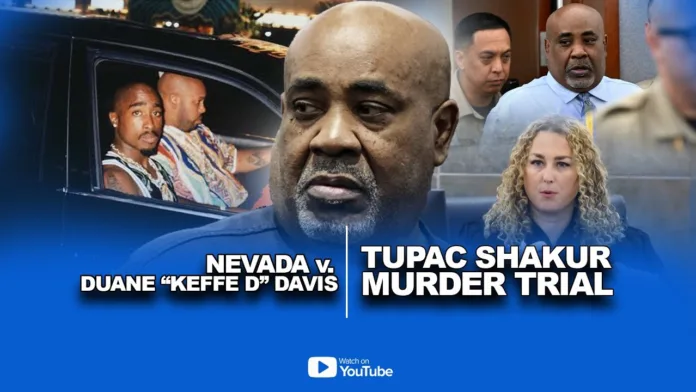

The trial over the killing of legendary rapper Tupac Shakur has begun in Las Vegas, nearly 30 years after he was shot.
Prosecutors say former gang leader Duane “Keffe D” Davis helped organise the shooting as an act of revenge following a fight involving his nephew, Orlando Anderson.
Davis, now 63, is accused of murder. He has pleaded not guilty and denies the allegations.
Prosecutors say Davis did not fire the gun himself but played a leading role in organising the attack.
Witness recalls the night Tupac was shot
One of the first witnesses to testify was Ingrid Stokes, who was in Las Vegas on the night of the shooting in September 1996.
Stokes told the court that she and her friends were driving around the city when they came across Tupac Shakur and Death Row Records co-founder Marion “Suge” Knight.
According to her testimony, another vehicle appeared to be following their car and trying to move in front of them.
The group eventually stopped near a traffic light because they were concerned about the other vehicle.
Stokes said she and her friends were changing drivers when they suddenly heard gunfire.
She described the scene as chaotic, saying: “All hell broke loose.”
Prosecutors say Tupac shooting was revenge
Prosecutors told jurors that the alleged attack followed a confrontation between Tupac and Orlando Anderson earlier that evening.
They say Anderson had been involved in a fight with Shakur, and Davis believed the incident required retaliation.
Chief Deputy District Attorney Binu Palal told the jury that Davis allegedly planned the shooting but did not personally pull the trigger.
Prosecutors claim Davis was the person who organised the group and helped direct what happened that night.
Police officer describes Tupac’s final days
The prosecution also called Garry Dale, a former Las Vegas Metropolitan Police Department officer who responded to the shooting.
Dale told the court that he travelled with Tupac in an ambulance after the rapper was wounded.
According to the officer, Shakur did not provide information about who shot him or explain what had happened.
The rapper reportedly told police that the matter would be handled by those around him.
Tupac was 25 when he was shot on 7 September 1996, after attending a Mike Tyson boxing match in Las Vegas. He died six days later.
Why the case remained unsolved for decades
The investigation into Tupac’s murder remained unresolved for many years.
Prosecutors say the gang culture and rivalry surrounding 1990s hip-hop contributed to the lack of cooperation with police.
The wider East Coast vs West Coast hip-hop rivalry, along with tensions between the Bloods and Crips, formed part of the background to the case.
Authorities have said that people who knew what happened were reluctant to speak to investigators.
However, members of Tupac’s entourage have previously accused police of treating them as suspects instead of properly following potential leads.
Duane Davis’s memoir became important evidence
The case received renewed attention after Davis published a memoir in 2019.
In the book and in later interviews, Davis has discussed his alleged involvement in the events surrounding Tupac’s death.
Prosecutors say Davis described being in the vehicle involved in the shooting and claimed that he gave a gun to his nephew, Orlando Anderson.
Davis’s lawyers have argued that the memoir contains fictional material and should not be relied upon as evidence.
However, a judge ruled that the book could be presented during the trial.
Defence says investigation was flawed
Davis’s defence team has strongly challenged the prosecution’s case.
His lawyers have questioned why the murder went without an arrest for almost three decades.
They have also pointed to missing police records and disputed evidence.
The defence claims investigators made mistakes and relied on witnesses whose accounts changed over time.
Lawyers for Davis have also questioned the credibility of some witnesses, arguing that certain individuals had criminal backgrounds or possible financial reasons to give particular accounts of events.
Prosecutors present their version of events
According to prosecutors, Davis obtained a gun and helped arrange vehicles to travel around Las Vegas on the night of the shooting.
They say one of the vehicles was a white Cadillac carrying Anderson and two other men.
Prosecutors allege that the group initially intended to go out and enjoy the night but later encountered Shakur and Knight.
They claim Davis and the others decided to turn around and confront the rapper.
The prosecution says Davis then passed a gun to Anderson, who allegedly fired at Shakur’s vehicle.
The defence disputes this account.
Tupac murder trial will continue
The opening statements marked the beginning of a trial that is expected to last several weeks.
Witnesses, investigators and experts are expected to give evidence about the events surrounding Tupac Shakur’s death.
The court may also hear from high-profile witnesses as prosecutors and defence lawyers present their cases.
The trial is being closely watched because Tupac remains one of the most influential figures in hip-hop history, and his murder has remained one of the music world’s most famous unsolved cases for decades.
Key facts about the Tupac murder trial
- Victim: Tupac Shakur
- Defendant: Duane “Keffe D” Davis
- Age of Tupac when killed: 25
- Shooting date: 7 September 1996
- Location: Las Vegas, Nevada
- Tupac’s death: Six days after the shooting
- Defendant’s plea: Not guilty
- Main prosecution claim: Davis helped organise the shooting
- Defence position: Davis is not responsible and the investigation was flawed