
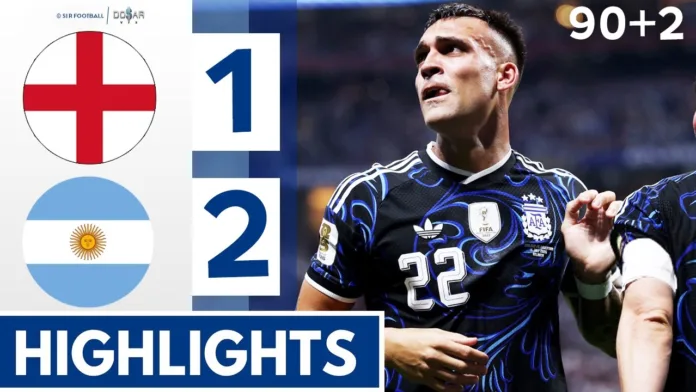

Anthony Gordon put England ahead in the World Cup semi-final, but late goals from Enzo Fernández and Lautaro Martínez sent Argentina into Sunday’s final against Spain.
Key takeaway
England were minutes away from reaching the 2026 World Cup final after Anthony Gordon gave them a second-half lead against Argentina. However, Enzo Fernández equalised in the 85th minute before Lautaro Martínez scored in stoppage time, completing a 2–1 comeback in Atlanta.
England suffer late World Cup semi-final heartbreak
England’s hopes of reaching the 2026 FIFA World Cup final ended in painful fashion after Argentina overturned a one-goal deficit during the closing stages of their semi-final in Atlanta.
Anthony Gordon gave England the lead in the 55th minute, meeting a low cross from Morgan Rogers and directing the ball beyond Argentina goalkeeper Emiliano Martínez. The goal appeared to place Thomas Tuchel’s team within touching distance of the final after a physical and closely contested first half had ended without a goal.
Argentina gradually increased the pressure as England attempted to protect their advantage.
The defending champions eventually broke through in the 85th minute. Following a quickly taken corner, Lionel Messi moved infield from the right and found Enzo Fernández near the edge of the penalty area. Fernández then struck a powerful shot beyond Jordan Pickford to make it 1–1.
The decisive moment arrived two minutes into second-half stoppage time. Messi delivered a cross from the right, allowing substitute Lautaro Martínez to head home from close range and secure a 2–1 victory for Argentina.
Tuchel’s changes come under scrutiny
England became increasingly passive after taking the lead, while Argentina committed more players to attack and began controlling possession in advanced areas.
Tuchel introduced Ezri Konsa in place of goalscorer Gordon before later replacing Reece James with Dan Burn and Declan Rice with Nico O’Reilly. The changes strengthened England defensively on paper, but the team struggled to retain possession or relieve the pressure around its penalty area.
After the match, Tuchel rejected the suggestion that England’s repeated disappointments in major tournaments were caused by a national curse. He acknowledged that his side had lost control after going ahead and accepted that his tactical decisions would be examined following the defeat.
Although Tuchel’s substitutions attracted criticism, Argentina’s two goals also involved high-quality individual execution. Fernández produced an excellent finish for the equaliser, while Messi’s delivery for the winning goal created the opening that sent the defending champions into another World Cup final.
What happens next for England?
England’s tournament is not yet over. Tuchel’s side will face France in the third-place play-off on Saturday, 18 July, after France lost 2–0 to Spain in the other semi-final.
Argentina will meet Spain in the final on Sunday, 19 July, in East Rutherford, New Jersey. Argentina are attempting to retain the trophy they won in 2022, while Spain are seeking their first men’s World Cup title since 2010.
England’s attention will now turn to the third-place match and to the wider debate surrounding Tuchel’s late substitutions and the team’s inability to maintain control after taking the lead.