
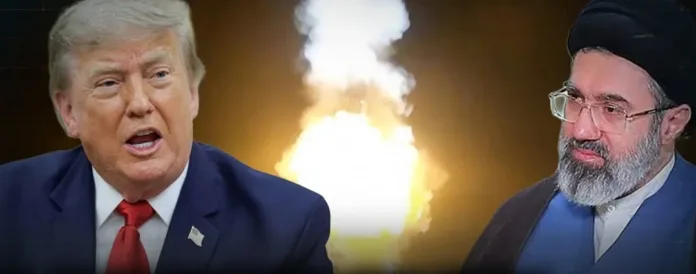

Iran says it hit US-linked facilities in Bahrain as Washington launches fresh strikes
Iran’s Revolutionary Guards have claimed they targeted facilities linked to the US Fifth Fleet in Bahrain, as the latest US-Iran escalation pushed the Gulf crisis into an even more dangerous phase.
The Guards said on Wednesday that they had struck command-and-control, logistics, fuel and military equipment facilities belonging to the US naval force. They said the attack was a response to US actions in the Indian Ocean and attempts to control the Strait of Hormuz and restrict shipping routes.
The claim has not been independently verified, and the Guardian said it could not immediately confirm all of Iran’s battlefield statements. But the warning itself was stark. The Guards said that if Washington tried to block regional oil and gas exports by controlling maritime routes, other export routes serving the US and its allies could also be closed.
The US-Iran escalation followed another round of American strikes. US Central Command said it completed a seven-hour wave of attacks at 10 pm ET on 14 July, hitting dozens of military targets near the Strait of Hormuz and Iranian coastal areas.
Centcom said US fighter aircraft, drones and naval vessels used precision munitions against Iranian missile and drone sites, naval capabilities and coastal defence systems. It said the purpose was to further weaken Iran’s ability to threaten commercial shipping and civilian crews.
The latest exchange came after days of intensifying conflict around one of the world’s most important energy routes. US forces have carried out strikes against Iran for four consecutive days, while Washington has also reimposed a naval blockade to stop ships sailing to or from Iranian ports.
The US-Iran escalation has already drawn in several Gulf states. Kuwait said its air defences were intercepting Iranian attack drones. Bahrain’s interior ministry said sirens had sounded in the country. Iran’s army also claimed it targeted US military facilities at Azraq base in Jordan for a second time, according to state media.
President Donald Trump has warned that US strikes will continue until he decides they have gone far enough. In an interview with Fox News, he said attacks could expand next week to power plants and bridges unless Tehran returns to negotiations.
That threat has raised further concern because the Geneva conventions prohibit attacks on sites considered essential for civilians. UN human rights chief Volker Turk has also warned that a return to US-Iran hostilities would be a major setback for civilians.
The US-Iran escalation has also shaken diplomacy. Iran’s deputy foreign minister Kazem Gharibabadi said the renewed US blockade had, in effect, dismantled the interim memorandum meant to reduce tensions. The deal had set a 60-day timeline for talks on Iran’s nuclear programme and arrangements around the Strait of Hormuz, but those talks have stalled as fighting has grown.
Energy markets have reacted sharply. Crude oil prices have reached their highest level in four weeks, while economists warn that global oil inventories could again come under pressure if shipping remains disrupted.
The crisis has also brought fresh US sanctions. Washington has targeted a shipping network linked to Mohammad Hossein Shamkhani, which the US Treasury says helps Iran evade restrictions on oil sales and other activities.
For now, the US-Iran escalation shows no sign of easing. Iran is warning that regional energy exports must be available to everyone or no one. The US says it is acting to protect commercial shipping. Between those positions, the Gulf is becoming more unstable by the hour.