
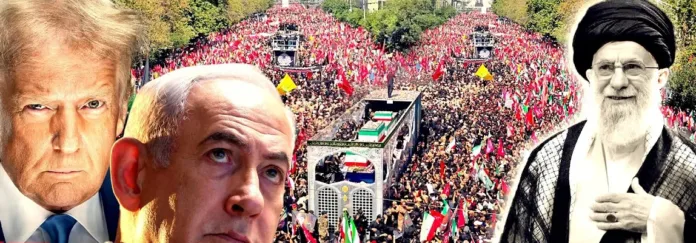

Crowds filled Tehran in 36C heat as grief, fury and defiance shaped the procession
Millions of Iranians filled central Tehran on Monday as the fourth day of mourning for assassinated former supreme leader Ali Khamenei turned into a vast display of grief, patriotism and anger.
The Khamenei funeral procession moved along Azadi Street towards Revolution Square in fierce 36C heat, with drums, chants, banners and flags filling the route. For many in the crowd, the day was not only about mourning a leader. It was also a public show of defiance after months of on-off war and a message that Iran had survived.
One banner captured the mood sharply, declaring that the people were Iran’s real missiles. Chants against US President Donald Trump rang out during the march, while some mourners spoke openly about revenge.
The Khamenei funeral procession drew families with children, elderly people in wheelchairs, clerics, doctors, engineers and young people dressed in everyday clothes. Water was sprayed over the crowd to ease the heat as people moved slowly through the capital.
The scene contrasted with the more solemn prayers held earlier at the Grand Mosalla mosque, where the six-day funeral period began. On the streets, grief mixed with politics. Some mourners said they had come to honour Khamenei as a father figure. Others said they wanted Iran’s enemies punished.
Fatima Zadeh, who joined the march, said the huge turnout showed Iran had won the war. She said people had not gathered only to cry, but to unite and gain strength.
Ali Sayadian, a cleric from Yasuj, said he had travelled about 1,000km to Tehran because he felt indebted to Khamenei’s leadership. He said Iranians had the right to demand revenge after their leader was killed.
The Khamenei funeral procession also carried a message aimed beyond Iran. Sayadian argued that the crowd represented the voice of the Iranian nation and rejected the idea that support came only from one class or region.
Yet the gathering did not reveal one simple national mood. Those who travelled long distances to mourn Khamenei were, by nature, a self-selecting group. Others who stayed away may hold different views about the political path Iran followed under him.
Even inside the march, not every voice sounded the same. One young woman in a chador quietly suggested that another revolution was still alive, then disappeared into the crowd after sensing too many people nearby.
Others spoke of regret. Maryam Ghiyasi, a doctor, said she felt ashamed that Iranians had not done enough for Khamenei while he was alive. Her husband, Hamid Razavi, praised Iran’s leadership and said it had protected the country’s land.
The Khamenei funeral procession also became a place for harder demands. Some mourners told reporters Iran should race to build a nuclear weapon, arguing that nuclear-armed states were treated differently. Others framed the moment as a clash between Islamic civilisation and the West.
Mohammad Mousabvi, a gymnastics coach, said he had come both to preserve Khamenei’s memory and to confront Trump. Standing near a poster aimed at the US president, he called for revenge through the destruction of Israel and America.
For supporters, the Khamenei funeral procession showed unity, endurance and national pride. For critics watching from outside the crowds, it may also have shown the depth of Iran’s unresolved divisions.
What was clear in Tehran was the scale of the moment. The Khamenei funeral procession was not quiet mourning. It was a march of grief, fury and identity, with millions using the streets to declare that Iran had not been broken.