
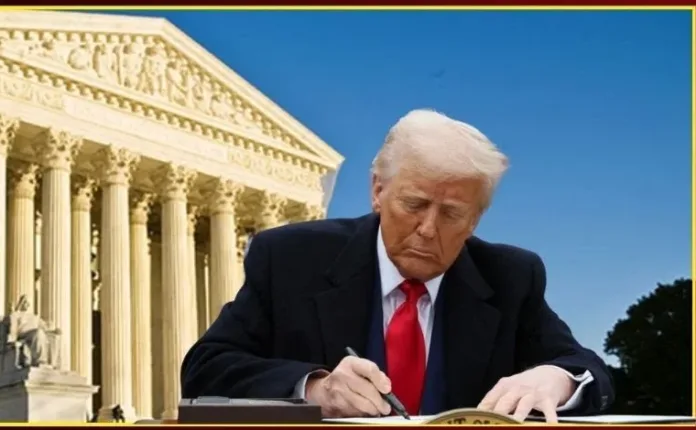

The Supreme Court weighs Trump’s sweeping global tariffs in a case that could reshape U.S. power
The world is watching as the United States Supreme Court prepares to rule on one of the most consequential trade disputes in modern history, a decision that could redefine presidential power and send shockwaves through the global economy.
Donald Trump’s sweeping global tariffs, which have been at the heart of his trade strategy since returning to the White House, now face their ultimate test. The administration is battling a coalition of small businesses and U.S. states who argue that the duties are unconstitutional and must be overturned.
If the court sides with Trump’s opponents, it could dismantle the foundation of his trade policy and force the government to refund billions of dollars in import taxes. Analysts warn the sum could eventually reach a staggering $1 trillion if the tariffs are struck down.
Trump has framed the case as a fight for national security and economic sovereignty. “If we don’t win, America will be weakened,” he said earlier this week. “We’ll be in a financial mess for many years to come.” He confirmed he will not attend the hearing in person, saying he does not want to distract from “the importance of the decision.”
The case revolves around Trump’s use of the 1977 International Emergency Economic Powers Act — a Cold War-era law allowing presidents to act swiftly during national emergencies. The administration has relied on it to justify imposing tariffs of 10% to 50% on goods from nearly every major trading partner. Trump claims that America’s trade deficit and foreign drug trafficking both qualify as “extraordinary and unusual threats” to national security, giving him the power to act unilaterally.
Critics say the president has stretched the law beyond recognition. They argue that tariffs, as a form of taxation, fall squarely under Congress’s constitutional authority — not the executive branch. Over 200 members of Congress, mostly Democrats but joined by Republican Senator Lisa Murkowski, have submitted a brief urging the court to curb presidential overreach. Three lower courts have already ruled against the administration, setting the stage for this final showdown before the nation’s highest judges.
For American businesses, the stakes could hardly be higher. Many companies have faced financial ruin under the weight of Trump’s import duties. Learning Resources, a U.S. educational toy company, says its tariff bill has soared to $14 million this year — seven times what it paid in 2024. “They’ve thrown our business into unbelievable disruption,” said CEO Rick Woldenberg.
In Georgia, Cooperative Coffees has paid more than $1.3 million since April. Co-founder Bill Harris described the strain as “an energy drain like I’ve never seen,” saying his company has been forced to raise prices, borrow more, and accept shrinking profits.
The impact stretches far beyond U.S. borders. In Switzerland, chocolatier Daniel Bloch said his company, Chocolats Camille Bloch, has lost all profits from its American operations due to tariffs of nearly 40%. “If the court makes the tariffs go away, that would be a positive sign,” he said. “But we don’t trust that it will bring a solution.”
The uncertainty has already delayed trade deals worldwide. The European Union, which agreed to a limited tariff pact with Washington in July, is holding off on ratification until the Supreme Court’s verdict is clear. “They’re not going to act until they see what happens,” said John Clarke, a former EU trade official.
Economists estimate that roughly $90 billion in import taxes have been collected under Trump’s emergency tariffs so far. If the Supreme Court rules them unlawful, the U.S. government could face a deluge of refund claims stretching back months.
Legal experts say the outcome could redefine the limits of presidential authority. The nine justices, six of whom were appointed by Republican presidents — including three by Trump himself — could either validate his aggressive interpretation of executive power or deliver a stinging rebuke.
“The court could go in any direction,” said former trade lawyer Greta Peisch. “It’s not just about tariffs. It’s about how much power a president truly has when claiming an emergency.”
Whatever the ruling, the decision will mark a turning point for global trade, U.S. law, and the balance of power inside the world’s most influential democracy.