
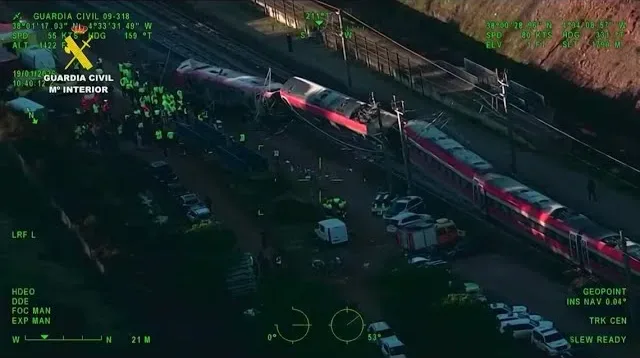

At least 40 dead after catastrophic train collision as rescuers warn toll is likely to rise
Spain will observe three days of national mourning beginning Tuesday as emergency crews continue to search through mangled train carriages and debris following a devastating rail collision that has killed at least 40 people and injured dozens more.
More than 18 hours after the crash, uncertainty and anguish gripped communities across the country as families desperately attempted to locate missing relatives. The collision involved a high-speed train carrying around 300 passengers travelling towards Madrid, which derailed and struck an oncoming train near the town of Adamuz in the province of Córdoba.
Relatives gathered outside emergency centres and hospitals, many still waiting for news. Juan Barroso said five members of his extended family had been travelling from Madrid to Huelva when the collision occurred. By Monday evening, only one had been located, a six-year-old child. The remaining four were still unaccounted for.
Barroso described frantic efforts to find answers, saying his family had visited multiple hospitals across Jaén, Úbeda and Córdoba without success. Similar scenes played out online, where people shared photographs of missing loved ones, pleading for information from anyone who might recognise them.
Police established several support offices to assist families, allowing them to file missing persons reports and submit DNA samples to aid identification efforts. Officials warned that the identification process would take time due to the scale and violence of the crash.
The collision happened shortly before 8 pm on Sunday when the rear section of the Madrid-bound train derailed and crossed into the path of another train travelling in the opposite direction. The impact derailed the first two carriages of the southbound train, sending them down a four-metre slope.
Spain’s transport minister described the derailment as unusual, noting that it occurred on a straight section of track that had been renovated just months earlier. The train involved was less than four years old and had undergone inspection only days before the crash, according to its operator.
While investigators have not confirmed the cause, rail officials said the circumstances were “strange” and suggested that human error was unlikely. A source familiar with the investigation said technicians had identified a broken rail joint that may have created a widening gap between track sections as trains continued to pass over it. That fault could prove central to understanding how the crash occurred.
Neither the rail infrastructure administrator nor the commission responsible for investigating rail accidents provided comment on Monday. Since 2022, however, infrastructure issues in the area — including signalling problems and overhead line faults — have been publicly documented. A train driver’s union had also warned last year that increased traffic was accelerating track wear, though it urged caution in linking those concerns directly to the crash.
Rescue operations began immediately after the collision, with emergency workers battling darkness and limited access to reach the remote site. A single-track road hampered movement as crews worked through the night to free survivors trapped inside twisted steel.
Some passengers escaped without assistance, smashing windows with emergency hammers and climbing out of overturned carriages. Others were carried to a nearby municipal hall that had been converted into an improvised aid centre, where victims received food, warmth and medical attention before being transferred elsewhere.
Local officials described the scene as horrific. The mayor of Adamuz, one of the first to arrive, said the night was “tremendously tough and sad,” leaving the small Andalucían town in shock.
Authorities cautioned that the death toll could rise further. The head of the regional government said several carriages were severely crushed, requiring heavy machinery to access. The violence of the impact scattered bodies hundreds of metres from the track, he added, complicating recovery efforts.
The disaster has shaken a nation that has long taken pride in its rail network, one of the largest high-speed systems in the world. As mourning begins, Spain awaits answers about how such a tragedy could unfold in a system seen as a symbol of modern safety and progress.