
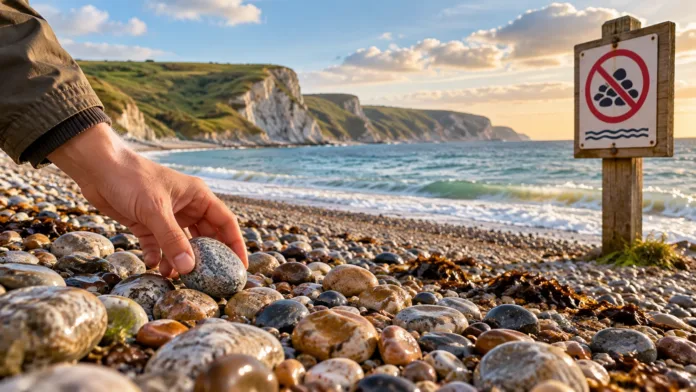
It is often said that taking a pebble from any British beach breaks the law. Section 18 of the Coast Protection Act 1949 says something narrower, and the difference decides whether you can.
Sometimes. There is no blanket ban on taking pebbles from every UK beach, but you should not assume any particular beach allows it.
Section 18 lets restrictions be applied to particular stretches of seashore. Where one is in force, removing material without permission can be unlawful. Local rules, landowner restrictions and environmental designations can apply on top.
Picking up a smooth pebble from the beach might seem like a harmless way to remember a day by the sea. But can you actually take pebbles from the beach in the UK?
The answer is: sometimes.
It is often claimed that taking pebbles, stones or other natural material from any UK beach is automatically illegal. However, the rules are more complicated than that.
Under Section 18 of the Coast Protection Act 1949, restrictions can be applied to particular stretches of seashore to prevent materials from being removed. This does not mean every beach in the UK is automatically covered by the restriction.
There can also be local rules, landowner restrictions and protections for environmentally sensitive areas.
So before slipping a pebble into your pocket, it is worth checking the rules for the beach you are visiting.
A memorable warning, and the version that spreads. It oversimplifies what the legislation actually says.
The restriction attaches to a named stretch of coast by an order that must be confirmed, not to the country as a whole.
Can you take pebbles from the beach in the UK?
You may be able to take a small number of pebbles from some UK beaches, but you should not assume that you can.
The British Geological Survey (BGS) explains that the Coast Protection Act 1949 does not create a blanket ban on collecting pebbles from every UK beach.
Instead, Section 18 allows restrictions on removing materials to be applied to particular portions of the seashore.
Once such a restriction applies, removing material from that part of the beach without the necessary permission can be unlawful.
Other restrictions can also apply depending on the beach, its ownership and whether the area has a protected environmental designation.
That means there is no simple rule that covers every beach.
Is it illegal to take stones from the beach?
Not necessarily.
This is where much of the confusion comes from.
Section 18(1) of the Coast Protection Act 1949 states that it is unlawful to excavate or remove materials from a portion of the seashore to which the provisions of the section are applied.
In other words, the wording does not automatically prohibit removing stones from every beach in Britain.
BGS explains that a coastal protection authority can apply these restrictions to a specific stretch of coastline through an order that goes through a statutory confirmation process.
Once an order is in force, removing material from that area without a licence can be unlawful.
So if you’re wondering “is it illegal to take stones from the beach in the UK?”, the most accurate answer is:
It depends on the beach and the restrictions that apply there.
What does the Coast Protection Act 1949 say about taking pebbles?
The legislation most frequently mentioned in discussions about taking stones and pebbles from beaches is the Coast Protection Act 1949.
Section 18 is headed:
“Prohibition of excavation etc., of materials on or under the seashore.”
The key detail is that the restriction concerns portions of the seashore where Section 18 has been applied.
BGS says an authority can make an order applying the restriction to a particular stretch of coastline, but the order must go through the relevant confirmation process before taking effect.
This distinction matters because saying “the Coast Protection Act makes it illegal to take any pebble from any UK beach” oversimplifies what the legislation actually says.
Why can taking pebbles from a beach be a problem?
A single pebble may seem insignificant, but beach material forms part of the coastal environment.
Pebbles, shingle and other natural materials can contribute to coastal protection and provide habitats for wildlife.
Cumberland Council, for example, has warned visitors against removing pebbles, shells and sand, explaining that these materials can contribute to natural sea defences, flood protection and wildlife habitats.
The issue becomes much larger when thousands of visitors each take something home.
What feels insignificant on an individual level can have a greater cumulative effect on heavily visited beaches.
Rocks, sand, shells and driftwood: what the rules cover
| Material | Section 18 | What to do |
|---|---|---|
| Pebbles | Where applied | Check for signs and the local authority’s rules for that beach before taking any. |
| Stones and rocks | Where applied | The Act refers broadly to materials. Changing the word from pebble to rock changes nothing. |
| Sand | Where applied | Part of the natural material forming a beach. Check before filling a jar. |
| Shells | Local rules | Some councils ask visitors to leave shells where they find them. |
| Driftwood | Local rules | Depends on location, ownership and protections. Ask first, especially for a large quantity. |
| Sea glass | Local rules | Not naturally occurring rock, but the beach’s own rules still apply. |
“Where applied” means Section 18 can cover that material, but only on stretches of coast where the restriction has actually been brought into force. “Local rules” means the position is set by the council, the landowner or an environmental designation rather than by the Act.
Can you take rocks from the beach?
The same principle applies if you’re wondering whether you can take rocks from the beach.
The Coast Protection Act refers broadly to removing materials, rather than creating a simple nationwide rule specifically for “pebbles” or “rocks”.
You should therefore check:
- signs at the beach
- local council restrictions
- landowner rules
- whether the coastline is environmentally protected
- whether a Section 18 restriction applies
Do not assume that changing the description from a “pebble” to a “rock” changes the rules.
Can you take sand from the beach?
You should also check before removing sand.
Sand is part of the natural material forming a beach and may be subject to restrictions depending on the location.
Some councils explicitly warn visitors not to remove it. Cumberland Council, for example, has told visitors to leave pebbles, shells and sand on the beach.
So even if you only want a jar of sand as a holiday souvenir, check the rules for that particular beach first.
Can you take shells from the beach?
Again, the answer depends on where you are.
There is not a simple rule saying that every shell on every UK beach can or cannot be taken.
Local restrictions, environmental protections and landowner rules can matter.
Some councils specifically ask visitors not to remove shells. Cumberland Council’s guidance, for example, tells beach visitors to leave both pebbles and shells where they find them.
If you are visiting a protected or particularly sensitive coastline, leaving shells where they are is the safest approach.
Can you take driftwood from the beach?
Driftwood is another area where you should avoid assuming that anything washed ashore is automatically free to take.
Rules can depend on the location, ownership of the beach and environmental protections.
If you want to collect driftwood, especially a large quantity, check with the relevant council, beach owner or authority first.
For a small beach souvenir, taking a photograph instead avoids any uncertainty altogether.
What about SSSIs and other protected beaches?
This is another reason there cannot be one universal answer for every UK beach.
Some stretches of coastline have additional environmental protections.
In England, for example, Sites of Special Scientific Interest (SSSIs) are designated because their wildlife, geology or landforms are of special interest.
There are also nationally protected Marine Conservation Zones, as well as other international, national and local environmental designations.
BGS therefore recommends checking whether a beach is affected by an SSSI, Marine Protected Area or other restriction before collecting natural material.
This is particularly important if you are interested in unusual rocks, fossils or geological specimens.
Can you be fined for taking pebbles from the beach?
Potentially, yes, where a relevant restriction applies.
For example, Cumberland Council warned visitors in 2024 that removing pebbles or shells could result in a fine of up to £1,000 in circumstances where the rules it described were enforced.
However, you should not interpret that £1,000 figure as an automatic nationwide fine for picking up one pebble from any UK beach.
The exact legal position depends on the location and the restriction being enforced.
That is another reason checking the rules of the particular beach is more useful than relying on general claims online.
How do you know if you can take pebbles from a particular beach?
The easiest rule is: check before you collect.
BGS says signs will usually warn visitors on beaches where relevant restrictions are enforced and recommends researching restrictions before visiting.
Before taking anything home, you can:
- 1
Look for signs at the beach
Restrictions may be displayed near entrances, paths or car parks.

A sign like this is the clearest answer you will get. Where restrictions are in force, the beach usually says so. Illustration: Daily Tuesday - 2
Check the local council website
Search for the beach name together with terms such as
pebbles,beach materialorcollecting. - 3
Check whether the beach is protected
SSSIs and other environmental designations can bring additional considerations.
- 4
Check who owns or manages the beach
The landowner or managing organisation may have its own rules.
- 5
Ask if you’re unsure
Contact the relevant council, coastal authority or landowner before removing natural material.
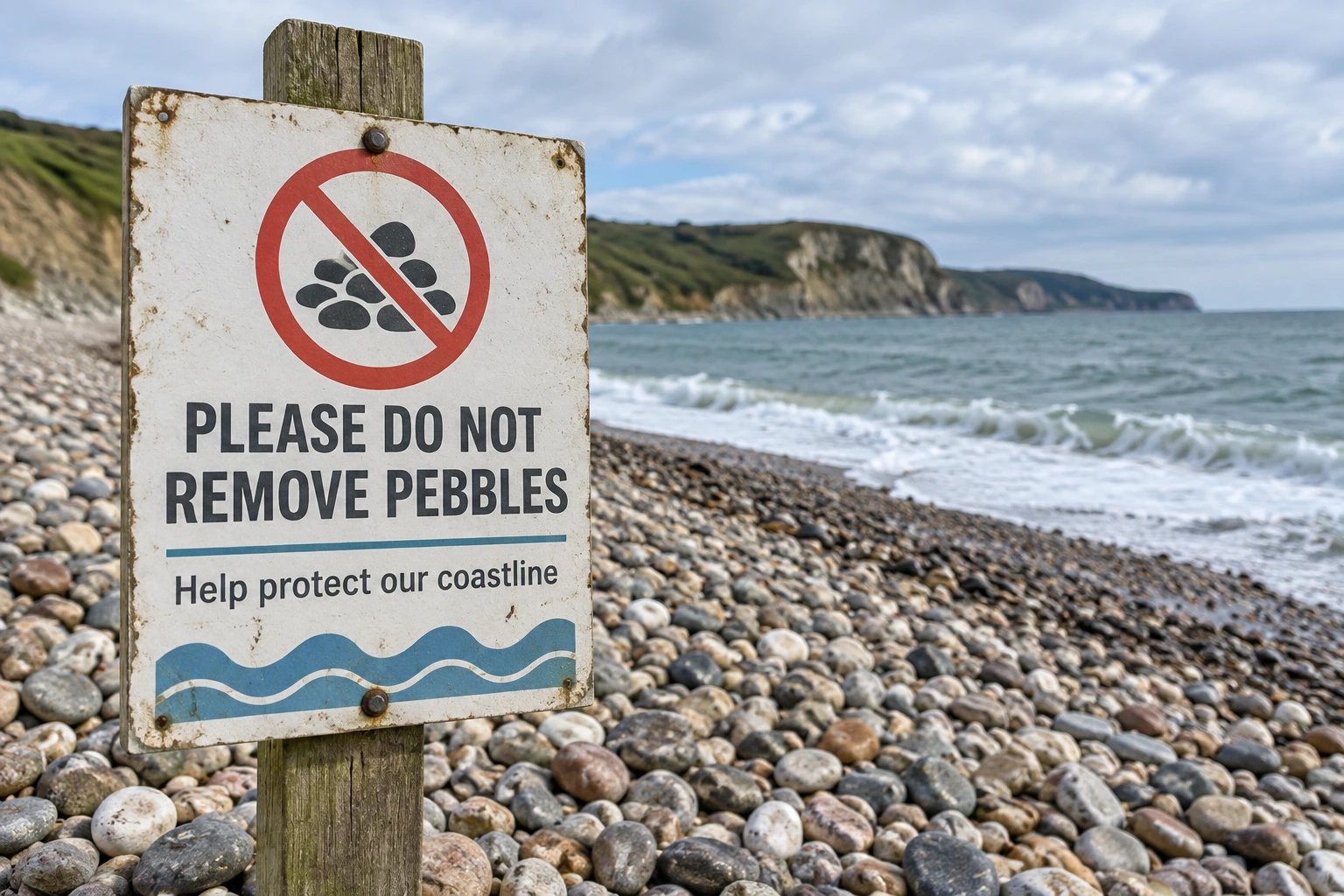

And if you cannot establish whether taking something is allowed, simply leave it where you found it.
Is beachcombing illegal in the UK?
Beachcombing itself is not automatically illegal.
Walking along a beach and looking for interesting objects is different from having a legal right to remove whatever you find.
Whether you can take an item home depends on what it is, where you found it and which rules apply to that location.
So you can enjoy searching for interesting pebbles without necessarily collecting them.
Photographing unusual stones is also a simple way to keep a record of what you find without removing anything from the beach.
What should you do if you’ve already taken a pebble?
There is no reason to panic over a pebble you previously picked up without knowing about the rules.
If you know which beach it came from and discover that collecting material there is restricted, you can check with the relevant council or organisation managing the beach about what to do.
For future visits, check the local rules before collecting.
The bottom line: can you take pebbles from the beach?
Sometimes, but don’t assume you can take pebbles from every beach in the UK.
The Coast Protection Act 1949 does not impose a simple blanket ban on collecting a pebble from every UK beach. Instead, Section 18 allows restrictions to apply to particular portions of the seashore.
Other local, ownership and environmental restrictions may also apply.
So before taking a pebble, stone, shell, sand or other natural souvenir:
check the signs, check the local rules and check whether the beach is protected.
And when in doubt, leave it on the beach.
FAQs
Can you take pebbles from the beach in the UK?
It depends on the beach. Restrictions under the Coast Protection Act 1949 can apply to particular portions of the seashore, while local, landowner and environmental rules may also restrict collecting.
Is it illegal to take stones from the beach in the UK?
Not from every UK beach automatically. However, taking stones can be unlawful where a relevant restriction applies. Check local signs and rules before removing anything.
Can you take rocks from the beach?
Possibly, depending on the location. Rocks and other beach material can be subject to coastal protection, local or environmental restrictions.
Can you take sand from the beach?
Do not assume you can. Sand can be protected as part of the beach material, and some councils specifically warn visitors against removing it.
Can you take shells from the beach in the UK?
Rules vary by location. Some councils specifically ask visitors to leave shells on the beach, and additional restrictions may apply in environmentally protected areas.
Is it illegal to take pebbles from an SSSI?
An SSSI designation protects an area’s special wildlife, geology or landforms, but the restrictions applicable to a particular site depend on its designation and protected features. Check the rules for the specific SSSI rather than assuming all SSSIs have identical collecting rules.
Is it illegal to collect sea glass in the UK?
Sea glass is different from naturally occurring rock, but you should still check the rules of the particular beach or protected area before removing material.
Sources checked
- Primary legislationCoast Protection Act 1949, Section 18
The wording that restrictions apply to a portion of the seashore to which the provisions of the section are applied.
- Geological surveyCollecting beach pebbles: fun hobby but is it legal?
That there is no blanket ban, how an authority applies a Section 18 order, and the advice to check for SSSIs and Marine Protected Areas before collecting.
- Local authorityBe sure to leave the pebbles at the beach!
The warning against removing pebbles, shells and sand, the role of beach material in sea defences and habitats, and the fine of up to £1,000.
- Government guidanceSites of Special Scientific Interest: new sites and changes to sites
What an SSSI designation is and why it is applied to a particular site.
- Government guidanceProtected sites and areas: how to review planning applications
Marine Conservation Zones and the other international, national and local environmental designations that can apply to a coastline.