
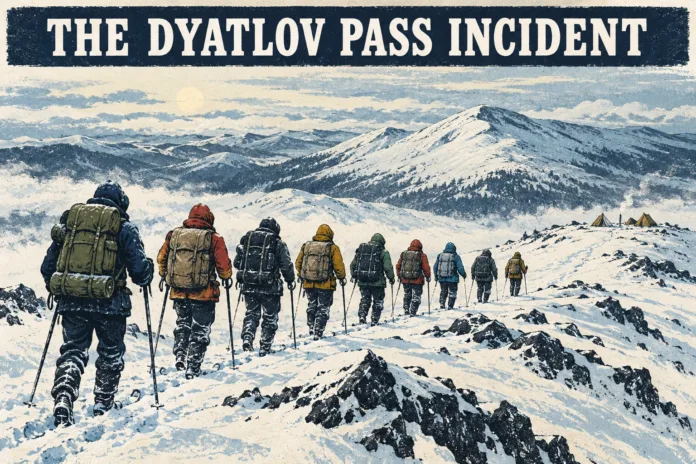

Quick answer: The most credible explanation for the Dyatlov Pass incident is a small delayed slab avalanche. A 2021 study modelled it using snow-simulation code adapted from Disney’s Frozen and 1970s General Motors cadaver crash data, showing how a modest snow slab could break ribs and skulls without leaving external wounds. It explains the injuries. It does not explain everything.
On the night of 1 February 1959, nine experienced hikers cut their way out of their tent from the inside and walked into a Ural winter, most of them without boots. Within hours, all nine were dead.
It took sixty-two years, a Disney animation studio and a General Motors experiment involving a hundred corpses to produce an answer that holds together.
Table of Contents
What happened on Kholat Syakhl
Ten students and graduates of the Ural Polytechnic Institute left Sverdlovsk on 23 January 1959, heading for Otorten mountain in the northern Urals. Their leader was 23-year-old Igor Dyatlov. One member, Yuri Yudin, turned back on 28 January with joint pain. That decision saved his life.
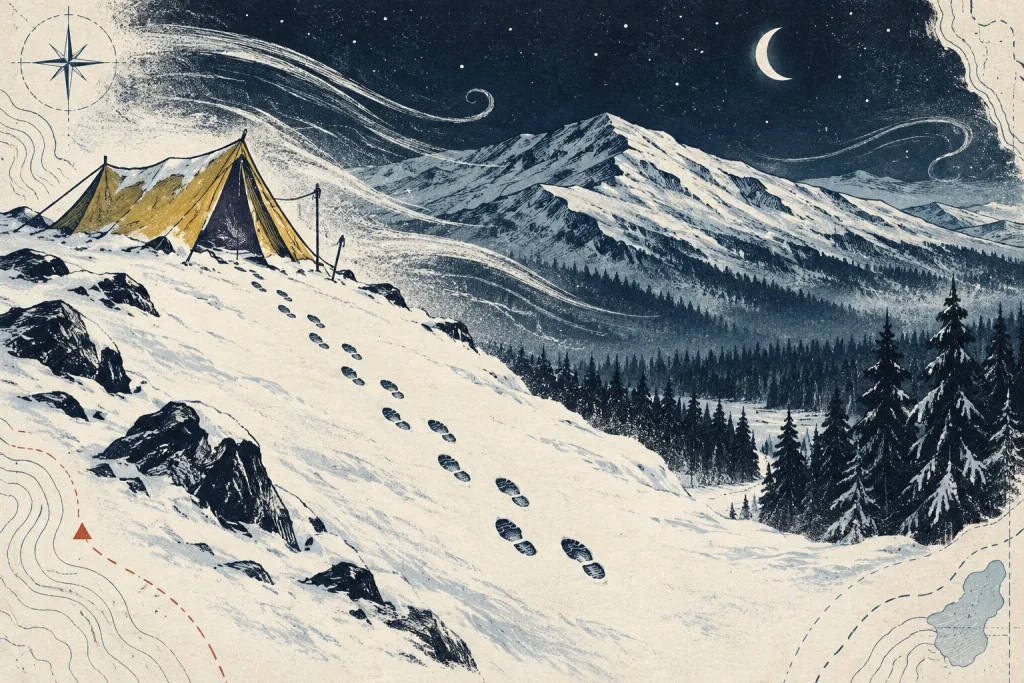
The remaining nine pitched camp on 1 February on the eastern slope of Kholat Syakhl, a mountain whose Mansi name is usually rendered as “Dead Mountain”. They were at roughly 1,600 metres. To level the ground for the tent, they cut into the slope.
Nobody heard from them again.
When searchers reached the site on 26 February, they found the tent half collapsed and buried in snow, slashed open from the inside. Everything was still in it. Boots, coats, food, cameras. Footprints led away downhill, some made by bare feet or socks.
They found Yuri Doroshenko and Georgiy Krivonishenko first, about 1.5 kilometres away beneath a Siberian pine, stripped to their underwear beside the remains of a small fire. Igor Dyatlov, Zinaida Kolmogorova and Rustem Slobodin lay on the slope between the pine and the tent, at 300, 480 and 630 metres, all positioned as though they had been climbing back towards the camp.
The last four were not found until 4 May, under four metres of snow in a ravine seventy-five metres beyond the pine. They were wearing clothing cut from the bodies of those who had died first.
What killed the Dyatlov Pass hikers?
Six of the nine died of hypothermia. Three did not.
Lyudmila Dubinina and Semyon Zolotaryov had catastrophic chest injuries. Nikolai Thibeaux-Brignolles had a fractured skull. The forensic examiner recorded that the force involved was comparable to a car crash, and noted something stranger still: there were almost no external wounds. The bones had broken, but the skin above them had not.
Dubinina was missing her tongue, her eyes, part of her lips and a section of facial tissue. Zolotaryov was missing his eyeballs. Traces of radiation were found on some of the clothing.
The 1959 Soviet inquest closed in May of that year, concluding that the hikers had died as the result of “a compelling natural force” that they had been powerless to overcome. It named nothing further. The files went to a classified archive, and into that vacuum went sixty years of theories: secret weapons tests, escaped prisoners, the indigenous Mansi people, infrasound-induced panic, a yeti, aliens.
Why nobody believed the avalanche theory for sixty years
An avalanche was always the obvious candidate, and for decades it was rejected for four reasonable objections.
The slope was too shallow, at around 23 degrees where it was measured, when slab avalanches typically need 30 or more. The search party found no debris field. Nine to thirteen hours passed between the tent being pitched and the group fleeing, which is not how avalanches usually behave. And the injuries were wrong: avalanche victims tend to suffocate, not arrive with crushed ribs and intact skin.
Any explanation had to defeat all four objections at once. For sixty years none did.
The four things that had to line up
In January 2021, Johan Gaume of EPFL and Alexander Puzrin of ETH Zürich published a paper in Communications Earth & Environment proposing a mechanism that does.
Their model requires four conditions, all of which were present that night.
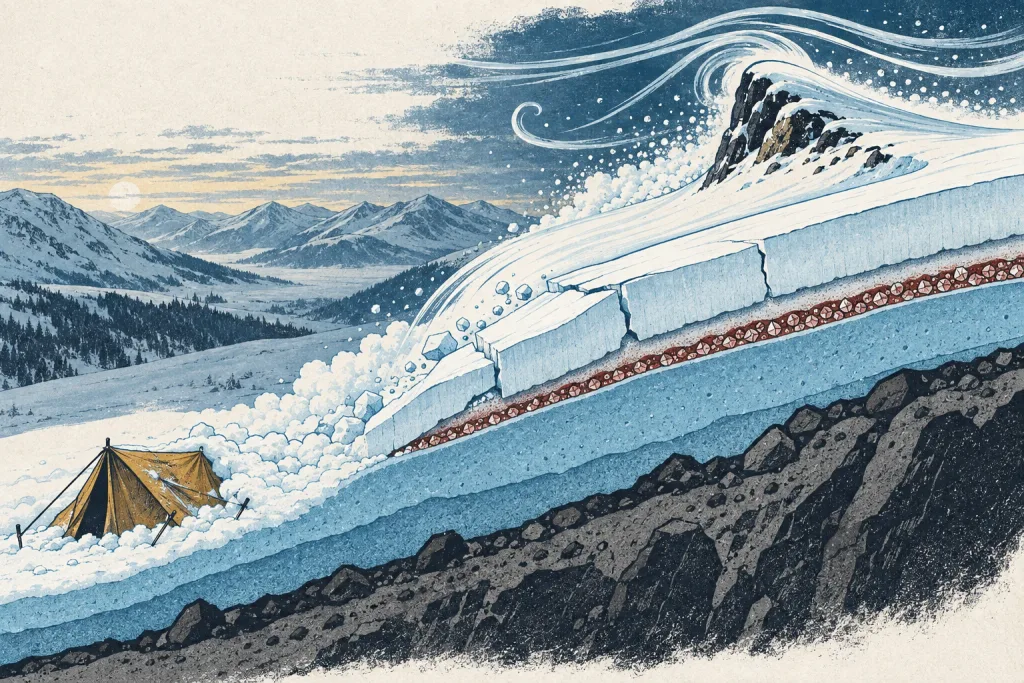
First, the buried weak layer of snow beneath the surface was steeper than the visible slope, because the terrain underneath was irregular. The 23 degrees the searchers measured was not the angle that mattered.
Second, the hikers cut into the slope to pitch the tent. That cut removed lateral support from the snow above them. It did not collapse anything immediately. It made a later collapse possible.
Third, a shoulder of ground about a hundred metres upslope acted as a trap, and strong katabatic winds funnelled snow into precisely that spot through the night, loading the weakened zone hour after hour.
Fourth, the failure was delayed. Their model predicted the slab would release between 7.2 and 13.5 hours after the tent was pitched. The forensic estimate for when the group fled was 9.5 to 13.5 hours. The numbers overlap.
What came down was small. Small enough that by the time searchers arrived weeks later, wind and fresh snow had erased any trace of it.
How a Disney film ended up in an avalanche laboratory
Johan Gaume watched Frozen and noticed something most viewers would not. The snow was behaving correctly.
Disney’s animators had built a snow simulation system that handled how snow fractures, compacts and flows, because a film about ice needed snow that looked right. Gaume, whose day job is modelling the physics of avalanches, recognised that the animators had solved a problem adjacent to his own.
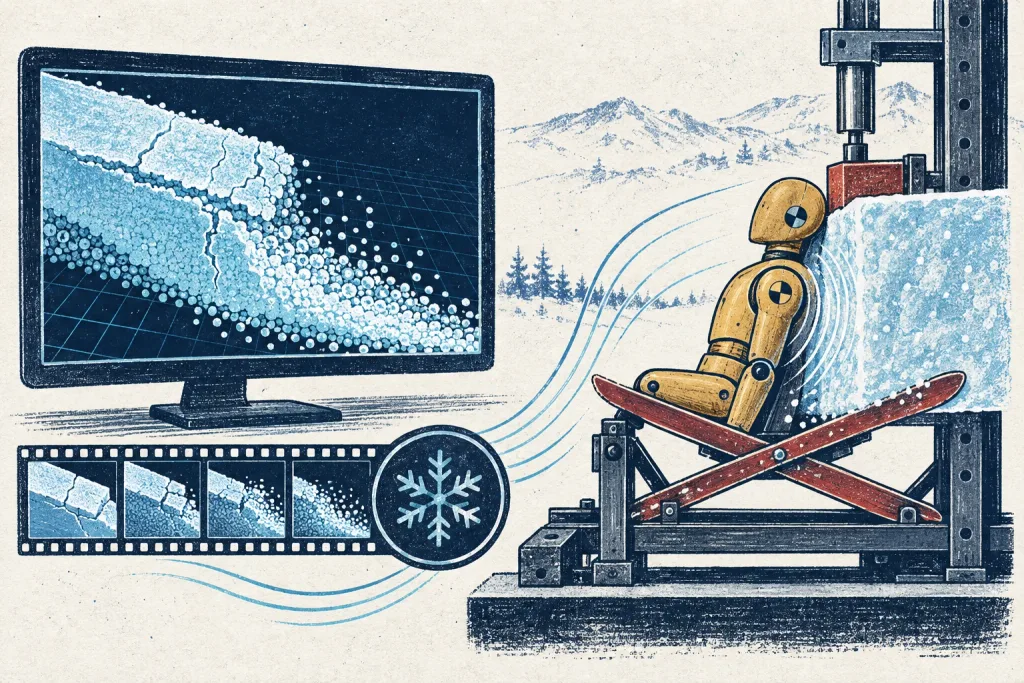
So he went to Hollywood, obtained permission to use the code, spoke to the studio’s snow effects specialist, and adapted it. Where Disney used it to make a fictional queen’s magic convincing, Gaume and Puzrin used their modified version to simulate how a real block of snow deforms when it lands on a human body.
It is a genuinely odd chain of causation. A children’s animated musical, made to sell tickets, produced a tool precise enough to be turned on a Soviet cold case.
Why General Motors broke a hundred sets of ribs
The second borrowed dataset is darker.
In the 1970s, General Motors ran impact experiments on roughly a hundred human cadavers to improve seat belt design, striking them with different weights at different speeds to establish how much force a human ribcage can absorb before it fractures. As Puzrin put it, GM “took 100 cadavers and broke their ribs”.
One detail in that grim archive turned out to be decisive. Some of the cadavers had been braced against a rigid surface. Others had not. The difference in outcome was significant.
The Dyatlov Pass hikers had laid their bedding on top of their skis. They were sleeping on a hard, unyielding platform. When a slab of snow struck them, their bodies had nowhere to give.
That is how you break ribs and a skull without breaking skin, and it is why the injuries that made the avalanche theory look impossible for sixty years turn out to be the evidence that supports it.
What the science still cannot explain
An honest account has to include the parts that do not fit, and this is where every other article stops short.
The traces of radiation on the clothing have no accepted explanation within the avalanche model. The paper does not attempt one.
The soft tissue losses are usually attributed to scavengers and to three months of running meltwater in the ravine where those four bodies lay, which is a reasonable explanation but not a proven one.
And the model explains why the group fled. It explains the injuries. It explains far less about the hours that followed: why they went 1.5 kilometres downhill rather than sheltering closer, why the fire under the pine was so small, what order things happened in.
The best current answer is that badly injured people, in the dark, at minus thirty, made a series of decisions we can only partly reconstruct. Two of them were found in their underwear, which is consistent with paradoxical undressing, a documented late-stage hypothermia phenomenon in which the dying feel unbearably hot and remove their clothes.
That is not a mystery. It is just terrible.
Is the Dyatlov Pass mystery solved?
Not entirely, and the researchers are the first to say so.
Gaume has been explicit that he never sought absolute closure and that nobody will ever be certain what happened on that slope. The paper itself lists its own limitations plainly: it uses a simplified two-dimensional model, makes assumptions about how brittle the weak snow layer was, and is sensitive to the size of the snow blocks involved. The authors state directly that their work addresses the avalanche mechanics and nothing else.
What the 2021 study achieved is narrower and more useful than “solved”. It demonstrated that a slab avalanche is physically possible under those exact conditions, which sixty years of objection had claimed it was not. It moved the avalanche from implausible to most likely.
Russian prosecutors had reached the same destination by a different road. In July 2020, Andrey Kuryakov of the regional prosecutor’s office announced avalanche as the official cause, describing conditions of 20 to 30 metres per second winds and temperatures reaching minus 40. His summary is worth quoting: “It was a heroic struggle. There was no panic, but they had no chance to save themselves under the circumstances.”
Who was the only survivor of the Dyatlov Pass incident?
Yuri Yudin, who left the expedition on 28 January 1959 because of joint pain and walked back alone. He lived until 2013, and spent much of his life among the families of the friends he had left behind. He is buried in Yekaterinburg near several of them, close to the Dyatlov Pass memorial.
Key takeaways
- Nine hikers died on Kholat Syakhl on the night of 1 February 1959 after cutting their way out of their tent and fleeing into a Ural winter.
- Six died of hypothermia; three had massive internal injuries with almost no external wounds.
- The avalanche theory was dismissed for sixty years on four objections: shallow slope, no debris, long delay, wrong injuries.
- A 2021 study by Johan Gaume and Alexander Puzrin answered all four, using snow-simulation code adapted from Disney’s Frozen and 1970s General Motors cadaver impact data.
- The hikers slept on bedding laid over their skis, a rigid surface that explains fractures without surface wounds.
- The study explains the mechanism, not the radiation traces or every detail of what followed. “Most likely” is the honest verdict, not “solved”.
FAQs
A small, delayed slab avalanche released several hours after the group cut into the slope to pitch their tent, injuring some of them severely and forcing all nine out into lethal conditions.
Russian prosecutors closed a re-investigation in July 2020 naming an avalanche as the official cause. The 1959 inquest had recorded only “a compelling natural force”.
Because the entrance was likely blocked or buried, and because leaving quickly mattered more than leaving properly. The cuts were made by the hikers themselves, which the 1959 investigation established.
Paradoxical undressing, a recognised effect in advanced hypothermia in which people feel overwhelming heat and remove clothing shortly before death.
It remains unexplained by the avalanche model. The 2021 study does not address it, and no consensus explanation exists.
Yes. The group’s own cameras were recovered with film intact, and the developed images from their final days are held in the case archive.