
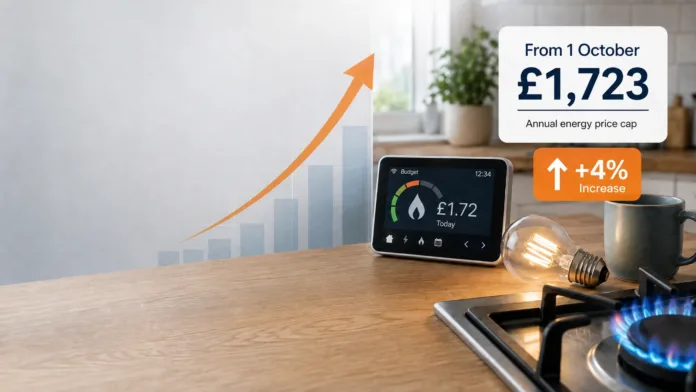

Ofgem’s energy price cap rises 4% from 1 October to £1,723. Here are the new gas and electricity rates, who is affected and what the change means for your bills
Households on standard variable energy tariffs in Great Britain will face higher energy costs from 1 October 2026, after Ofgem confirmed a 4% increase in the energy price cap.
For a typical household paying by Direct Debit for both gas and electricity, the annualised figure will rise from £1,663 to £1,723, an increase of £60, or around £5 a month if the October level were maintained for a full year.
The new cap applies from 1 October to 31 December 2026. Ofgem updates the cap every three months to reflect changes in the costs suppliers face. Ofgem’s October energy price cap announcement
Importantly, £1,723 is not the maximum any household can be charged. The amount you actually pay depends on how much energy you use, where you live, your payment method and your meter.
What is the energy price cap from October 2026?
From 1 October, the typical annualised price-cap figure for a dual-fuel household paying by Direct Debit will be £1,723, compared with £1,663 under the July to September cap.
The £1,723 figure is based on Ofgem’s estimate of how much energy a typical household uses. It is mainly a way of helping consumers compare price-cap periods.
The cap itself limits the unit rates and standing charges suppliers can charge customers on standard variable or default tariffs. It does not put a £1,723 ceiling on an individual household’s total bill.
Ofgem explains that your actual rates can also vary depending on your region, payment method, fuel and meter type. Ofgem’s explanation of how the price cap works
What are the new energy price cap rates per kWh?
For customers on a standard variable tariff paying by Direct Debit, Ofgem’s average rates across England, Scotland and Wales will change as follows:
| Charge | July to September 2026 | October to December 2026 |
| Electricity unit rate | 26.11p per kWh | 26.32p per kWh |
| Electricity standing charge | 57.19p per day | 54.83p per day |
| Gas unit rate | 7.33p per kWh | 7.97p per kWh |
| Gas standing charge | 29.04p per day | 29.68p per day |
These are national averages rather than the exact rates every customer will pay.
The figures also show that the October increase is not spread evenly across every part of the bill. The average electricity unit rate rises only slightly, and the electricity standing charge falls, while the gas unit rate rises more noticeably.
Ofgem’s published rates include 5% VAT on gas, while there will be no VAT on domestic electricity from 1 October 2026 to 31 March 2027. See Ofgem’s October unit rates and standing charges
Embed from Getty ImagesWhen does the new energy price cap start?
The new price cap takes effect on 1 October 2026 and runs until 31 December 2026.
Customers on standard variable tariffs do not need to apply for the new rates. Suppliers adjust their capped rates for the new period.
The next cap, covering 1 January to 31 March 2027, is due to be announced by 25 November 2026. Ofgem has not yet confirmed what that next cap will be, so forecasts for January should not be treated as final prices. Ofgem’s confirmed price cap dates
Does the £1,723 price cap mean your bill cannot be higher?
No.
This is one of the most important things to understand about the price cap.
Ofgem does not limit every household’s total energy bill to £1,723. Instead, it controls the maximum rates suppliers can charge customers on default tariffs for each unit of gas and electricity, together with standing charges.
A household that uses more energy than Ofgem’s typical consumption assumption could therefore pay significantly more than £1,723.
Equally, someone who uses less energy could pay less.
For that reason, households should look at their own unit rates, standing charges and energy usage, rather than assuming £1,723 is what everyone will pay.
Why is the energy price cap rising in October?
Higher wholesale energy costs are a major reason for the increase.
Ofgem said wholesale prices had risen by 11% over the previous three months, with continuing disruption linked to the Middle East contributing to higher gas prices.
The impact is visible in the new rates. The average capped gas unit rate rises from 7.33p to 7.97p per kWh, while the electricity unit rate rises much less sharply.
The price cap also reflects other costs faced by suppliers, including energy networks, operating costs, government schemes and supplier allowances.
Why are bills rising if electricity VAT is being removed?
From 1 October 2026, VAT will be removed from household electricity bills.
The government estimates that the measure will save households an average of around £45 a year, although the actual saving depends on electricity prices and how much electricity a household uses.
Customers do not need to apply for the reduction.
The VAT removal also applies to customers who have already agreed fixed energy tariffs. Government guidance on the electricity VAT cut
So why does the typical price-cap figure still rise?
Because the reduction in electricity costs is not enough to fully offset increases elsewhere, particularly the higher cost of gas.
Ofgem says electricity-only households, or households that use proportionately more electricity than gas, may receive a greater benefit from the VAT change.
Who is affected by the October energy price cap?
The price cap protects customers on standard variable or default tariffs.
It can cover customers paying by:
- Direct Debit;
- standard credit;
- prepayment meter; or
- Economy 7 arrangements.
Customers who are already on a fixed-rate tariff are not affected by the October price-cap change in the same way, because the rates agreed under their fixed deal remain in place for the duration of that tariff.
However, the separate electricity VAT reduction from October is expected to be passed on to fixed-tariff customers too.
The Ofgem price cap covers Great Britain, meaning England, Scotland and Wales. Northern Ireland operates under a different energy regulatory system.
Why is comparing £1,723 with older price caps difficult?
There has also been an important change in how Ofgem calculates its typical-household figure.
From July 2026, Ofgem updated its Typical Domestic Consumption Values, known as TDCVs, because households are using less energy than they were when the previous assumptions were set.
Ofgem says typical electricity consumption is now around 7% lower, while typical gas consumption is around 17% lower than under the previous review.
This means the headline cap figure cannot always be directly compared with much older price-cap figures without taking the consumption change into account.
For context, Ofgem says that under the older 2023 consumption assumptions, the current £1,663 cap would have appeared as approximately £1,862, while the October cap would be around £1,935. Ofgem’s explanation of the updated household consumption figures
That does not mean households are secretly being charged £1,935. It shows why headline annual figures from different periods are not always directly comparable.
Should you consider fixing your energy tariff before October?
There are fixed tariffs available below the incoming October price cap, so some households may be able to reduce their expected costs by switching.
The Guardian reported on 29 August that some available fixed deals could save certain households up to around £173 a year compared with the incoming cap, although available tariffs can change quickly. Current reporting on fixed energy deals below the October cap
That does not mean fixing is automatically the right decision for every household.
Before switching, check:
- the electricity and gas unit rates;
- daily standing charges;
- how long the fixed period lasts;
- any exit fees;
- your actual annual energy use; and
- whether your current supplier charges you to leave your existing deal.
It is better to compare the estimated annual cost for your own usage than to choose a tariff solely because it sits below the £1,723 headline figure.
What happens next?
The October cap will remain in place until the end of December.
Ofgem will then set new rates for the period beginning 1 January 2027, with the announcement due by 25 November.
Until those rates are formally announced, estimates about what households will pay from January remain forecasts rather than confirmed price-cap figures.
For households on variable tariffs, the confirmed change for now is that the typical annualised figure rises to £1,723 from 1 October, with average Direct Debit rates of 26.32p per kWh for electricity and 7.97p per kWh for gas.
The amount an individual household pays will still depend on its own energy use, region, payment method and tariff.