
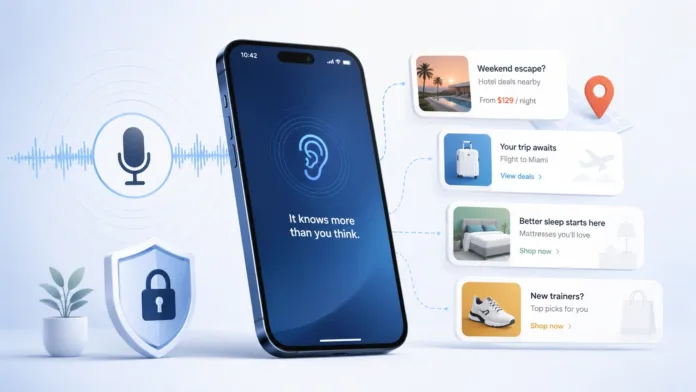

You mention that you might need a new mattress. Later that evening, an advert for mattresses appears on Instagram. You talk to a friend about visiting Edinburgh, and suddenly your phone starts showing you hotel deals, train tickets and videos about the city. After all, how else could an advert appear for something you discussed but never typed into a search bar?
It can feel far too specific to be a coincidence.
Moments like these have convinced many people that their phones are secretly listening to their private conversations. After all, how else could an advert appear for something you discussed but never typed into a search bar?
The truth is slightly less dramatic, but perhaps just as unsettling.
Your phone is technically capable of listening to you, and some apps can use its microphone when you give them permission. However, the adverts that seem to read your mind are usually explained by something much bigger: the enormous amount of information collected from your searches, location, browsing habits, purchases, contacts and online behaviour.
Your phone may not need to listen to your conversation. In many cases, it already knows enough to make a remarkably accurate guess.
So, does your phone listen to your conversations?
The honest answer is: sometimes, but not necessarily in the way you think.
Your mobile phone has a microphone, and many everyday features depend on it. Voice assistants, video calls, voice notes, audio searches, social-media videos and recording apps all need access to your microphone.
When you say “Hey Siri” or “Hey Google”, your device must be listening for a particular wake phrase. This does not automatically mean that every conversation is being recorded, stored and sent to advertisers. It does mean, however, that some form of audio monitoring is required for the feature to work.
Apps can also access your microphone if you have granted permission. The UK Information Commissioner’s Office advises people to check whether an app’s request for microphone access is genuinely necessary and to restrict permissions that appear unreasonable or excessive.
For example, it makes sense for WhatsApp to request microphone access when you send a voice message. It is less obvious why a simple calculator, torch or wallpaper app would need the same permission.
The important distinction is between a phone listening for a legitimate function and a company secretly recording ordinary conversations to choose which adverts to show you.
Major advertising platforms say they do not use private telephone conversations for advertising. Google states that it does not use information from phone calls, emails or Google Drive to influence the adverts people see. Meta has also repeatedly denied secretly listening to private conversations for advertising purposes.
Of course, company statements do not mean people should stop asking questions. Privacy scandals and data breaches have given the public good reason to be cautious. However, in most everyday situations, there are easier and more efficient ways for advertising systems to work out what interests you.
Why do adverts feel so unbelievably accurate?
Modern advertising systems do not need a recording of you saying, “I need a new pair of trainers.”
They may already know that:
- You recently visited a sportswear website.
- You watched several running videos.
- You walked past or entered a shopping centre.
- Someone in your household searched for trainers.
- You follow fitness accounts on social media.
- You downloaded a running app.
- You clicked on an advert for a gym.
- People with similar interests recently bought running shoes.
Put all of those signals together, and showing you a trainer advert becomes a fairly sensible prediction.
Google explains that personalised adverts can be influenced by searches, YouTube viewing, installed Android apps, interactions with content and the general area from which someone uses its services.
Meta says its advertising preferences may be based on profile information, activity on Facebook and Instagram, and activity received from other websites and apps.
Individually, each piece of information may appear harmless. Together, they can create a surprisingly detailed picture of your routines, interests and possible future purchases.
That can make the result feel like eavesdropping, even when no private conversation was required.
Your friends and family can influence your adverts
One of the strangest parts of targeted advertising is that the information does not always have to come directly from you.
Imagine that you and your partner live together, regularly use the same Wi-Fi network and visit many of the same places. Your partner searches for holidays in Greece. You later see adverts for hotels in Athens, despite never searching for them yourself.
This does not prove that your phone overheard a conversation about Greece.
Advertising systems may have linked your devices through a shared internet connection, location patterns, household information or similar online behaviour. They may also have placed you in the same broad audience group.
The same can happen between friends, colleagues and family members. If you spend time together, visit the same places or interact online, the systems may notice connections between your behaviour.
As a result, an advert linked to someone else’s search can appear on your screen at exactly the moment you are discussing it.
Sometimes it really is a coincidence
People see hundreds or even thousands of marketing messages during an ordinary week. Most are ignored almost immediately.
You probably do not remember the adverts for sofas, insurance, skincare or meal-delivery services that had nothing to do with your recent conversations.
But when one advert matches something you mentioned earlier, it stands out.
This is partly because the human brain is very good at spotting patterns. Once a subject becomes important to us, we notice it more often.
Perhaps you have decided to buy a red car. Suddenly, red cars seem to be everywhere. The number of red cars may not have changed. Your attention has.
The same thing happens online. After discussing coffee machines, you are more likely to notice a coffee-machine advert, even if similar adverts had appeared before the conversation.
This does not explain every strange advertising experience, but it helps explain why the accurate ones feel so memorable.
Can apps use your microphone without you realising?
An app normally needs permission to access your microphone. However, many people approve permissions quickly when installing an app without checking why they are needed.
Once access has been granted, the app may be able to use the microphone according to the rules of the phone’s operating system and the permission selected.
That does not mean every app with microphone access is spying on you. A social-media app may need it for recording videos, live streaming or making calls. The problem is that users do not always know when a permission is being used or whether it is still necessary.
Both iPhones and Android phones now include visual warnings.
On an iPhone, an orange indicator appears when an app is using the microphone. A green indicator can appear when the camera—or the camera and microphone together—is being used.
On many Android phones, a green indicator appears at the top of the screen when an app is using the camera or microphone. Tapping the indicator can show which app is responsible.
These indicators are useful, but they only help if you notice them.
There is also a separate risk from malicious software. A compromised phone or dishonest app could attempt to misuse permissions or exploit a security weakness. That is different from the ordinary personalised-advertising systems used by mainstream platforms, but it is another reason to keep your phone updated and avoid downloading suspicious apps.
How to check which apps can access your microphone
You do not need to stop using every app or cover your phone in tin foil. A few simple checks can significantly improve your privacy.
On an iPhone
Open:
Settings → Privacy & Security → Microphone
You will see a list of apps that have requested microphone access. Turn off access for any app that does not clearly need it.
You can also use Apple’s App Privacy Report. It shows how often apps access sensitive information such as your microphone, camera and location, as well as the internet domains they contact.
To switch it on, open:
Settings → Privacy & Security → App Privacy Report
The report begins collecting information after it has been activated.
On an Android phone
The exact wording may vary slightly depending on the manufacturer, but you can usually open:
Settings → Security and privacy → Privacy → Permission manager → Microphone
You can then see which apps have microphone access and choose whether they can use it all the time, only while the app is open, or not at all.
Android’s Privacy Dashboard also shows which apps have recently used permissions such as the microphone, camera and location.
Remove access from anything that does not seem to need it.
Should you be worried?
There is no need to panic every time an advert matches a conversation.
In most cases, the explanation is likely to be a combination of online tracking, shared household data, location, previous activity and coincidence.
However, that does not mean privacy concerns are imaginary.
The fact that advertisers can predict your interests without listening to a private conversation is arguably the more important issue. It shows how much information can be collected from small, ordinary actions that people barely notice.
A search here, a video there, a location check-in and a few clicks may not feel significant. Combined over months or years, they can reveal habits, relationships, interests and possible intentions.
The ICO warns that connected products can build a detailed picture of people through their online behaviour and location, which may then be used for personalised advertising where consent has been given.
The sensible response is not fear. It is awareness.
Check your permissions. Question why an app needs access to your microphone. Review your advertising settings. Delete services you no longer use. Pay attention to the privacy indicators on your screen.
So, does your phone listen to your conversations?
Your phone can listen when you use voice-controlled features, make calls, record videos or grant an app microphone access. There is also a genuine risk from malicious or poorly designed software.
However, the strangely accurate adverts most people experience do not prove that their phones are secretly recording every conversation.
Advertising systems already have access to far more information than many people realise. Searches, browsing, videos, purchases, locations, app activity and connections with other users can be enough to predict what you might want next.
The unsettling truth may not be that your phone hears everything you say.
It may be that it does not need to.