
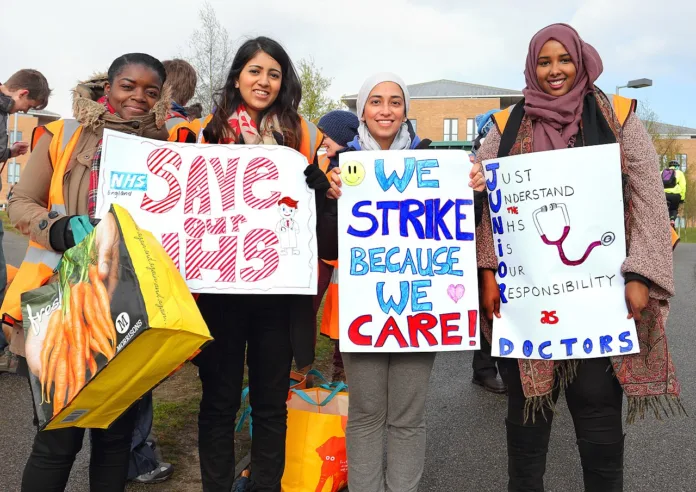
.jpg)

NHS privatisation has long been treated as one of British politics’ most emotionally loaded accusations, easy to weaponise, easy to dismiss, and often hard to define. Yet the numbers now make the argument harder to wave away. Private providers in England have been receiving a growing share of NHS-funded work for years, from diagnostics and elective surgery to mental health and community care, while NHS waiting lists remain above seven million and outsourcing continues to rise.
That does not mean the NHS has been “sold off” in the dramatic way campaign slogans often imply. There are no insurance desks in A&E and no invoices landing after a GP appointment. But privatisation of the NHS has never looked like a single political event. It has looked like a slow administrative shift: more contracts, more outsourcing, more private capacity, and more public money leaving the public system.
That is where the real change has happened. Not in whether the NHS still exists, but in what increasingly sits behind it.
The NHS was not sold off. It was quietly restructured
For years, debates around NHS privatisation have been framed too bluntly. The public argument tends to imagine a dramatic American-style takeover: hospital fees, insurance plans, and a sudden end to universal care. That has not happened.
What has happened is slower, less visible, and politically easier to defend.
Britain’s health system has been gradually restructured around a mixed-delivery model, where care is still publicly funded but increasingly delivered by private firms. Patients still enter through the NHS. But behind the scenes, more of the service is no longer being run by the state.
That distinction matters because it is where the political argument often gets lost. The NHS can remain free at the point of use while becoming steadily less public in practice.
What NHS privatisation actually looks like
For most patients, NHS privatisation does not arrive as ideology. It arrives as process.
It looks like:
- NHS patients being sent to private hospitals for routine surgery
- private firms running diagnostics, scans and elective care
- outsourced contracts in mental health and community services
- non-clinical services like estates, admin and logistics handed to private contractors
- NHS trusts relying on private capacity to cut waiting lists
None of this looks dramatic in isolation. That is precisely why it has been so politically effective.
The shift has happened in fragments, not headlines. Piece by piece, function by function, capacity has moved outward.
If the NHS is still free, why does this matter?
This is where the debate becomes more serious than slogans.
One of the most common public questions is: if the NHS is privatised will it still be free? In the short term, likely yes, at least formally. The NHS can remain free at the point of use while relying far more heavily on private providers underneath.
That is what makes the privatisation of NHS more complicated than many voters assume. The danger is not necessarily immediate charging. It is a structural dependency.
Once a public service becomes reliant on private delivery, three things tend to happen:
- Public capacity weakens
The more the NHS outsources, the less pressure there is to rebuild internal capacity. - Private dependency grows
Temporary outsourcing becomes routine reliance. - Profit begins shaping provision
Services are no longer designed only around public need, but commercial viability.
This is the quieter concern behind what will happen if the NHS is privatised. Not whether the NHS disappears overnight, but whether it becomes harder to recognise in the long term.
The argument in favour: Pragmatic or necessary?
Supporters of outsourcing argue the case is practical, not ideological.
The NHS is under extraordinary pressure. Waiting lists remain politically toxic, staffing shortages are chronic, and demand continues to outpace capacity. In that context, using private providers is presented as simple pragmatism: if the NHS cannot treat patients quickly enough on its own, it should use whatever capacity is available.
This is the core defence against accusations of NHS privatisation. Patients are still treated free of charge. The state still pays. The NHS remains universal. The only thing changing, supporters argue, is who delivers the care.
That is the government’s preferred language: reform, flexibility, efficiency, partnership.
It is also why this shift has been easier to sell politically than outright reform.
The argument against: Reform or managed decline?

Critics argue this is not reform. It is managed decline.
Their argument is not that private providers should never be used. It is that normalising private delivery changes the long-term shape of public healthcare. Every outsourced contract may solve a short-term pressure point, but it can also weaken the public system beneath it.
This is the central criticism of the privatisation of the NHS: The state is not replacing private provision after the crisis. It is becoming increasingly dependent on it.
That has wider consequences:
- NHS money leaves the public system as profit
- Staff are pulled into better-paid private roles
- Internal NHS capacity becomes harder to rebuild
- Wealth gaps widen through faster mixed-market access
This is where privatising the NHS stops sounding like a campaign slogan and starts looking like a policy trajectory.
Where Reform UK fits into the debate
The political edge of this argument sharpens further when Reform enters the frame.
Reform UK NHS privatisation has become a growing point of scrutiny because the party has repeatedly pushed market-led language around public services, tax, and state reform. That has raised obvious questions: will Reform privatise the NHS? More directly, does Reform want to privatise NHS provision by expanding private competition inside healthcare?
Reform has publicly denied any plan to end free NHS care. Like previous governments, its likely position is that the NHS should remain taxpayer-funded while becoming more “efficient”, more competitive, and less state-heavy.
That wording matters. In British politics, healthcare privatisation is rarely sold as privatisation. It is sold as modernisation.
And that is precisely how NHS privatisation becomes politically survivable.
The real question is not whether the NHS survives
The NHS will almost certainly survive in name. That is not the real question.
The more serious question is what survives with it.
Will the NHS remain a publicly run health service, or simply a publicly funded brand managing private delivery? Will universal access remain meaningfully equal, or become increasingly shaped by outsourcing, postcode, and commercial logic?
That is where this debate becomes more urgent than party politics.
Because the real risk in NHS privatisation is not that Britain wakes up one morning and discovers the NHS is gone. It is that the country keeps calling it public long after the system underneath has fundamentally changed.
And by the time that change feels obvious, it may already be permanent.